
Ascendant Wealth Partners
October 1, 2026
Overview
The third quarter closes with equity markets near new all-time highs and earnings growth running well ahead of forecast, yet four cross-currents deserve attention as we build fourth-quarter positioning:
- Valuations reset even as the market and earnings growth advances;
- A global bond market that is not behaving the way a decade of central-bank intervention trained investors to expect;
- Technology sector reset that has nothing to do with demand or chip supply and everything to do with politics — including the U.S. midterms, which markets seem otherwise inclined to shrug off; and
- Canadian investment summit that produced real, quantifiable commitments rather than the usual communiqué language.
As always, our house view consistently distinguishes fundamental data from temporary market noise. While political friction is causing near-term market volatility, the underlying economic foundation—corporate earnings, capital expenditure, and capital formation—remains fundamentally solid. This structural health supports maintaining a full, targeted equity allocation (focused on selective areas like U.S. tech infrastructure and Canadian equities) and a defensive stance in fixed income, rather than pulling back due to a demand or credit shock.
1. Exceptional Earnings, Contracting Multiples
Equity markets have moved into new and higher ground over the past two months, and breadth has confirmed the advance: advance-decline lines and equal-weighted index versions have made new highs alongside — in some cases ahead of — the capitalization-weighted S&P 500 index. The move has been earnings-led rather than multiple-led, which is the healthier of the two ways a market can rise.
- During the first half of 2026, S&P 500 earnings growth was upwardly revised to approximately 32%, according to Bloomberg data compiled by RBC Capital Markets. Furthermore, corporate guidance remains highly optimistic for the remainder of 2026 and into 2027.
- Because earnings estimates rose faster than prices, the forward P/E on the S&P 500 has eased from 22x at the start of the year to a more comfortable 20x today, even as the index itself rose from 6,846 to 7,660 – see Figure 1.
- The markets already assume two to three Fed hikes, a higher than 5% 10-year Treasury yield, and above 3% CPI inflation. The first of the Fed hikes has since been delivered: the FOMC raised rates 25 bps on September 16th (see Section 2).
- Valuations outside the U.S. remain considerably lower: Canada, the U.K., Europe and Japan trade in the mid-teens on a forward basis; China, Hong Kong and South Korea lower still — a relevant consideration for non-U.S. equities, such as emerging markets.
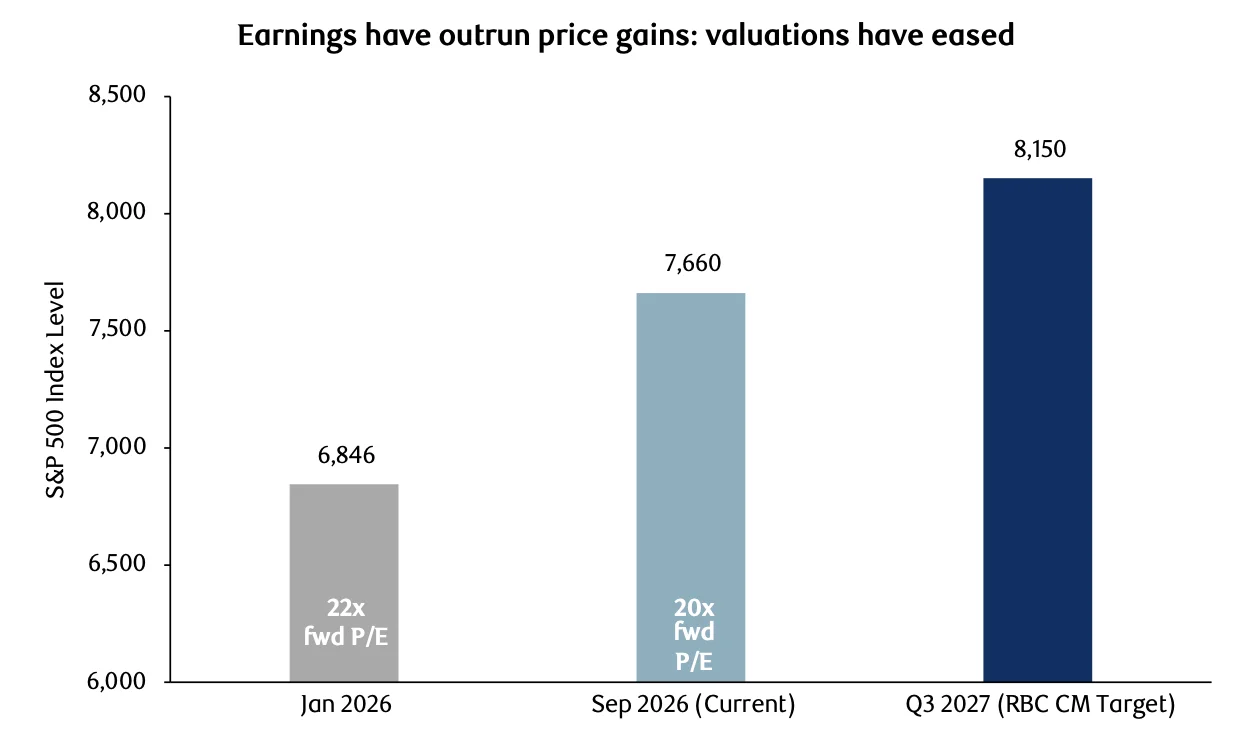
Figure 1. S&P 500 index level and forward P/E, January 2026 vs. September 2026 vs. RBC Capital Markets' Q3 2027 target. Source: RBC Wealth Management, Global Insight (September 2026).
A near-term U.S. recession is unlikely, in our view. Historically, it would take upward of 100 basis points of Fed tightening — or more if bond yields rise simultaneously — to invert the yield curve and trigger a traditional recession warning. Investor sentiment gauges are unremarkable in either direction, offering no contrarian signal.
AWP's Take: We recommend portfolios retain a full, targeted commitment to equities — not an over-commitment. The multiple compression we have witnessed is the market digesting good news well, not the early stage of a valuation problem. Given the earnings concentration in Information Technology (Section 3 below), we favour a disciplined rebalancing approach over adding further concentration risk into strength.
2. Rising Bond Yields: Inflation Expectations Meet an Activist Treasury
The 30-year U.S. Treasury yield, at roughly 5.5%, is the highest in over two decades. What has changed is the U.S. Treasury's posture: Secretary Scott Bessent announced in August that the Treasury's long-bond buyback program would “at least” double, to an implied $64 billion USD or more annually, funded by increased short-term bill issuance. The stated aim is to shrink the supply of long-dated bonds without changing total debt outstanding — only its composition.
- RBC's fixed income team is skeptical the intervention changes the fundamental trajectory: term premiums have already risen under new Fed Chair Kevin Warsh's less communicative policy stance, and a more “activist” Treasury could add further upward pressure on those same premiums.
- The clearest driver of the rise in long bond yields is oil (refer to Figure 2 below). The U.S./Israel military campaign against Iran and the near-halt of the Strait of Hormuz shipping corridor has pushed crude sharply higher throughout 2026 — WTI oil has traded as high as the low-$100s as recent as mid-September, up from the high-$60s in February. U.S. headline CPI has risen in step, to 3.4% year-over-year from 2.9% at the January 2025 inauguration.
- The transmission to bond yields is direct, not incidental: an oil-driven rise in realized and expected inflation pushes nominal Treasury yields higher on its own, through rising breakeven inflation and term premium, independent of anything the Fed or Treasury does — and it is precisely what forced the Fed's hand at the September 16th meeting below. AI infrastructure capital spending (industry estimates put hyperscaler capex above $700 billion USD in 2026) and tariff-driven goods-price pressure are compounding factors on top of that oil-led base case.
- That inflation dynamic was confirmed at the September 16th FOMC meeting: the committee raised the federal funds target range 25 bps to 3.75%–4.00% in a unanimous 12–0 vote. The updated dot plot showed 16 of 18 participants penciling in at least one more 25bps hike before year-end (four expect two). Chair Warsh reiterated that “inflation is too high and has been for too long”. A Fed hiking into an already oil-driven rise in the long end is a materially different setup than the rate-cut cycle many portfolios were built around as recently as the start of this year.
- The recent surge in long-term yields extends beyond oil price fluctuations and Federal Reserve policy; rather, it reflects a broader global phenomenon. Yields in Germany, France, the United Kingdom, and Japan have all reached multi-decade highs. This synchronized upward pressure is driven by structural fundamentals—including escalating debt burdens, expanding fiscal deficits, deglobalization, and de-dollarization, none of which can be fully addressed by localized supply-side technical adjustments or temporary commodity shocks.
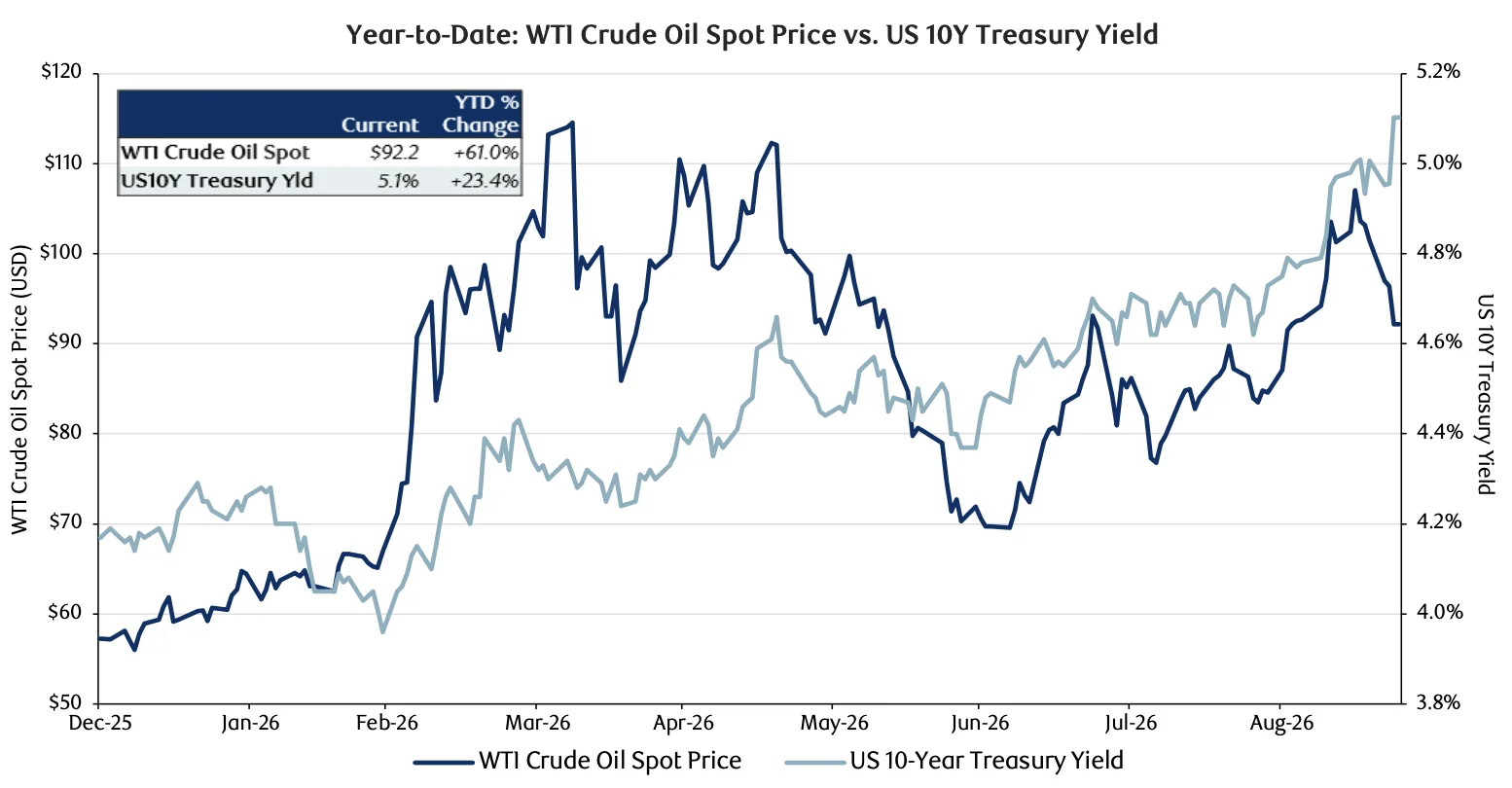
Figure 2. Rise in long bond yields has been correlated to the price of oil. Ascendant Wealth Partners, FactSet. Data presented as of September 24, 2026.
AWP's Take: We remain underweight duration in U.S. and European fixed income. The September 16th hike and hawkish dot plot reinforce that stance rather than change it — we are not chasing the long end for yield alone, and a Fed still raising rates argues for patience before extending duration. Investments with lower interest rate sensitivity, such as floating-rate debt and short-duration credit, continue to offer the defensive characteristics that traditional long-duration bonds currently fail to provide.
3. The Technology Reset: Demand and Supply Aren't the Problem — Politics Is
Technology-sector fundamentals remain intact by any conventional measure: hyperscaler capital expenditure is projected above $700 billion USD in 2026 (Figure 3), earnings growth for the Information Technology sector is running well ahead of the broader index, and the “Magnificent 7” cohort has been joined by a second wave of infrastructure beneficiaries — advanced hardware, memory, networking and power-management names.
This is not a story about slowing AI demand or a chip shortage. The sector's shifting sentiment is driven almost entirely by politics at the local, state, and federal levels.
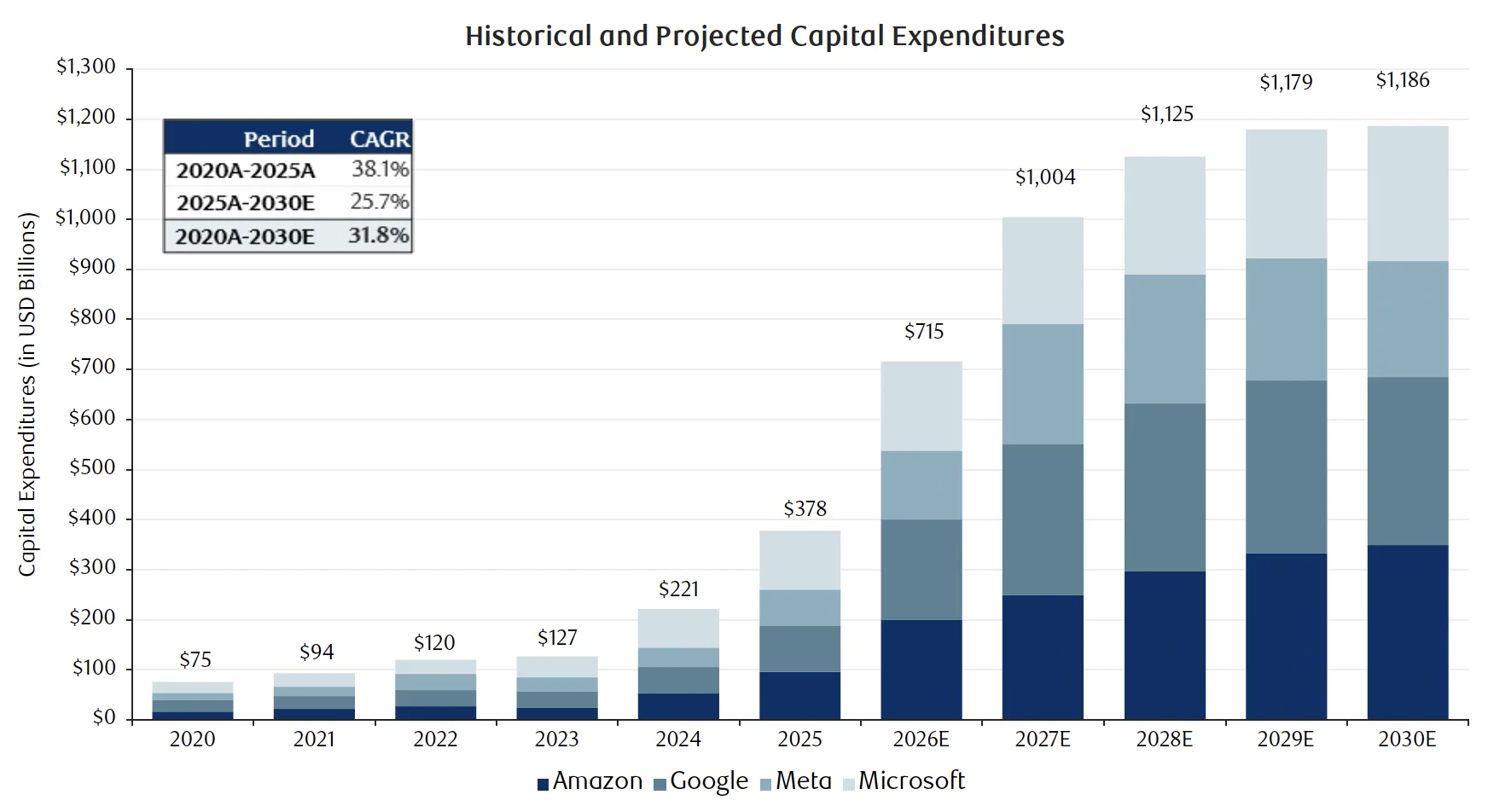
Figure 3. Bloomberg Intelligence's Interactive Capex Model provides estimates of hyperscale capital expenditures based on company guidance and analyst consensus forecasts. Ascendant Wealth Partners, FactSet. Data presented as of September 24, 2026.
Local opposition has become a genuine constraint
- While affordability remains a central issue for the upcoming U.S. midterm elections, the growth and regional distribution of data centers have also emerged as highly debated, localized concerns.
- Bipartisan opposition to a data center being built in one's own community — not a partisan issue at all. A Gallup poll in March 2026 found 70% of Americans opposed a new AI data center in their own neighbourhood, and a separate survey by the Annenberg Public Policy Center found opposition had risen to 61% by mid-2026, up 12% from the spring. As Figure 4 depicts, there is also widespread division from both a gender and political affiliation perspective.
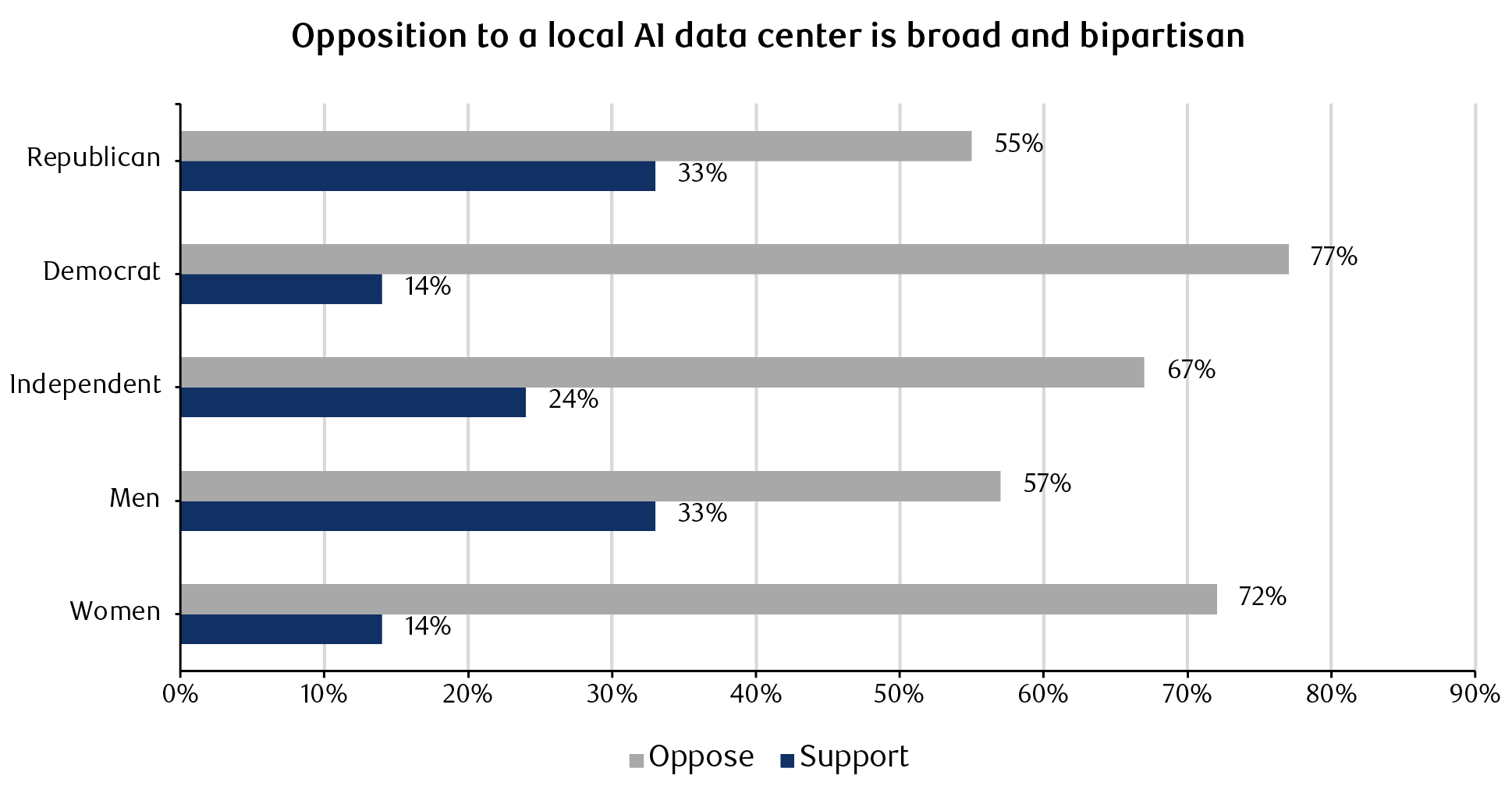
Figure 4. Support for and opposition to a local AI data center, by political affiliation and gender. Source: Quinnipiac University poll, published March 2026 (cited in RBC Global Insight, September 2026).
- States are taking unilateral action in the meantime: Pennsylvania removed AI data center proposals from fast-track permitting in August 2026; several other states have advanced their own siting, water-use and ratepayer-protection rules. Internationally, Scotland's parliament voted 80–26 in mid-September to tighten data center rules, illustrating the direction of travel outside the U.S. as well.
- Canada has taken a more coordinated approach: on September 3rd, federal AI Minister Evan Solomon announced a data center framework — minimizing water usage, transparency on local impact, and not shifting electricity costs onto Canadian ratepayers — which more than 20 companies, including OpenAI and Anthropic, have signed on to.
AWP's Take: We believe the secular AI capex cycle remains intact and are not reducing our technology and infrastructure allocations despite current political uncertainties. But we are becoming more selective: we favour hyperscalers and enablers with resolved permitting and secured power access over names still dependent on speculative site approvals, and we are watching regulated Utilities closely given the compounding pressure of higher bond yields and this NIMBY/regulatory risk. This is a stock- and site-selection discipline, not a change in our secular thesis.
4. What Investors Need to Know About the Canada Investment Summit
Prime Minister Mark Carney's first-ever Canada Investment Summit in Toronto convened over 100 global investors — collectively managing more than $100 trillion in assets, by the government's account — on September 14–15, deliberately timed alongside the Toronto International Film Festival to maximize global attention.
The government's pitchbook listed 167 candidate “nation-building” projects. Unlike previous investment summits, this initiative produced specific, quantifiable commitments.
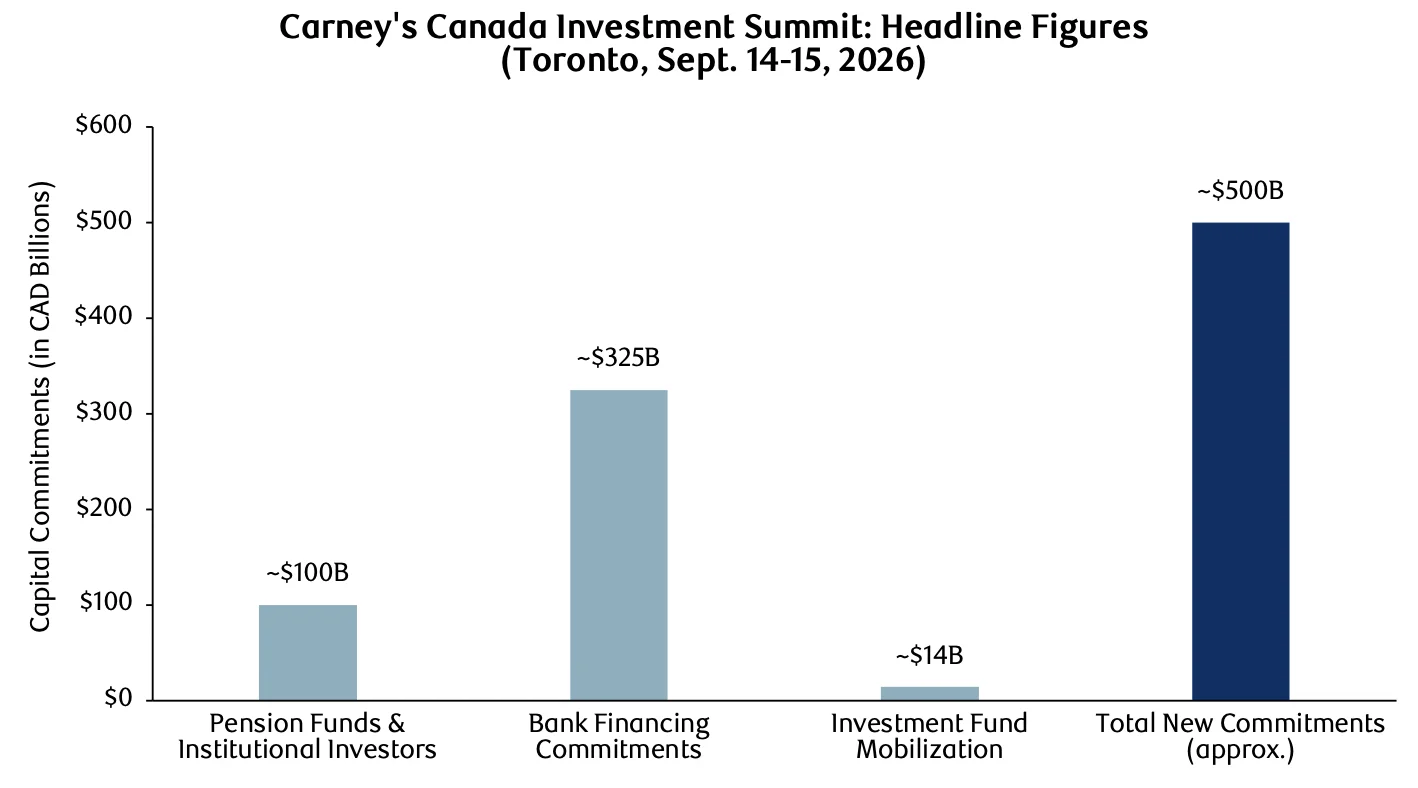
Figure 5. Headline investment commitments announced at the Canada Investment Summit, as stated by the Prime Minister's Office. Figures are as announced and have not been independently audited. Source: Office of the Prime Minister of Canada, remarks of September 15, 2026.
- As shown in Figure 5 above, Canada's largest pension funds, insurers and institutional investors committed roughly $100 billion in new capital to Canadian assets; Canadian banks committed close to $325 billion in new financing to Canadian businesses and infrastructure.
- The marquee individual project: Bell Canada and the Government of Saskatchewan announced a 1.2-gigawatt AI infrastructure hub — a more than $50 billion investment, the largest in the province's history, expected to generate over 4,500 jobs. This is explicitly framed as Canada building sovereign AI compute capacity.
The policy package clients should have on their radar
- Productivity Mega Deduction: immediate expensing is being widened from roughly 15% to nearly two-thirds of qualifying capital assets (fiber-optic cable, mining property, pipelines, rail, aircraft, vehicles, manufacturing equipment) and made permanent. The government states this will make Canada's effective tax rate on new investment the lowest among major economies and less than half the U.S. rate.
- Building Canada Act: extends the Major Projects Office's expedited-review approach economy-wide, targeting a “one project, one review, one year” standard for permitting.
- An additional $1 billion through the Business Development Bank of Canada's $6 billion platform, targeted at critical minerals and defence-sector scale-ups.
Early market reaction has been constructive: Bloomberg reported that multiple fund managers are increasing Canadian equity allocations, citing the valuation discount to U.S. markets, an improving growth outlook, and the tax and regulatory signals from the summit. The broader context is worth keeping in view — this is occurring against continued Canada–U.S. trade friction, which the government frames explicitly as the impetus for this diversification push.
AWP's Take: We view the summit as a constructive incremental catalyst — particularly for Canadian financials (expanded lending mandates), critical minerals, defence, and AI infrastructure — rather than a reason to make an outsized tactical shift into Canadian equities. Committed capital typically deploys over several years, and today's announcements are unaudited government figures.
Closing Thoughts
Each of these four threads shares a common feature: the fundamental picture — earnings, capex, capital formation — is constructive, while the source of near-term volatility is political rather than economic. That is a meaningfully different risk to underwrite than a demand shock or a credit event, and it argues for staying invested at target weights while being more deliberate about where, within each asset class, that exposure sits.
We remain committed to a full, targeted equity allocation and a defensive posture we can accelerate into if conditions warrant, an underweight duration in U.S. and European fixed income, and a constructive but selective stance on both U.S. technology infrastructure and Canadian equities.
We welcome the opportunity to discuss how these themes intersect with your specific objectives, and as always, we are grateful for your continued trust and support.