
Barasch - Wellwood Wealth Partners
August 23, 2026
Let’s start with a chart that sums up why Canada and the U.S. are in a trade dispute:
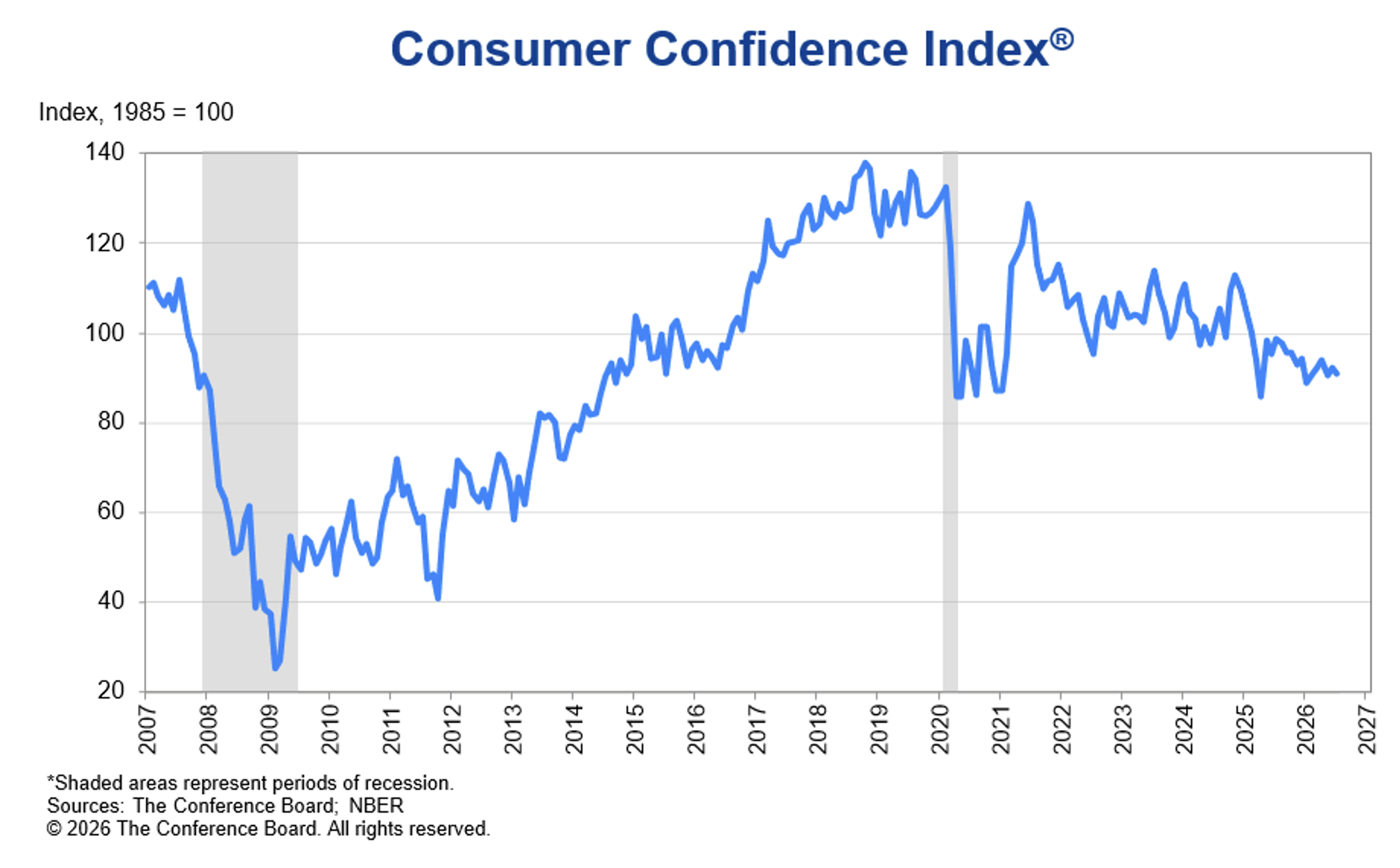
Perhaps no chart better captures the failures of the current U.S. administration. Unemployment is near all-time lows, the stock market is near all-time highs and yet consumers are barely more confident than they were at the depths of COVID. To distract from these failures, you need stories for the media ecosystem and Fox News can only run so many pieces on the latest trans athlete to steal the medal of some poor nine-yearold. Sadly, Canada is easy fodder for “Operation Distraction” and so, rather than release the complete and unredacted Epstein Files, we get a trade war.
Make no mistake, this will be bad for Canada and, to a lesser extent, for the U.S. We would love to say that America will suffer as much as Canada, but it will not. But also make no mistake, this dispute is not about unfair trade practices— it’s about failure.
The current administration has completely and utterly failed at almost everything it has attempted to do thus far. Prices are far higher than they were when Joe Biden left office, as is the pace of price increases. Iran has become a quagmire that has no good outs. While most Americans favor a strong border, the administration still finds itself well underwater on immigration, as most Americans do not favor occupation and gulags.
U.S./Canada Talks Breakdown
On its face, the collapse of trade talks between Canada and the U.S. will be bad for the Canadian economy. While the 50% tariffs that went into effect at midnight on August 21 only impact about five percent of traded goods between Canada and the U.S., those industries—plastics, wood and paper, electronics, furniture and others—are likely to be severely impacted. Let’s look at this under the guise of the “not-so-bad” and the “bad,” as there is not really any good that will come of this for Canada other than a resolution to the dispute.
The Not-So-Bad: RBC Economics estimates that, with no offset, the tariffs are likely to take a 0.4% bite out of both GDP and jobs. Most goods—~80%—will still flow tariff-free (assuming no other attempts at distraction) and with the economy already gathering some momentum over the past year, Canada is likely to see net growth and a net positive change in employment in the second half of 2026 into 2027. In other words, while the tariffs will hurt Canada broadly, the economy was in a good enough place heading into the dispute that the tariffs are unlikely to severely damage the growth forecast.
The Bad: Ideally, we would want this to hurt as much (or more) for the Americans (or more) as it does for us, but unfortunately this will not be close to the case. Let’s look at a chart and then comment:
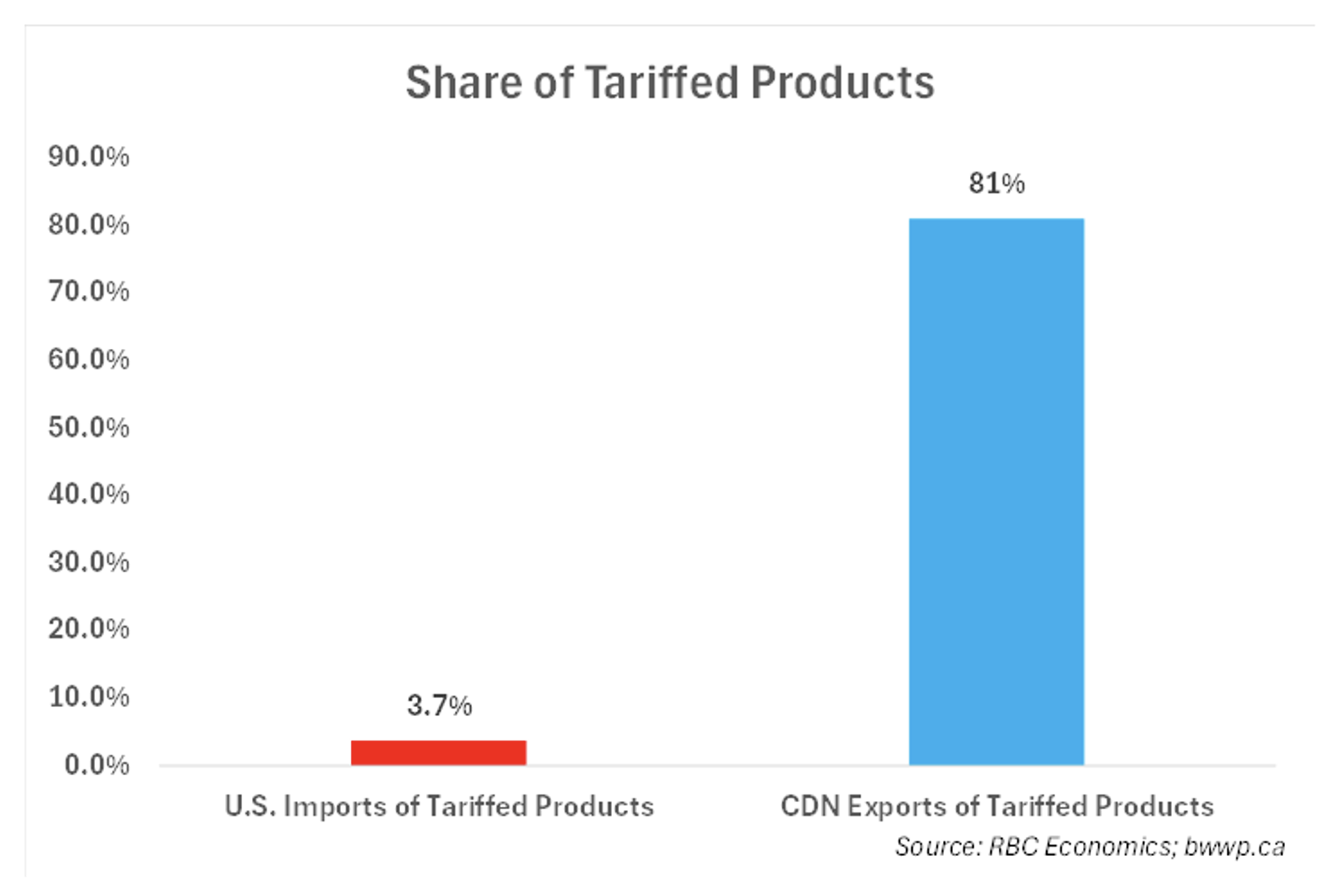
The U.S. gets less than four percent of the tariffed goods from Canada, so importers will likely not have a problem sourcing these goods from other unaffected regions. Conversely, virtually all of Canada’s exports of these goods go to the U.S. and finding a new home for them will likely be very challenging, especially since many of them rely on supply chains that were built over many years. Some will surely be absorbed domestically, but the bottom line is that, absent either a quick resolution to the dispute or significant government support, the affected industries are going to struggle to survive.
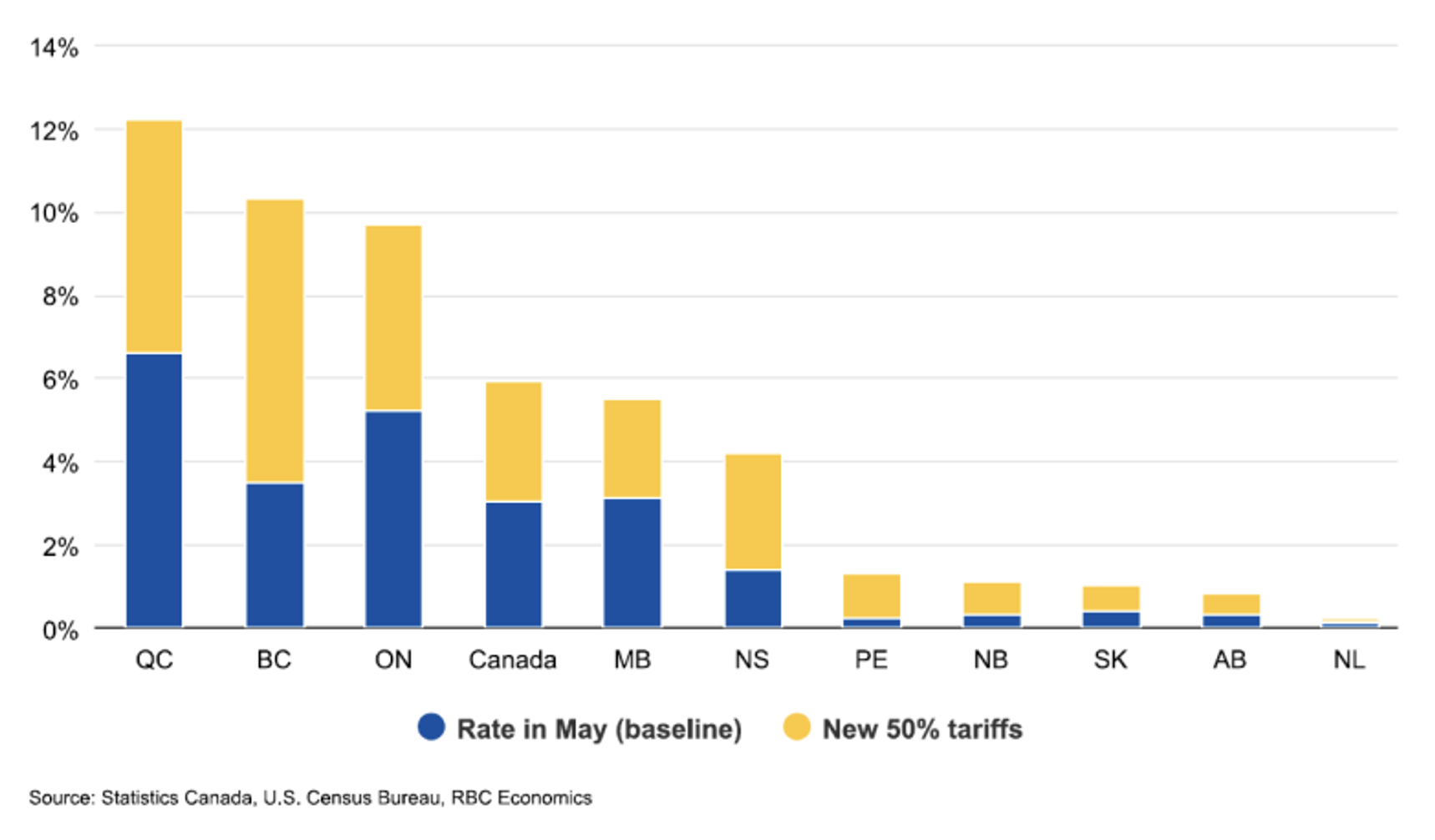
We would also add that the tariffs will have an outsized impact on three provinces—Ontario, Quebec and British Columbia—with most of the affected industries residing in these provinces. Conversely, most other provinces will feel limited to no impact:
Questions to be Answered
- The Response: Canada has vowed to respond by September 8 with retaliatory tariffs designed to match the tariffs on Canadian goods “dollar-for-dollar”. One interesting wrinkle here is that Canada is actually a net importer of the tariffed goods from the U.S., with ~$23 billion flowing in and ~$20 billion flowing out. It is possible that some of the domestic production of these goods which is no longer flowing to the U.S. could replace the U.S. inflows of these goods (assuming Canada directs tariffs at these imports, thus making them prohibitively expensive in Canada), although, as RBC Economics notes, this would likely take some time as the aforementioned supply chains are not easily redirected.
- Government Support: We have already heard from some of the heavily impacted provinces about potential support for affected businesses and we would not be surprised to see some move to offset the impact. Canada has taken a number of positive steps over the past year or so to unlock the potential of the economy and, as the saying goes, “never waste a good crisis.” In other words, we would like to see the Carney government accelerate some of the moves it has made in order to offset the lost growth from the tariffs. Further, the Bank of Canada (BoC) is unlikely to do much to help as inflation remains its core concern. That said, while there was a scenario, albeit unlikely, in which the BoC might be forced to raise rates at some point in the near future, we would presume that the tariffs would take that off the table.
- How long will this last? Trump and his administration have repeatedly backed down when faced with the economic and market impacts of his policies. Further, while the talks broke down, it does sound like the two sides were not that far apart, so we would not discount the possibility that this is resolved in the coming days or weeks.
The Market Impact
While we would not be surprised to see an initial negative reaction by the Canadian stock market to this news, we do not think it will have an enduring impact. The impacted industries make up only a small sliver of the Canadian economy and an even smaller sliver of the S&P/TSX. Ironically, Canada’s response could have a bigger negative impact on markets, depending on where retaliatory tariffs are directed, but it is too early to weigh in on this.
Final Thoughts
While the headlines are bad, we have a strong sense that Canada will push through this latest crisis better than many pundits expect. As we have learned over the past 20 months, reacting to the latest failure from the U.S. is a bad strategy.
We took some time to review our holdings ahead of Friday’s breakdown in talks as we suspected there were more risks to the deal than were laid out and we are comfortable that our exposures are minimal, although general market noise could impact all boats at least for a period of time.
As always, we welcome any questions or areas of discussion you might want us to explore.