Barasch - Wellwood Wealth Partners
July 29, 2026
Elon Musk’s SpaceX went public last month with much fanfare. Initially valued at nearly $2 trillion (or more than half the market capitalization of every company in Canada), the stock has since bounced around from over $220/share to its current price of around $115 (~15% below its initial issuance price of $135/share).
SpaceX is largely an investment in belief. While some of the business is tangible - Starlink, X (formerly Twitter), the Falcon 9 rocket - much of its value is based on the belief that Musk and his team of engineers can achieve the heretofore impossible - massive data centers in space. People on Mars. Technologies that would have been utilized by Captains Kirk and Picard.
We are not here to argue whether or not it will be achieved, but rather the many beliefs one must have at a nearly $2 trillion initial valuation for an investment in SpaceX to make sense. Since this quite literally involves rocket science, we are going to get a tad bit nebulous, but we will do our best to keep this on a terrestrial level.
One thing before we start – while SpaceX carries the name “Space”, it is not so much a space-company as it is an artificial intelligence-company that is reliant on outer-space to make the story work. Thus, while many of the challenges with the SpaceX story revolve around the difficulty of getting things off the surface of the Earth and into orbit, ultimately, it is how investors view SpaceX’s artificial intelligence unit – xAI – that is going to dictate the success of the stock.
The Tyranny of the Rocket Equation
Let’s start with something known as “The Tyranny of the Rocket Equation” and the work of everyone’s favorite rocket scientist – Konstantin Tsiolkovsky.
For those not familiar with Tsiolkovsky, he was a self-taught rocket scientist (who isn’t these days?), who developed what was and is now known as “Tsiolkovsky’s Rocket Equation (TRE)”. Now, creating a rocket equation is pretty darned impressive in 2026, but what makes Tsiolkovsky’s achievement all the more impressive is that he came up with the thing in 1897, which was a few years before we actually had flight, let alone rockets.
TRE basically says that the maximum change in velocity of a spacecraft is dependent on how fast the rocket can expel its fuel and the relationship between the weight of the full rocket vs. the weight of the rocket after it has expelled all of its fuel (the final mass of the rocket). Let’s take a look at a diagram that explains the formula:
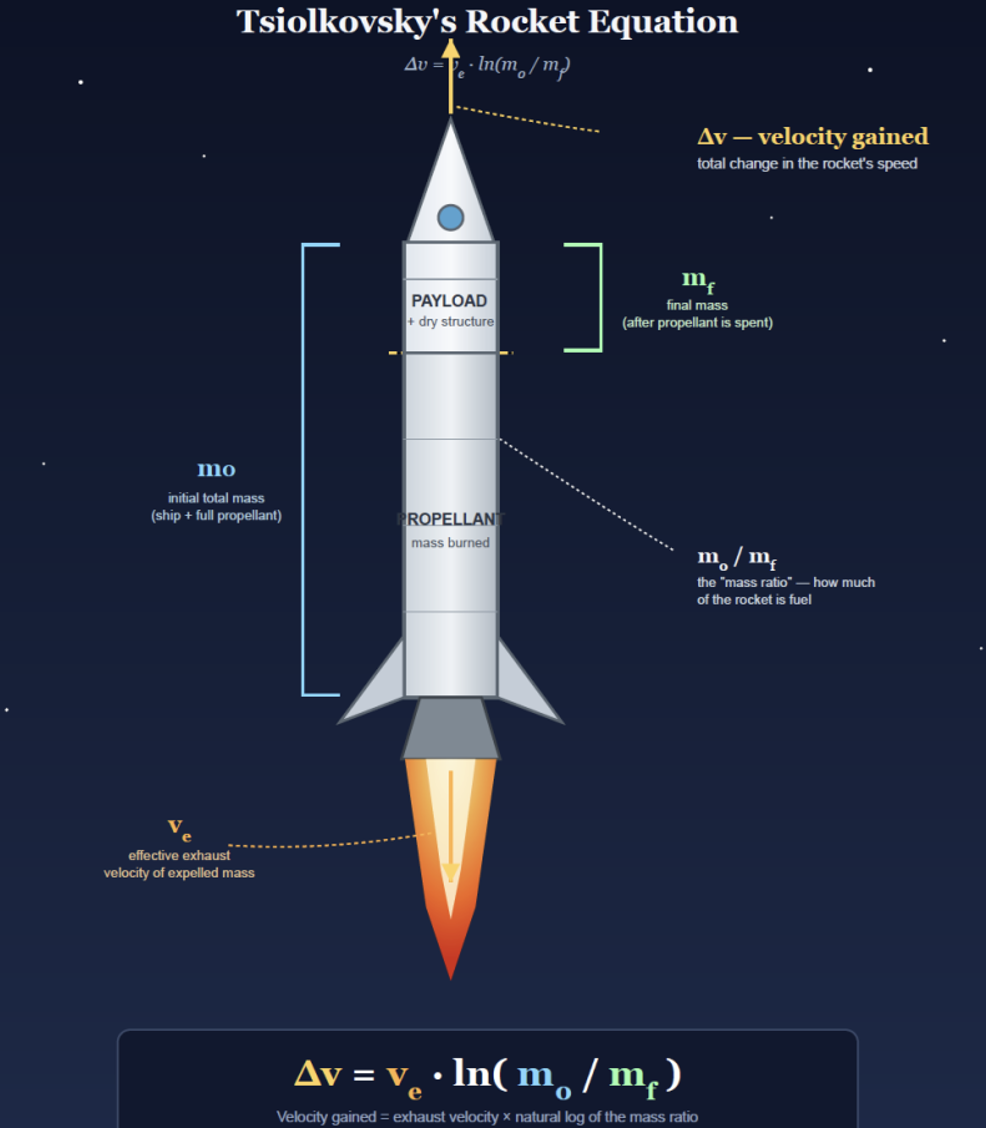
The latter part in brackets at the bottom - the ratio of a rocket full of fuel (m0) relative to the rocket when it has burned off its fuel (mf)- gives rise to the “Tyranny of the Rocket Equation”, which goes something like this - we need rocket fuel to launch mass (i.e. weight) into space – anything that has mass needs to be accounted for as it requires fuel for launch. The spacecraft (or payload) and the rocket it sits on have mass, but the rocket fuel that powers the rocket also has mass. So, we not only need fuel to launch the spacecraft and the rocket into space, but we also need fuel to launch the mass of the fuel. The more fuel we need to get the spacecraft and the rocket off the ground and into earth’s orbit, the more fuel we need to get the fuel in the rocket off the ground. But as we add more fuel to get the mass of the fuel off the ground, we need more fuel as we are adding more mass. And the relationship between the full rocket and the empty rocket is not linear, but rather it is exponential. Which means if you want to get more velocity, you need to add exponentially more rocket fuel to do it, which makes the mass/fuel problem worse and worse. Get it? If not, no worries – just think of it this way – getting heavy stuff off the ground is really hard.
You ever wonder why we stage rockets?
There is no ground-based solution to TRE. In other words, you simply could not build a rocket and spacecraft/payload light enough (less mass) and fill the rocket with enough fuel to make the TRE work – the rocket/payload would fail to reach space as the velocity gained would fall short of the required amount to reach low Earth orbit (LEO). So, you have to stage the rockets such that each time a rocket is emptied of jet fuel, it is jettisoned from the rocket assembly thus reducing the mass (weight) and giving way to the next stage, which fires its engine and begins expelling its fuel and so on. This is basically how we have done it since the beginning of the space program in the 1960s and continue to do so today.
SpaceX and the TRE
Okay, but we are here to talk about SpaceX not long dead Russian rocket scientists. Now, SpaceX is a big, complicated story – one that generates ~$19 billion of revenue and operating income of ~$6.6 billion - but we can simplify that into three big pieces:
- Starlink, which is the satellite Internet business that we are all familiar with. Currently, Starlink is responsible for ~$11 billion of revenue (~60% of current revenue) and ~$7.7 billion of operating income, meaning that the rest of SpaceX is currently losing money as overall operating income for the entire business is about $1 billion less than what Starlink generates.
- Artificial Intelligence, which flies under the banner of xAI and includes all of SpaceX’s data center investment, Grok, its agentic AI platform, and all associated AI research. xAI currently generates about $3 billion of revenue (~20% of the company total) and has an operating loss of ~$6.4 billion, which is primarily associated with the massive amount of spending to build-out data centers. We should note that xAI recently signed a deal with rival Anthropic to lease out xAI’s data capacity to Anthropic for $1.25 billion/month (not included in the above figures as it had not started as of the IPO). This is important for two reasons:
1. The Anthropic revenue will significantly boost SpaceX’s overall revenue ($15 billion that is not included in current totals or more than 75% of what the company currently generates) and operating income (this should be pretty high margin revenue for SpaceX);
2. It is not necessarily a great sign as xAI is essentially leasing out space to one of its direct AI competitors so that Anthropic can continue to build out its agentic AI platform (Claude). With the long lead time (2-3 years) for new data centers, xAI is essentially helping a competitor where the competitor might be otherwise capacity-constrained in return for a cash flow boost. We would add that Anthropic can opt out of this agreement, which one would assume it will do when it has built out its needed data center capacity, so we are not sure how reliable this revenue will be beyond the next couple of years. - Space, which is a mix of the Falcon, Dragon and Starship programs. The easiest way to break this down is that Falcon is Space division’s current breadwinner driven by the Falcon 9 rocket, which propels more than half of the world’s annual launches into low Earth orbit, while Dragon is the spacecraft that transports astronauts to the International Space Station. Starship is the literal moonshot as it is designed to power the Space division out of LEO and ultimately to the moon and Mars. The Space division currently generates ~$4 billion of revenue (~20%) and is operating at close to breakeven largely because Starship is not generating much revenue but is eating through a lot of capital as it tries to figuratively and literally get off the ground.
Starlink – not so much belief as reality
Let’s get Starlink out of the way first because it is straightforward. Driven by the low cost, reusable Falcon 9 rocket, Starlink has been able to put more than 10,000 satellites into orbit, which accounts for ~2/3rds of all active satellites currently in LEO. This has helped to drive massive growth in its satellite internet business and has enabled the company to aggressively cut prices. While this sounds counter-intuitive, when you have such a massive network of coverage, every new user essentially costs the company nothing and is pure profit. So, cutting prices not only increases users, but also acts as a deterrent to competition, which would have to invest massive amounts to catch up to Starlink’s infrastructure advantage at the same time that prices are falling.
So, we would have high confidence that Starlink, which is currently a ~$12 billion revenue company, could probably get to ~$50 billion of revenue in the next 5-years (assumes ~30% annual growth, which is slower than the current 50% run rate) and ~$25 billion of operating income. What investors are willing to pay for this is open to debate, but probably something between 15-20x operating income, which suggests a value of between $300 billion and $500 billion for Starlink.
Now for the hard part
While Starlink provides a nice base for our analysis, it is really xAI and Space – working in concert – that is going to drive the bus for SpaceX’s valuation, as we have about ~$1.35 trillion or so of value left to account for in order to justify the ~$1.75 trillion initial value.
In its offering documents, SpaceX outlines a $28.5 trillion total addressable market (TAM) for xAI and Space with the vast majority - $26.5 trillion – assigned to xAI; although, because the SpaceX thesis is in part based on the idea of data centers in space, we would lump the two together. Now, a couple of things here:
1. The entire software industry’s annual revenue is currently less than $1 trillion, so SpaceX is identifying a TAM that is ~30x this amount;
2. If one really wanted to hype-up a story, one would pick a ridiculously big number for its TAM, which would help foster the idea that if they only captured a small part of that TAM – say 10% - it would still be a ridiculously large amount of money;
3. We love the fact that they included “.5” in the estimate, which provides some precision to the number where we imagine none existed.
What a fool believes?
Let’s start with xAI and the need for this business unit, driven by SpaceX’s agentic AI agent – Grok – to generate most of SpaceX’s ultimate valuation. Now, as we noted at the outset, xAI lost money in 2025; although, with the Anthropic deal, this will change in 2026. Currently, most industry watchers put Grok firmly behind ChatGPT (Open AI) and Claude (Anthropic) in terms of quality and traffic and potentially even behind Chinese entry Kimi.
The business is currently losing money – we are going to ignore the Anthropic data center lease, which, as we mentioned, is not really the kind of revenue/earnings xAI wants to generate in the long-run as it benefits one of Grok’s main competitors. At some point in the next 5-7 years, xAI is going to need to generate a lot of revenue and income in order to drive a valuation that exceeds $1tn for the business. The question is – what needs to happen to get there? Let’s touch on a few things:
The SpaceX Belief System
- Orbital Refueling: SpaceX will essentially be using this staged process (because you can’t fight TRE), but with a twist. With very few exceptions (the Apollo missions, the Voyager deep space unmanned missions), almost all launches have aimed for LEO. Starship is aiming not only to fly people and equipment to the moon and ultimately Mars, but also to carry payloads that contain the building blocks of massive orbital data centers. Even with a staged process, the math of TRE will not work as going from the ~9.4 km/second needed to achieve low earth orbit to the ~16 km/second needed to reach the moon while carrying the mass that Starship is targeting is simply not achievable from traditional staging alone (we would note that SpaceX has improved on traditional rocket fuel going from older kerosene engines to a methane/oxygen mix, which can be expelled more efficiently and thus overcome some of the TRE issues).
Rather, Starship will have to do orbital refueling in which previously launched refueling rockets will have to rendezvous with the Starship rocket and refuel them while in orbit, so that the ship has enough fuel to travel to the moon or Mars, successfully land (ironically easier on Mars than on the moon as Mars has an atmosphere that provides some resistance and thus lowers the amount of fuel needed to slow a descent to the surface), and successfully return to Earth. While this sounds great in theory, there has never been an attempted refuel of a methane/oxygen fuel mix in the vacuum of space while orbiting the earth at 28,000 km/hour. - Data Centers in Space: As discussed, lifting the heavy payloads involved in building data centers in space is going to be a challenge. But assuming this can be done, the next question becomes – what does building and operating a data center in space actually look like? Now, unlike terrestrial data centers, which are massive town-sized complexes that house thousands and thousands of stacks of chips, data centers in space will essentially be clusters of satellites that are optically linked. And these are not going to be small clusters, but rather tens of thousands will be needed each year to achieve a space-based data center. By one estimate, SpaceX will need to build (no small task) and launch 50k satellites per year beginning in 2029 in order to achieve its goals. This will amount to several Starship launches per day in order to achieve 2029, 2030 and 2031 goals. While not impossible, it is well beyond what has been achieved by SpaceX up until now (there have been seven successful Starship launches and five failures with no two launches occurring in the same month, let alone on the same day).
And that’s just getting the satellites up into space. It does not account for actually powering (solar) and operating these satellite clusters to achieve something similar to ground-based data centers. Data centers generate an incredible level of heat, and this heat must somehow be vented, and the vacuum of space creates heretofore unseen challenges for the heat-venting issue. On earth, fluids are used as the conduit for expelling heat, but this is not an option in space. Again, the SpaceX folks are far smarter than we are, but one needs to have a lot of faith and belief that these challenges can be overcome. - Grok as a major profit center: While vast sums of money have been spent building out the AI ecosystem, which has been a major boon to those companies that have supplied this build-out, the leading agentic AI providers – OpenAI, Anthropic, xAI – have yet to prove that their businesses can be massive profit engines. AI use has exploded and thus it is not hard to imagine these businesses generating the sorts of sums that would justify trillion dollar-plus valuations, but there are no guarantees. Further, as we mentioned, Grok is currently not considered on the same level as ChatGPT or Claude. This can obviously change as the technology is constantly evolving, but considering xAI is leasing out its data center space to competitors rather than reserving it for Grok, the current competitive situation does not breed a lot of confidence.
- People and equipment on the moon and Mars: The ironic thing is – manned missions to the moon and Mars are less important to the ultimate SpaceX story – at least from a valuation perspective; although, we acknowledge that psychologically, failure to achieve the moon/Mars missions could leave a sour taste in investors’ minds. That said – the logistical challenges involved in these missions are numerous because unlike past missions – Apollo, Artemis – SpaceX aims to not only go the moon and, perhaps, Mars, but also to do so carrying significantly more weight than any previous missions. Returning to our good friend Tsiolkovsky – more weight means more fuel and more staging and more in-space refueling and a significantly greater velocity needed as we are no longer striving just for low Earth orbit, but rather breaking free of Earth’s orbit.
The Cult of Elon
We would be remiss if we did not attribute some potential valuation – perhaps, significant – to what we will call the “Cult of Elon”. There is no doubt as evidenced by the lofty valuation attached to Tesla (TSLA) and to the initial valuation of SpaceX that investors are willing to give a wide berth to the Cult of Elon. Despite some bold claims that have not yet come to pass – SpaceX was first supposed to reach Mars in 2018 for example, while Tesla was supposed to be fully self-driving in the same year – many investors are willing to give more credence to Musk’s bold predictions than they would other CEOs. Thus, despite Tesla only accounting for ~3% of U.S. auto sales, it has a market cap larger than all other car companies combined – the Cult of Elon is clearly a driving force behind this.
Massive Opportunities - Massive Risks
There is little doubt that the opportunity set in front of SpaceX is enormous. The Space division has pioneered low-cost space flight and completely dominates the launch market. But the road ahead of the space division involves much larger rockets transporting much larger payloads with much greater frequency.
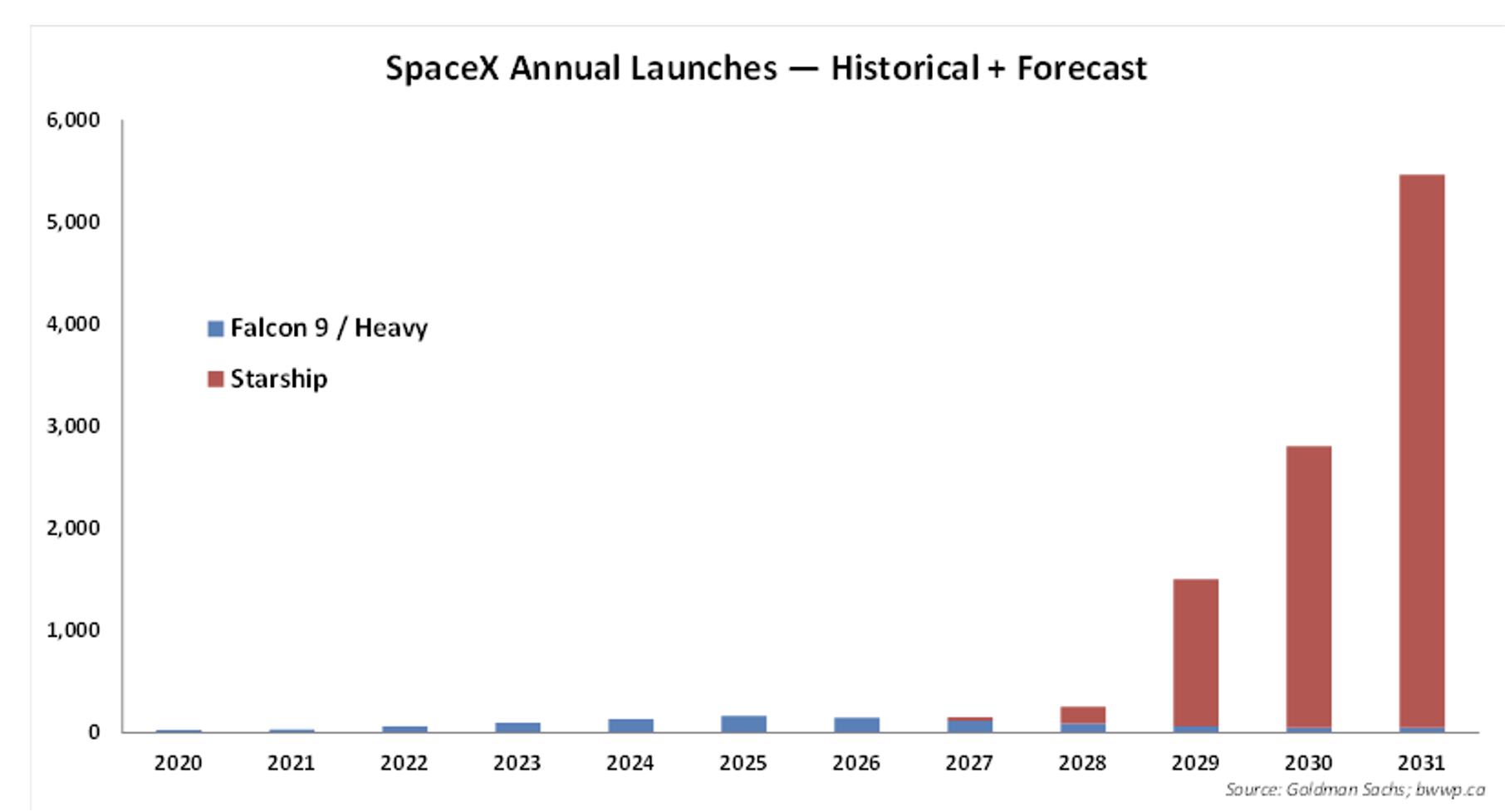
Meanwhile, xAI will spend hundreds of billions of dollars in an “AI arms race” with the likes of ChatGPT, Anthropic, Google and Meta with an enormous potential payout at the end, but the real potential that xAI’s well-capitalized and better quality (at least currently) peers thwart xAI’s efforts.
Against this backdrop, SpaceX will need to raise in excess of $250 billion of debt, while its stock will have to face the headwind of insiders potentially offloading their shares as they look to capitalize on the sharp increase in the value of the company when it was private.
Final Thoughts
The above does not set out to determine whether SpaceX is a good investment or not – but rather the number of challenges the business faces in achieving even some of its goals and the belief system that investors need to have to justify the nearly $2 trillion valuation afforded the company at its IPO. We would add that we endeavored to merely justify the value of SpaceX at its launch (pun intended), which says nothing about achieving valuations in excess of $3 trillion or $4 trillion – values that would be needed to justify a large initial investment in the stock (one wants to make money after all). The Cult of Elon is a powerful force – one that has cost skeptics of Telsa dearly over the years. Thus, while we would count ourselves as skeptical (and, perhaps, a little more than just regular skeptical), we would be cautious about concluding that SpaceX is a bad investment, especially as its stock price falls to more favorable entry points.