
Jamie Burak
Senior Investment and Wealth Advisor
August 2, 2026
Friends & Partners,
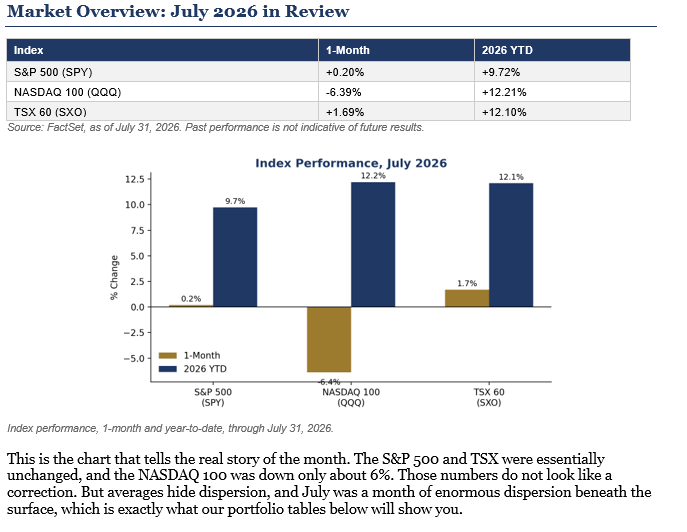
July gave us a real test. A Federal Reserve meeting that ended in a rare three way hawkish dissent, a reescalation of the Iran conflict, and a sharp correction in semiconductors, AI infrastructure names, and momentum stocks generally. If you only looked at the S&P 500 or the TSX, you would not have known any of this happened. Both indexes finished the month roughly flat to positive. But underneath that calm surface, many of the individual names that led the market higher over the past year, including several we own, gave back a meaningful chunk of their gains in a matter of weeks.
We want to walk you through what actually happened, why we do not think it changes the underlying thesis, and how the rebalancing work we did earlier in the month, before any of this started, is exactly the kind of discipline this portfolio is built around.
Every New Era Has Its Shakeout
We have said for some time that AI infrastructure spending represents a genuine, multi year investment cycle, not a speculative bubble. We still believe that. But every transformational investment cycle, whether it was railroads, electrification, or the early internet buildout, has gone through violent mid cycle shakeouts where the market separates conviction from momentum. July was one of those moments.
The proximate causes were real and worth naming plainly. The Federal Reserve held rates steady at 3.50% to 3.75% for a fifth consecutive meeting, but three regional Fed presidents dissented in favor of a hike, the first three way hawkish dissent since 2016, citing inflation that has now run above target for more than five years. Futures markets responded by pricing in a much higher probability of a September hike rather than a cut. The 10 year Treasury yield has climbed to roughly 4.68%, up from 4.38% in late June. That is a real move and a real headwind for richly valued growth stocks, but we want to be precise with you rather than reach for a dramatic headline: this is not a 20 year high in rates. The 10 year traded above 5% as recently as 2023. What is true is that rates are climbing again after a period of relative calm, and that alone was enough to pressure the most expensive corners of the market.
At the same time, the AI infrastructure story hit a genuine supply problem. Memory chip prices have surged as much as 130% this year as AI data centres now absorb an estimated 70% of global memory output, squeezing supply for everything from laptops to smartphones. Samsung, SK Hynix, and Micron, who together control the vast majority of global DRAM production, have been reallocating capacity toward the high bandwidth memory that feeds AI accelerators. This is a demand story, not a demand problem, but it is forcing a repricing of who benefits and who gets squeezed along the AI supply chain, and markets do not like repricing exercises.
Layered on top of that, hyperscale earnings season arrived with a vengeance. Alphabet reported first and its stock fell roughly 7% on capex guidance alone, not on the earnings themselves, and that set the tone for the rest of the group. Amazon, Meta, and Microsoft all reported in the days that followed, and all faced the same question from investors: is the roughly $725 billion in combined 2026 AI capital spending, up 77% from last year, going to show up in revenue on a reasonable timeline. Microsoft's own report ultimately reassured the market, and the stock rallied hard, up nearly 25% over the month. But the scrutiny on every dollar of capex guidance is now intense, and that scrutiny is what drove the volatility in the names most levered to the AI infrastructure build, including several names we own.
Finally, the Iran conflict, which briefly cooled after a ceasefire was signed in mid June, has escalated again meaningfully over the past two weeks, with renewed strikes and rising involvement from regional actors. This adds a geopolitical risk premium on top of everything else, and it is a genuine source of uncertainty we are watching closely, though it has not changed our underlying portfolio positioning.
Rebalancing vs Indexing: Why July 7th Mattered
Here is the part of this story we are most proud of. On July 7th, three weeks before any of this correction began, we completed a full rebalance of both the U.S. and Canadian sides of the portfolio.
On the U.S. side, we trimmed several names that had run up to expensive valuations and added to a number of well priced, high conviction positions across the portfolio. We did this because sizing discipline matters as much as stock selection, and names that run too far ahead of their fundamentals eventually give some of that back, which is precisely what happened to several of them in July.
On the Canadian side, we trimmed our overall weighting to the Canadian banks, which have had an outstanding multi year run, and used the proceeds to add MDA Space as a new position. MDA gives us direct exposure to the satellite and space infrastructure buildout, a theme that is closely related to, but distinct from, the AI data centre story, and one we think has years of growth ahead of it.
This is the argument for rebalancing over simply indexing. An index does not trim what has gotten expensive or add to what is well priced ahead of a shakeout. It just holds whatever weight the market assigns. Our discipline of regularly resetting position sizes based on valuation, not on recent performance, is what allowed us to walk into July already leaner in the names that corrected hardest, and already positioned in a new name we believe in for the next several years. That is the entire point of active, disciplined portfolio management, and July was as clear a validation of it as we have seen in some time.
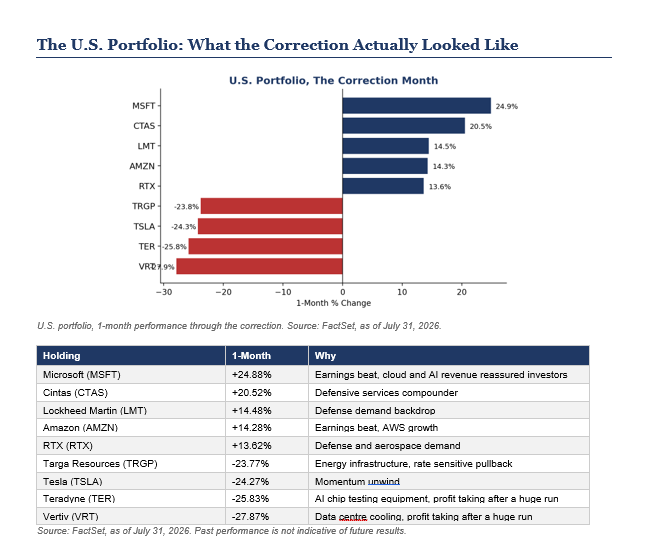
Microsoft was the standout of the month, up nearly 25%, as its earnings report gave investors the clearest evidence yet that AI infrastructure spending is translating into cloud revenue growth. Amazon and defense names Lockheed Martin and RTX also held up well. On the other side, Vertiv and Teradyne, two of the picks and shovels names behind AI data centre buildout that have had extraordinary multi year runs, gave back a significant chunk of recent gains as investors took profits and reassessed near term capex timelines. We view this as healthy repricing after a strong run, not a change in the underlying thesis. Both remain core positions.
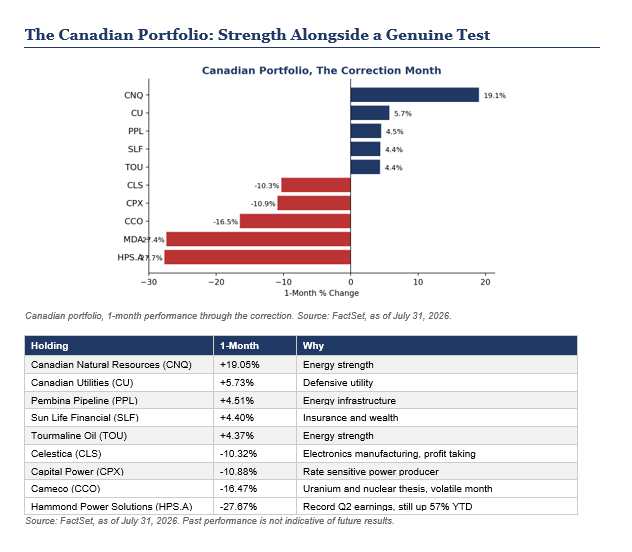
Hammond Power Solutions deserves special mention. The stock fell nearly 28% in July, our largest one month decline anywhere in the portfolio, purely on momentum unwind and profit taking after an extraordinary run. And yet on July 30th, the company reported a record second quarter, with gross margin improving to 31.5% from 30.7% a year ago, year to date earnings per share up to $4.81 from $3.32, revenue up 14%, and backlog up 28%, all driven by the same data centre and grid infrastructure demand that has powered this stock since we first bought it. This is precisely the kind of divergence between stock price and business fundamentals that a shakeout produces. The company is executing better than ever. The stock, for one month, did not agree. Hammond remains up 57% year to date and is still our highest conviction Canadian holding.
MDA Space, our newest Canadian position, was also caught up in the same momentum unwind, down over 27% for the month. We added this position deliberately as part of the July 7th rebalance and view any near term weakness as noise around a multi year thesis, not a signal to change course. Cameco had a volatile month as well, tied to the same energy and uranium sensitivity we have discussed before, while our energy names, led by Canadian Natural Resources, and our defensive utilities and insurance holdings provided real ballast.
The Broader Picture
AI Infrastructure, Still the Right Side of History. Nothing about July changes our conviction that AI infrastructure spending is a real, multi year cycle. The $725 billion in combined 2026 hyperscaler capex is not a projection, it is largely already committed. What changed in July is that investors demanded more proof that spending translates to revenue, and Microsoft's report gave them exactly that. We expect more volatility as this proof plays out company by company, quarter by quarter, and we would use further weakness in high quality names as an opportunity, not a warning sign.
Rates and the Fed. A genuinely divided Fed, with three officials now on record wanting higher rates, is new information, and it is why we are watching the September meeting closely. We do not think this changes the longer term trajectory, but it does mean less certainty in the near term than markets had priced a few months ago.
Geopolitics. The renewed conflict involving Iran is a genuine wildcard and a reminder of why we keep energy and defense exposure in both books. We are watching it closely and will update you if it materially changes our positioning.
August Planning Focus: Make Room for Something New
Every year, the calendar does the same thing to us. September arrives, the kids go back to school, and the busy season, portfolio reviews, tax planning, year end conversations, starts back up for all of us almost overnight. Before that happens, we want to leave you with a simple ask. Take one thing this month, a trip, a weekend away, a project around the house, time with family, that has been sitting on the back burner, and make room for it. Markets will always give us something to react to. Summer will not wait for us.
If part of that planning involves a financial decision, a major purchase, a gift to family, a change in your work situation, please loop us in early. The earlier we know, the better we can help it fit into your broader plan rather than reacting to it after the fact.
Closing Thoughts
July was a real test of conviction, and by most measures the portfolio, and the discipline behind it, passed. The names that corrected hardest did so because they had run the furthest, not because their businesses deteriorated, and in several cases, like Hammond Power Solutions, the underlying business actually got stronger during the very month the stock fell the most. That gap between price and fundamentals is uncomfortable in the moment and is usually where the best long term returns are made.
Our job through the rest of the year remains the same as it always is: rebalance with discipline rather than react with emotion, stay invested in businesses whose fundamentals are improving even when their stock prices are not, and keep this conversation focused on your plan, not on any single month's headlines.
As always, if any of this raises questions about your specific accounts or your broader plan, please do not hesitate to reach out.
That conversation is always welcome, and it is always about you first.