
Caitlin Burton
Investment Advisor
October 6, 2026
Some of the most impressive financial stories I see don't come from a perfectly balanced portfolio. They come from one great thing: a business built from the ground up, a property bought at the right time, a company stock that grew alongside a career. Building significant wealth around a single asset takes vision, conviction and a lot of hard work. It's a real achievement, and it deserves to be celebrated.
It also deserves to be protected. When so much of what you've built rests on one asset, its ups and downs become your ups and downs. This month, I want to talk about how to honour that success while thoughtfully building a wider foundation underneath it. This isn't about stepping away from what got you here. It's about making sure your wealth can stand on its own, whatever happens to any one piece of it.
Protecting and Building On What You've Created
Concentration is often how wealth gets built. It's rarely how wealth gets kept. The goal isn't to undo what's worked; it's to make sure your future doesn't depend on one asset continuing to perform exactly as it has. Here are the questions I hear most often from clients in this position.
1. How do I know how much of my net worth is tied up in one asset?
Start with a full picture: every account, property, business interest and holding, valued as realistically as possible. Then look at what share of the total rests on a single asset, sector or source of income. Many clients are surprised by the result, especially when their employment income, pension or real estate is tied to the same company or industry as their investments. A clear, honest balance sheet is the starting point for every good decision that follows.
2. How do I start building wealth alongside the asset that's gotten me here, without it feeling like I'm betting against it?
Diversifying isn't a vote of no confidence. It's a way of locking in some of what you've already earned. Think of it as building a second pillar next to the first, not tearing the first one down. That might mean directing new savings elsewhere, gradually trimming a position over time, or using registered accounts to build a separate pool of investments. You can remain fully committed to the asset and still give yourself a foundation that doesn't rely on it.
3. What's a thoughtful timeline for broadening my financial foundation?
There's rarely a need to do it all at once, and doing it all at once can create unnecessary tax. A well-paced plan often unfolds over several years, taking into account capital gains, market conditions, your cash flow needs and any restrictions on selling. The right pace is one that meaningfully reduces your risk while respecting the tax realities and your own comfort level.
4. How do I make sure my success in one area is protected by strength in others?
By building a foundation with several independent sources of stability: an emergency reserve, a diversified investment portfolio, appropriate insurance, and a sound estate plan. When those pieces are in place, a difficult year for your primary asset becomes a setback, not a crisis. That's what lasting wealth looks like: success in one area, backed by strength everywhere else.
A Note for Business Owners
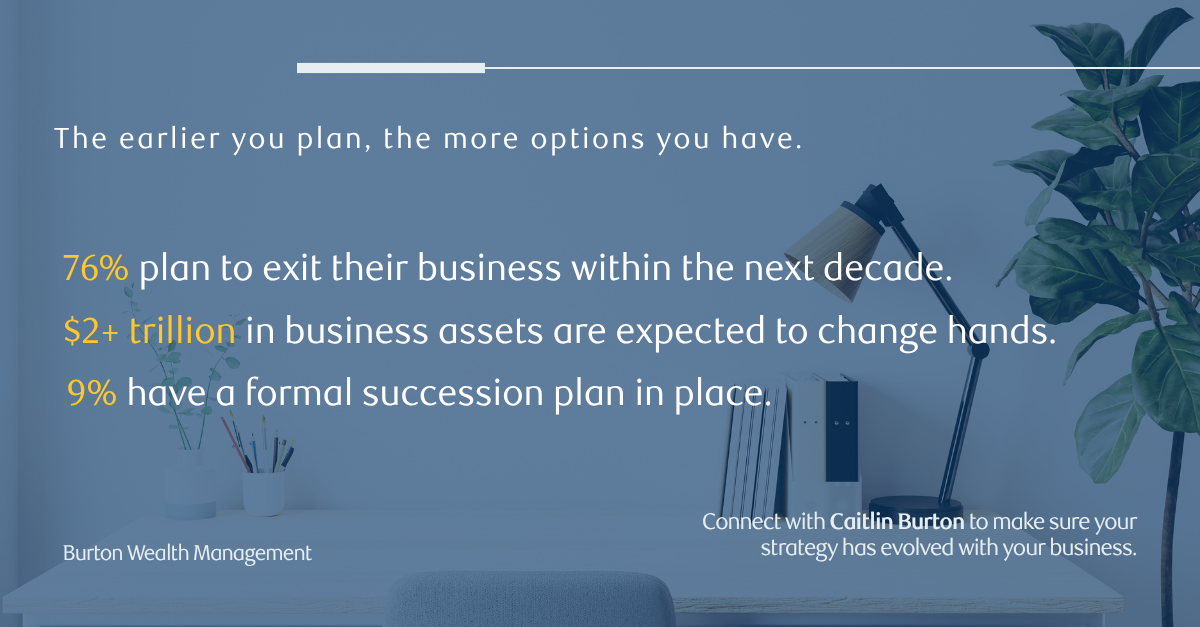
For business owners, concentration is almost a given. The business is often the largest asset you own, your main source of income and, in many cases, your retirement plan. The Canadian Federation of Independent Business (CFIB) found that 76% of small business owners plan to exit their business within the next decade, putting more than $2 trillion in business assets in motion, and that a majority rely on the sale of their business to fund their retirement. Yet only 9% have a formal succession plan in place.
1. How do I build wealth outside the business while staying focused on growing it?
It starts with paying yourself intentionally. Decide how much to draw from the business each year, through salary, dividends or a combination, and direct a consistent portion into investments outside the company. Your RRSP, TFSA and personal non-registered accounts can build a separate foundation over time, while surplus cash inside the corporation can be invested with a clear purpose. Growing the business and building wealth outside it aren't competing goals; each makes the other more secure.
2. What does a realistic, well-paced diversification timeline look like for a business owner?
It usually works backward from your eventual exit. If you're ten or more years out, the focus is on steadily building outside savings and making sure your corporate structure is efficient. Five to ten years out, it's about planning for the tax on an eventual sale, including whether you may qualify for the lifetime capital gains exemption, and exploring options like a family trust or holding company with your accountant. In the final years, it's about lining up your successor or buyer and making sure your retirement doesn't depend on getting one perfect price on one particular day. The earlier this starts, the more options you'll have.
Leading Succession and Inheritance Conversations
Many of the women I work with have built a business, grown a family enterprise, or hold significant wealth in their own right, and they're fully capable of leading the planning around it. Yet in succession and estate conversations, they can still find themselves as one voice among several rather than the one driving the strategy. This section is about stepping into that leadership role.
1. What does it look like to lead a succession plan, rather than simply weigh in on one?
It means setting the goals, calling the meetings and choosing the professional team. Leading isn't doing everything alone; it's holding the vision and keeping the process moving.
2. How do I make sure my perspective carries full weight in decisions about a business or estate I helped build?
Make your role and contribution visible, and make sure they're reflected in shareholder agreements, wills and any trust structures. Be in the room for advisor conversations, not briefed afterward.
3. What's the difference between equal and fair, and how do I make that case with authority?
Equal means everyone gets the same; fair means each person gets what makes sense given their role and needs. A child who has worked in the business for years might receive it, while a sibling receives other assets of similar value. Know the numbers, explain the reasoning and put it in writing.

Bringing It All Together
Building wealth around one great asset is an accomplishment worth being proud of. The next step is making sure that success lasts: that it's protected, broadened and eventually passed on according to a plan you lead. That doesn't mean walking away from what got you here. It means building a foundation strong enough that your future never rests on a single outcome.
A few questions worth sitting with this month:
- Do I know what percentage of my net worth depends on one asset, company or industry?
- If that asset had a difficult year, how would it affect my plans and my family?
- Am I building wealth outside my business, or is the business still my entire retirement plan?
- Do I have a written succession or estate plan, and does it reflect my goals?
- Have I thought about what "fair" looks like for my family, and could I explain it with confidence?
If any of these gave you pause, that's worth acting on. Protecting what you've built is just as important as building it, and the earlier we start, the more thoughtfully we can do it. Let's take a closer look together.
Let's Connect
Let's make sure the success you've worked so hard for is built to last, through all seasons of life.
Where you can find me: LinkedIn Facebook
Caitlin Burton
Caitlin Burton, Investment Advisor, Burton Wealth Management of RBC Dominion Securities Inc., caitlin.burton@rbc.com, 613-566-7511
RBC Wealth Management is a business segment of Royal Bank of Canada. For further information on the entities that are member companies of RBC Wealth Management, click here. The content in this publication is provided for general information only and is not intended to provide any advice or endorse/recommend the content contained in the publication.
® / ™ Trademark(s) of Royal Bank of Canada. Used under licence. © Royal Bank of Canada 2026. All rights reserved.
Resources:
- Canadian Federation of Independent Business. Over $2 trillion in business assets are at stake as majority of small business owners plan to exit their business over the next decade, January 10, 2023. 76% plan to exit within a decade; over $2 trillion in assets; 9% have a formal succession plan; a majority rely on the sale to fund retirement.
- BNN Bloomberg (Dale Jackson). New RRSP and TFSA limits revealed for 2026, December 31, 2025. 2026 TFSA limit $7,000 (cumulative $109,000); RRSP limit 18% of earned income up to $33,810.
- Scotia Wealth Management. Cancellation of the proposed capital gains inclusion rate increase, April 7, 2025. Inclusion rate remains 50% following the March 21, 2025 announcement; LCGE increase to $1.25 million maintained.
- Canada Revenue Agency. Line 25400 – Capital gains deduction. LCGE of $1,250,000 on qualifying property, indexed to inflation.
- Canada Revenue Agency. Gifts of shares, stock options, and other capital property.