
Caitlin Burton
Investment Advisor
November 10, 2026
Here's something I find genuinely reassuring: the most successful, financially savvy people I know are wired with the same mental shortcuts as everyone else. Seasoned entrepreneurs, executives and long-time investors all feel a loss more sharply than a gain. They all get attached to the price they paid. They all feel the pull to act when markets get noisy. That isn't a flaw in them. It's simply how human brains are built.
November is Financial Literacy Month in Canada, and this year I want to focus on a side of financial literacy that doesn't get enough attention: understanding how we make decisions, not just what we know. Researchers who study how people make decisions have spent decades describing these shortcuts, and I see them play out with clients every week. Once you can recognize them, they stop working against you and start working for you. This month, I'll share what that looks like in practice for your personal wealth, for your business, and for the experience you've already earned.
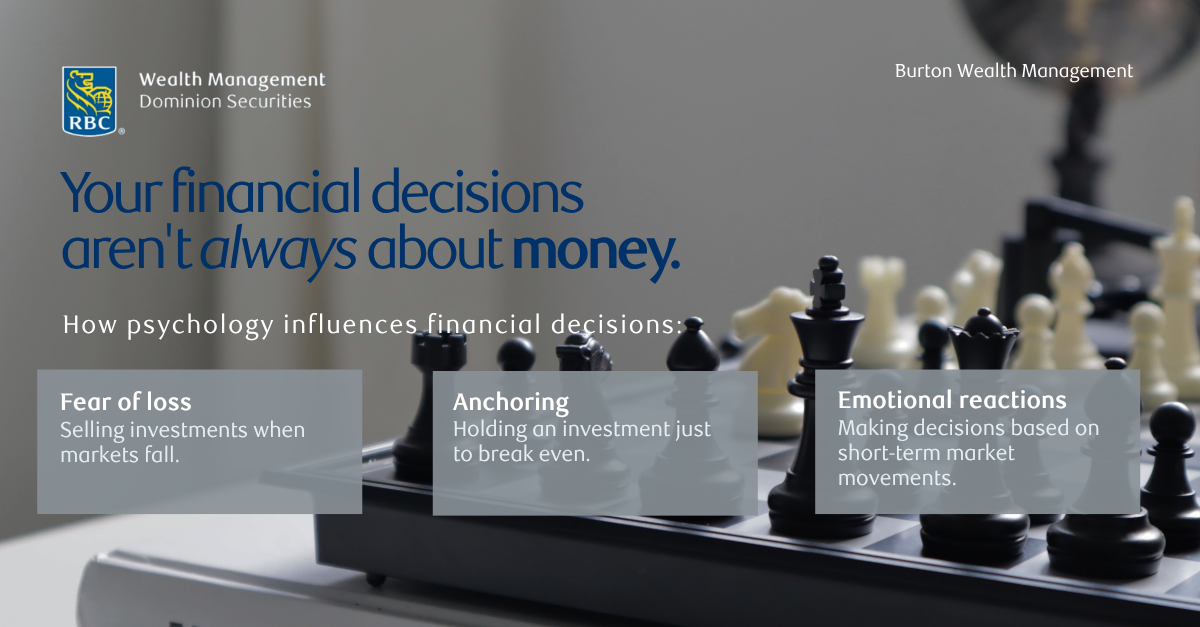
Understanding Your Own Decision-Making
Good financial decisions don't come from having no emotions about money. They come from knowing which emotions are in the room and giving them the right seat at the table. Here are the questions I hear most often when clients start paying attention to how they decide, not just what they decide.
1. Why does losing money feel different than gaining the same amount, and what can I do with that knowledge?
Because we're wired that way. Research on how people weigh risk has found that a loss tends to feel roughly twice as strong as a gain of the same size. A $50,000 drop in your portfolio stings far more than a $50,000 rise feels good. That's useful to know. It explains why selling during a downturn can feel like relief, even when it locks in the very loss we're trying to escape. The practical response is to decide ahead of time how you'll act when markets fall, so that a plan, not a feeling, makes the call.
2. How do I make sure I'm evaluating an investment based on today, not on what I originally paid for it?
The price you paid is a powerful anchor, but the market doesn't know or care what it was. A simple test helps: if you held this amount in cash today, would you buy this investment at its current price? If the answer is no, the original price shouldn't be the reason you're still holding it. This is especially timely in November, as many of us review our non-registered accounts before year-end. Looking at each holding on its current merits, rather than waiting to "get back to even," often reveals opportunities, including tax-loss selling that can offset capital gains elsewhere.
3. How do I build a financial plan that accounts for how I'm actually wired to make decisions?
By building in structure that does the hard work for you. Automatic contributions to your RRSP and TFSA remove the temptation to time the market. A target asset mix with set rebalancing ranges means you trim what's done well and add to what's lagged without having to talk yourself into it. A written investment policy, even a one-page version, gives you something to return to when headlines get loud. The best plans don't ask you to be a perfectly rational person. They assume you're human and work with that.
4. What habits help me make calmer, clearer financial choices?
A few that I've seen make a real difference:
- Build in a pause. For any significant decision, give yourself 48 hours before acting.
- Check less often. Looking at your portfolio daily magnifies every dip. A monthly or quarterly review is usually plenty.
- Write down your reasoning. A short note on why you made a decision makes it easier to judge later whether the thinking was sound, not just whether the outcome was lucky.
- Talk it through. Saying a decision out loud to a trusted advisor or partner often reveals assumptions you didn't know you were making. Fittingly, this year's Financial Literacy Month theme from the Financial Consumer Agency of Canada is "Talk Money."
A Note for Business Owners
No financial decision is more personal than one about a business you built. It carries your name, your late nights and often your family's future. That commitment is what made the business succeed. It can also make it harder to see clearly when it's time to invest, borrow, sell or step back. We tend to value what we've built more highly than an outsider would, simply because we built it.

1. How do I make objective financial decisions about a business I'm personally invested in building?
Bring in an outside view and give it real weight. A formal business valuation every few years shows you what a buyer would likely pay, which may differ from the number you carry in your head. Before a major decision, such as an expansion, a large loan or turning down an offer, ask how you'd advise a friend who owned the exact same company. It's also worth looking at the business the way you'd look at any other holding in your portfolio: what share of your net worth it represents, and what return it's earning on the capital you keep in it.
2. What helps me separate emotional attachment from sound financial judgment when it comes to my company?
Structure and people. Set decision criteria in advance, such as the return you need, the price you'd accept or the timeline you're working toward, and write them down before an offer or opportunity is on the table. Build a small circle of advisors, typically your accountant, lawyer and wealth advisor, who will tell you what you need to hear. And separate the two questions that often get blended together: "What is right for the business?" and "What is right for me and my family?" They don't always have the same answer, and both deserve their own conversation.
The Decision-Making Edge Built From Experience
Many of the women I work with have spent decades investing, running businesses and managing significant wealth. That's a real track record. Yet I often see that experience underweighted, sometimes by the women themselves, in favour of second-guessing and extra caution. Canadian research reflects this. A 2025 survey for the Canadian Investment Regulatory Organization (CIRO) found that 47% of women felt confident making investment decisions, compared with 66% of men. On a financial knowledge quiz, women were more likely to answer "don't know," and when that option was removed, the gap between women's and men's scores narrowed. In other words, many women know more than they give themselves credit for.
1. How do I recognize the decision-making strengths my experience has actually built?
Look back before you look ahead. Think about the major financial decisions you've made over the past 10 or 20 years: a business you grew, a property you bought, a market downturn you stayed invested through, a career move you negotiated. Write down what you decided and how it turned out. Most women who do this exercise find a record of patience, discipline and sound judgment that they haven't been counting.
2. Where am I being more cautious than my track record justifies?
Caution is valuable when it reflects your goals. It's costly when it reflects doubt. Signs worth noticing include holding more cash than your plan calls for, deferring decisions to a spouse or advisor on matters you understand well, or asking for "one more opinion" when you already know your answer. A useful question is: if a colleague with my exact experience brought me this decision, would I tell her to wait?
3. What does fully trusting my own financial judgment look like in practice?
It means setting the agenda in advisor meetings rather than reacting to it. It means making decisions on the timeline your plan calls for, not the one your nerves prefer. And it means treating your advisors as people who inform your decisions, not people who make them for you. Trusting your judgment doesn't mean never asking questions. It means asking them from a place of confidence, because your experience has earned it.

Bringing It All Together
Financial literacy isn't only about understanding RRSPs, tax rules and market returns. It's also about understanding yourself: how you react to a loss, what you hold onto and why, and where your confidence matches your experience. Everyone, no matter how successful, makes decisions with the same human wiring. The people who make the best decisions over time aren't the ones without those instincts. They're the ones who recognize them and have a plan that works with them.
A few questions worth sitting with this month:
- Is there an investment I'm holding mainly because I'm waiting to get back to what I paid for it?
- Do I have a plan for how I'll act the next time markets fall, written down before it happens?
- If I looked at my business the way an outside buyer would, what would I see?
- Which financial decisions over the past decade am I proudest of, and what do they say about my judgment?
- Where am I waiting for permission or certainty I don't actually need?
If any of these made you pause, that's a good place to start. This Financial Literacy Month, take the "Talk Money" theme to heart and have the conversation. Let's sit down together, look at the decisions in front of you, and build a plan that fits how you actually think.
Let's Connect
Clear thinking leads to confident decisions. Let's make sure your plan supports both, through all seasons of life.
Where you can find me: LinkedIn and Facebook
Caitlin
Caitlin Burton, Investment Advisor, Burton Wealth Management of RBC Dominion Securities Inc., caitlin.burton@rbc.com, 613-566-7511
RBC Wealth Management is a business segment of Royal Bank of Canada. For further information on the entities that are member companies of RBC Wealth Management, click here. The content in this publication is provided for general information only and is not intended to provide any advice or endorse/recommend the content contained in the publication.
® / ™ Trademark(s) of Royal Bank of Canada. Used under licence. © Royal Bank of Canada 2026. All rights reserved.
Resources:
- Financial Consumer Agency of Canada. Financial Literacy Month. November 2026 theme: "Talk Money," encouraging Canadians to have purposeful conversations about money.
- Canadian Investment Regulatory Organization (CIRO) Investor Advisory Panel / Innovative Research Group. Women and Investing, 2025. Survey of 3,154 Canadian adults, April 2025: 47% of women vs. 66% of men confident making investment decisions; gap in quiz scores narrows when "don't know" is not offered.
- Tversky, A. and Kahneman, D. Advances in Prospect Theory: Cumulative Representation of Uncertainty, Journal of Risk and Uncertainty, 1992. Losses weighted roughly twice as heavily as equivalent gains.