
Cushing Private Wealth
October 6, 2026
Sometimes, you just have to do the hard thing because you know it’s for the best. Hitting the gym, going to the dentist, saving instead of spending, eating your veggies…there are lots of everyday examples. In financial markets, the top example by a long shot is increasing interest rates. It slows down growth, it reprices investments, it makes the President chew you out on Twitter - but if central banks don’t do it when the economy is strong, growth will get too hot, prices will go up and inflation expectations get entrenched. As it turns out, Q3 was the tipping point for markets to realize that it’s time for us all to eat some interest rate veggies.
A couple points of clarification here. First, we’re talking about the US, not Canada. Growth is obviously weaker here at home given the continued hangover in the real estate and construction sectors (especially for condos), the impact of tariffs on trade, and the throttling of immigration. The Bank of Canada has not increased rates, and while Canadian 5- and 10-year bond yields have moved up somewhat, it has not been in lock-step with the US…which incidentally is the main reason for Canadian dollar weakness in recent months. No rate hikes here makes sense - Canada’s real GDP growth is barely positive this year after all, while America’s is up 2.25%.
Second, US midterm elections are less than 30 days away, and as a result the narrative around US rate increases is politicized. Handwringing about the size of the deficit and US government solvency is helpful for the Blue Wave that is currently sweeping America, but it is not the reason rates are up. For one thing, US debt as a percentage of GDP is not increasing. With US GDP growing at 2.25% real, and inflation running well over 3%, the sum of those two puts nominal GDP growth at around +6%. The US deficit was 5.9% last year and is projected by the CBO to be slightly less this year…so the US debt-to-GDP ratio is really just treading water. That’s doesn’t mean running this sized deficit in good times is prudent, but it isn’t the reason rates are going up.
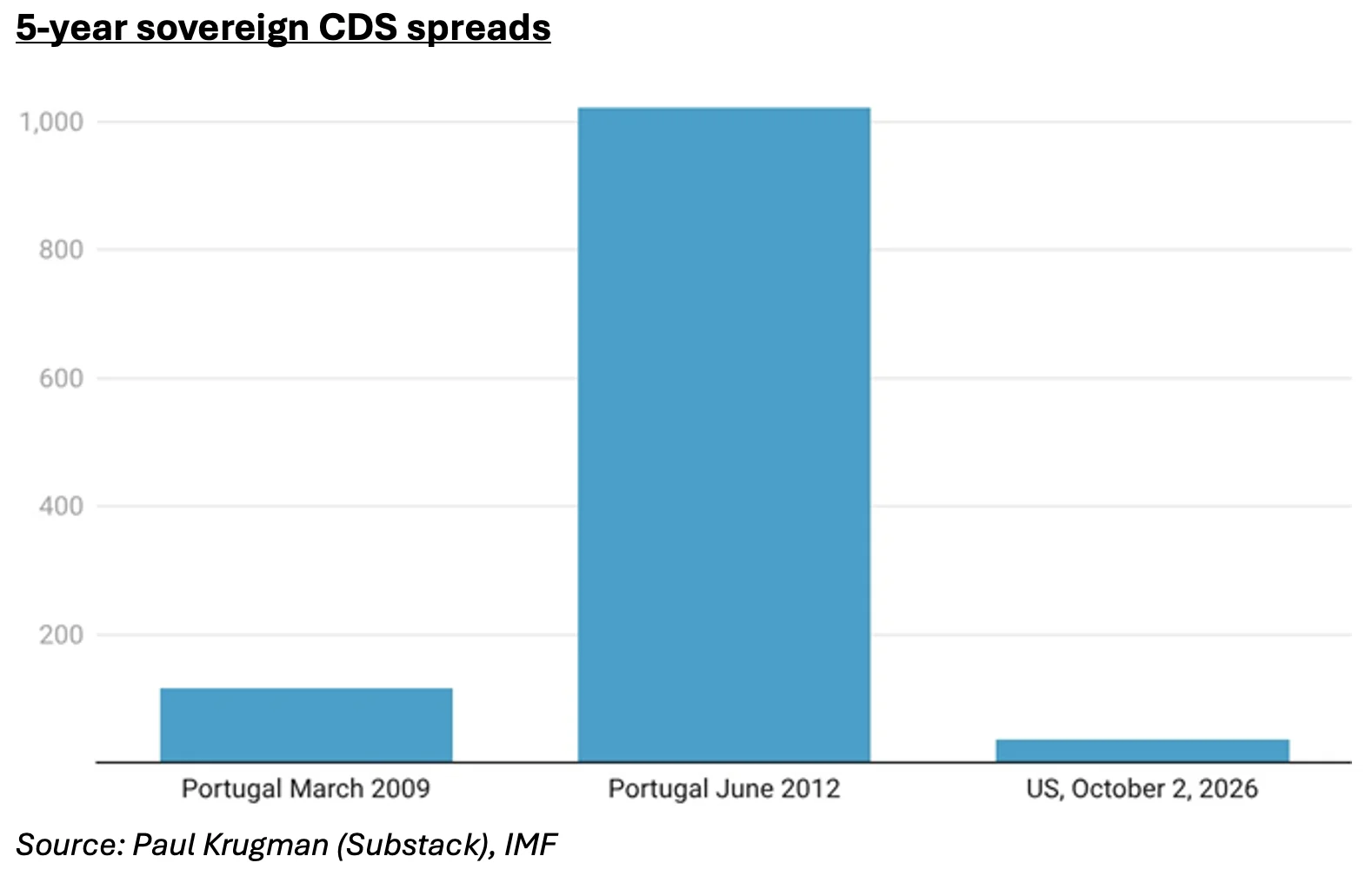
Clear evidence of this same point can be seen objectively in the market for credit-default swaps (“CDS”). These are a tool used by institutional investors to insure against a business or a country failing to make good on their debt. The higher the perceived risk of default, the higher the CDS spread. When investors feared that Portugal would follow Greece in defaulting on their debt back in 2012, for example, Portuguese CDS spreads leapt to over 10%. For context, here’s how they looked before those fears, and how US CDS levels look today.
Looking for other causes of rising interest rates, obviously high energy prices from the war in Iran have had an impact on inflation. But those effects are mainly - at the risk of using a currently dirty word in the field of Economics - transitory. For example, we’re only 5 months away from lapping the one-year anniversary of the war; at that point, energy prices will very likely become somewhat deflationary. In addition, industry reports show oil transits from the Middle East were back above pre-war levels in September…so the risks to energy prices seem skewed to the downside at this point, not the upside.
The only reasonable explanation left for the recent rise in US interest rates is therefore good ol’ economic growth. This is a good thing! Eating your veggies to keep things in balance isn’t so bad versus plowing them down in response to a crisis. What’s more, this is a classic mid-cycle pattern for the economy: growth starts to run hot, central banks and markets respond with higher rates, and this in turn gives investors pause for sober second thought. That (hopefully) tempers growth somewhat, allowing the economic cycle to gracefully extend.
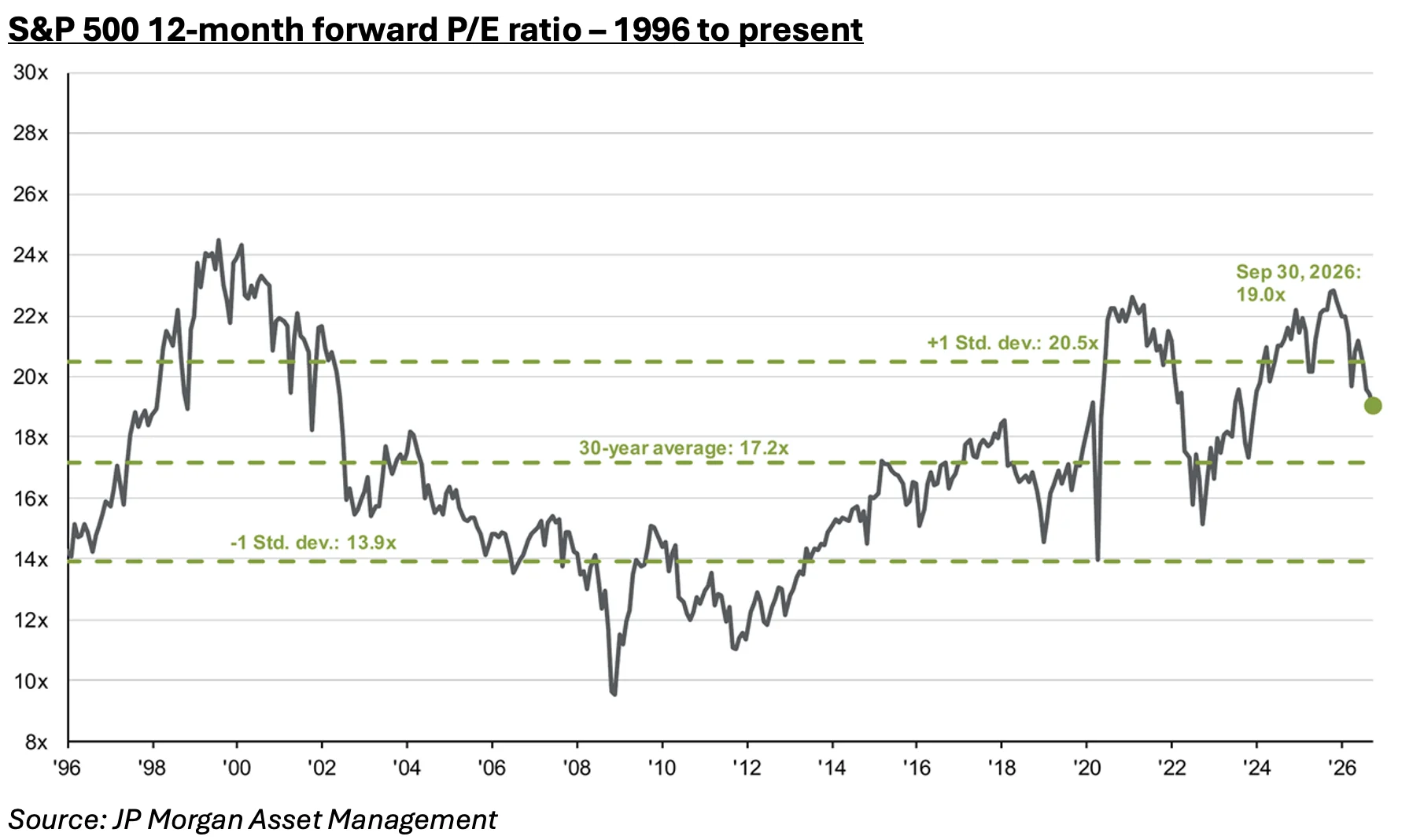
Counterintuitively, sober second thought is exactly what equity markets have done so far this year. Annual earnings for the S&P 500 are up a massive 32% YoY as of last quarter, and that’s excluding even bigger one-time gains. With the index up a bit over 10% so far in 2026, the difference of 20% is how much valuation has dropped this year. Forward P/E has fallen to an unremarkable 19x for an S&P 500 that is showing stellar growth - attention Walmart shoppers!
It isn’t quite that simple though, because for equity markets, a transition to mid-cycle tends to align with investors pivoting away from very economically sensitive stocks, and towards those with more consistent “quality” characteristics. Speculative, cyclical and levered companies start to fall behind - for example semiconductor and auto stocks powered ahead in early 2026 but have started to lag since August - while those with strong free cash flow, stable margins, and lower leverage begin to pull ahead. Similarly, sectors that are directly sensitive to interest rates due to high leverage should underperform. That’s exactly what has happened, with utilities, telcos and REITs being the worst performing sectors on both sides of the border in Q3.
As a result, a key market debate is now unfolding: are Google, Amazon, Microsoft, Meta, etc. still the cream of the “quality company” crop? If so - as they have been for about 15 years - then they are the ideal stocks to invest in now, and given their size, markets should then grind mechanically higher. But since they are now spending well north of 100% of their massive annual cash flow to fund AI data centre buildouts (except for Microsoft), and given that AI is disrupting tech industries generally, are they now lower quality and more risky companies than they once were?
Unpacking the return on investment for AI data centres is worthy of a note unto itself. For now, suffice to say we are in the camp of “it’ll work out well…over time”. Of course, a lot of investor doubt and anxiety can roil their share prices in the interim. Their spending, however, is the engine driving that mid-cycle economic growth. Which leaves us in a slightly strange place: investors are worried that Big Tech is spending too much, while that same spending is helping keep the economy strong enough to push interest rates higher.
Our view: a healthy economy, strong rising earnings and somewhat cheaper valuations are a good combination for equity investors. Higher interest rates are the price to pay for that, and they will both make the ride bumpier and will rotate the market leaders. As a result, trimming winners and diversifying equity portfolios is arguably more important now than ever.
Higher interest rates right now are a feature, not a bug. Sometimes the economy needs a little restraint before excesses become real problems. You know the drill: eat your veggies.