Di Iorio Family Wealth
October 15, 2026
How near-term price pressures and AI's longer-term potential could shape markets
Inflation is back in the headlines. Energy costs have climbed, governments are spending heavily, and the world's largest technology companies are building the infrastructure needed for AI. It is understandable that investors are asking whether higher inflation is here to stay.
In our 2026 Outlook, we questioned the growing consensus that inflation would remain structurally higher for years to come. Recent events are a reminder that the path will be uneven. They have not changed our longer-term optimism about what technology can do for productivity.
The cost of building what comes next
The current investment wave needs physical resources. Data centres need electricity, chips, cooling systems, copper and skilled trades. Governments are also investing in defence and infrastructure, while businesses spend to make supply chains more resilient. When many projects need the same resources at once, prices can rise.
Energy adds another layer. Higher fuel costs affect transportation and manufacturing, and may eventually reach the prices consumers pay. The Bank of Canada recently noted that gasoline had pushed headline inflation toward 3%, while inflation excluding gasoline was 2.2% and underlying measures were around 2%. The distinction matters: an energy shock can lift the inflation number without every other price rising at the same pace.
The Federal Reserve is watching its own inflation pressures. In September, it raised the U.S. policy rate to 3.75% to 4.00%. Fed policymakers also revised their expected rate path upward. Their median projection for the end of 2027 moved from 3.6% in June to 4.1% in September, even as they continued to expect inflation to ease over time.
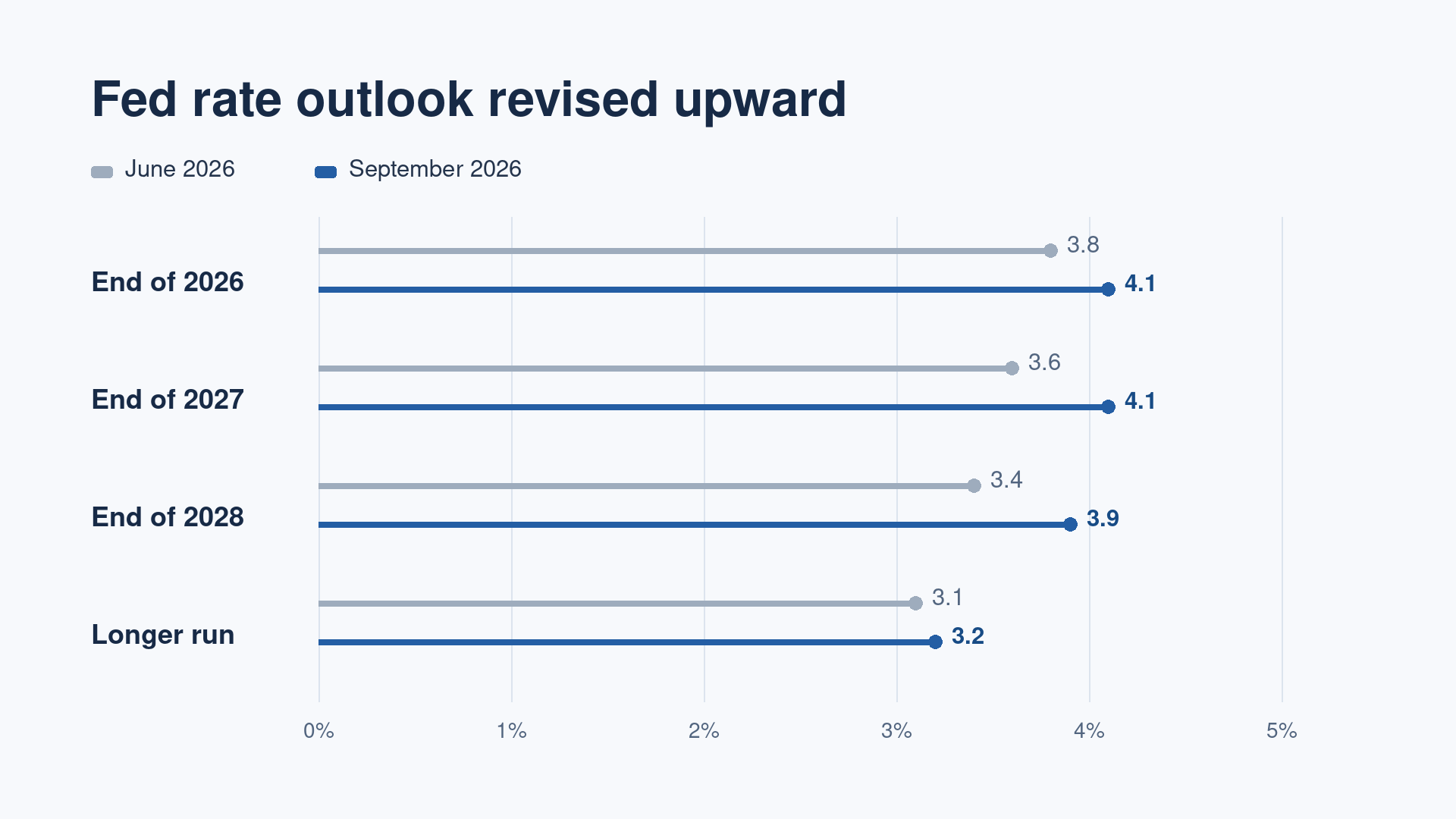
Median Fed policymakers' projections for the federal funds rate, comparing June and September 2026. Yearly figures are for year-end; “longer run” is a separate estimate. These projections can change and do not represent 10-year bond yields. Source: Federal Reserve, September 2026 Summary of Economic Projections.
A note on debt and long-term rates
Higher inflation has a curious effect on government debt. Suppose a government owes $100 on a fixed-rate bond. If prices rise 10%, it still owes $100, but that amount buys about 9% less than before. Unexpected inflation has made its existing debt easier to repay in real terms.
Inflation can reduce the real burden of yesterday's fixed-rate debt while raising the cost of tomorrow's borrowing.
As old bonds mature, governments must issue new ones at the rates investors demand. This matters to markets. The Fed sets a short-term rate, while longer-term bond yields also reflect where investors think rates and inflation are headed, plus the return they require for lending over many years. Those longer-term yields can stay elevated even if the Fed eventually cuts its policy rate.
For stocks, a higher long-term yield can reduce what investors are willing to pay today for profits expected years from now. Company earnings still matter enormously. The two forces often move at the same time.
What happens after the buildout?
In The Age of Autonomy, we wrote about how intelligent systems could change work across industries. The investment in AI infrastructure is a step toward that future. The more important question is what businesses do once those tools become widely available.
Consider a customer-service team that can resolve questions faster, a hospital that gives doctors more time with patients, or a manufacturer that spots a problem before producing a defective part. These are different uses of the same idea: more useful output from the same time, people and equipment.
We are beginning to see evidence on a smaller scale. In one large study, customer-support staff using an AI assistant resolved about 14% more issues per hour, on average. One workplace cannot tell us how fast an entire economy will change, but it shows how productivity gains can start.
The potential goes further than answering questions quickly:
·Fewer hours on routine work: Software can help draft, search, organize and check information, giving people more time for work that needs judgment and a human relationship.
·Less waste: Better inventory planning, delivery routes and equipment maintenance can save fuel, materials and time.
·Faster development: Teams can test designs and ideas sooner, reducing the cost of bringing a new product to market.
·More competition: As AI tools become cheaper and easier to use, smaller companies can take on work that once required a much larger organization.
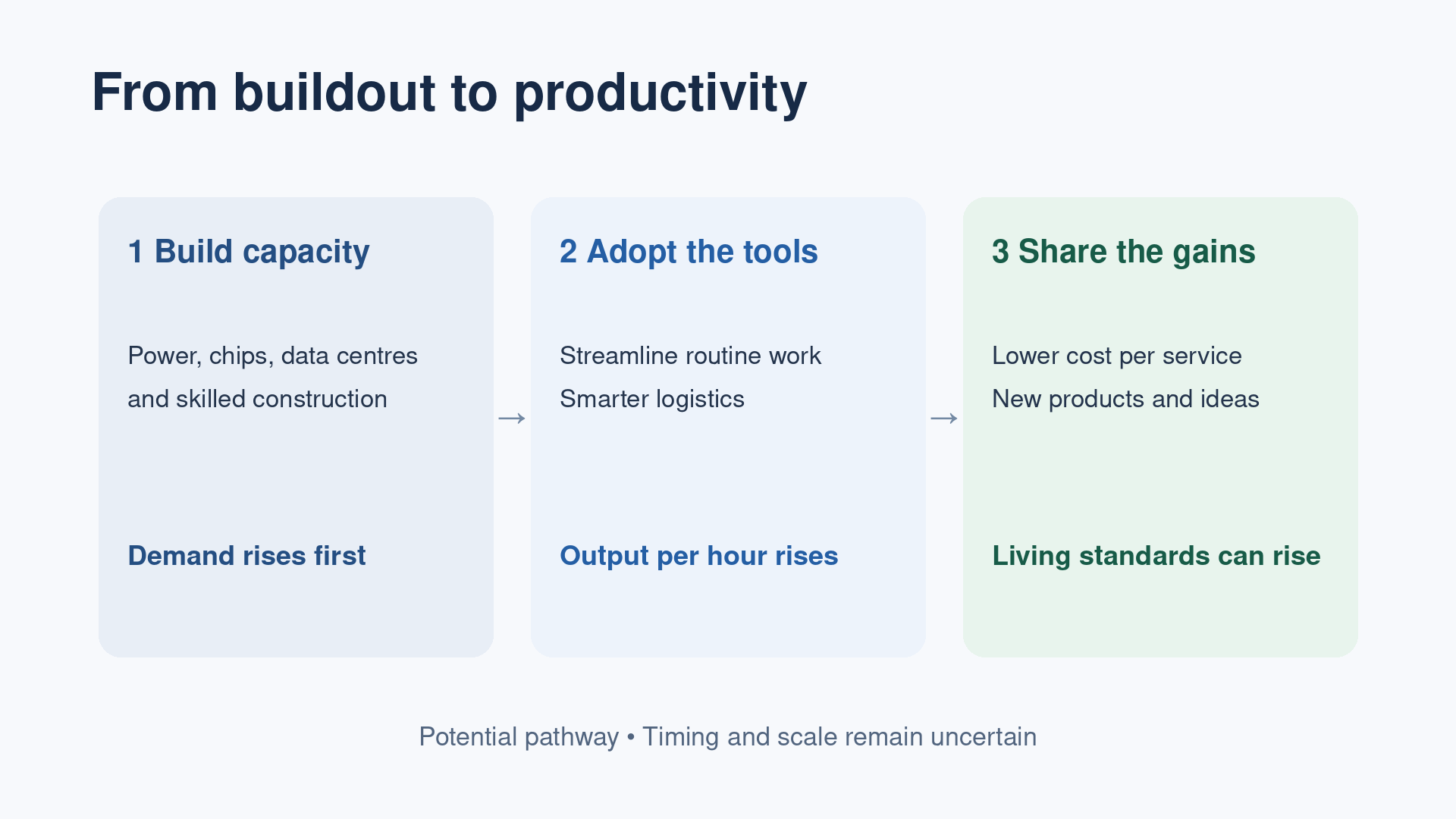
A possible path from capital spending to productivity gains. The timing and scale will depend on adoption.
Those savings can appear in different places. A company might charge less, improve its service, raise wages, invest more or earn a better margin. Competition will help determine who receives the benefit.
Across a broad economy, producing more without using proportionately more resources creates room for growth with less upward pressure on prices.
Economists call slower price increases disinflation. Some individual services may actually become cheaper. We do not need to assume economy-wide deflation to see a meaningful improvement in purchasing power.
Where we see the investment opportunity
So far, investors have focused heavily on the companies supplying chips, equipment and data centres. We believe the next phase can reach much further. Financial institutions, industrial businesses, healthcare companies and retailers all have processes that could improve as AI becomes more capable and affordable.
That fits our emphasis on U.S. equities, where we see a deep market of technology builders and businesses with the scale to put new tools to work. Our Canadian holdings can participate through energy, metals and infrastructure needed for the buildout, as well as Canadian businesses that improve their own productivity.
We still have to be thoughtful about price. A strong company may be a poor investment if its share price already assumes years of exceptional growth. Conversely, a company that quietly improves its costs and service may benefit without ever being labelled an AI stock. Long-term interest rates and currency movements will also affect returns along the way.
Our March post, What History Says About AI and Your Portfolio, looked at sharply different predictions about AI. We continue to favour the constructive view while letting evidence, company results and valuations guide our decisions.
Looking ahead
The near-term costs of building the AI economy are real. So is the opportunity on the other side: businesses doing more with less, new products becoming viable and households getting more value for their money.
We do not know when those benefits will become large enough to show up clearly in inflation data. We do believe productivity is one of the most powerful forces behind long-term growth, and that the opportunity for investors can spread well beyond today's most familiar AI names.
The buildout is getting the attention. The productivity gains may be the more important story.
Sources for editorial review
- Federal Reserve, September 16, 2026 FOMC statement
- Federal Reserve, September 2026 Summary of Economic Projections
- Bank of Canada, September 2026 Governing Council deliberations
- Bank of Canada, The rise in the Canadian term premium in a global context
- Bank of Canada, AI is knocking: Canada's next productivity story
- NBER, Generative AI at Work
- International Monetary Fund, Fiscal Policy Can Help Tame Inflation and Protect the Most Vulnerable
- Bank for International Settlements, The impact of artificial intelligence on output and inflation