Deep roots make strong trees

Portfolio Advisor
April 17, 2026
How diversification’s deep roots can help you weather any storm
When a fierce storm hits, it's not the tallest tree that survives – it's the one with the strongest, deepest roots. The same can be said of your investment portfolio. While market headlines focus on which investments or markets shot up or down, today – or this month or this year –the real strength of a successful portfolio lies in how well it can weather whatever storm comes next along the journey to reaching your goals.
Your diversified portfolio works like a tree's root system, spreading deep and wide to find stability in different conditions, in turn feeding that through and delivering “the fruits” of long-term growth, dividends, and interest that compound and multiply over time. In today's often volatile and challenging world, your portfolio’s strong roots matter more than ever.
Why your portfolio benefits from deep roots
Imagine a mighty oak tree. Its roots don't just grow straight down—they spread in all directions, seeking water and nutrients from many sources. If one area dries up, the tree can still thrive because it has other roots drawing from different places. This is exactly what diversification does for your investment portfolio.
Recent market data shows that a diversified, balanced portfolio returned 13.8% in 2025,¹ while experiencing much smaller drawdowns than more concentrated portfolios. And the magic isn't just in the returns – it's also in the smoother ride that keeps you on track to your goals and sleeping well at night.
In 2025, while global equity indices delivered outstanding returns,² many investors would have found the daily volatility exhausting and intolerable. Meanwhile, those with diversified portfolios enjoyed more moderate returns, but without the emotional roller coaster. Like a tree with deep roots, their portfolios weathered the ups and downs.
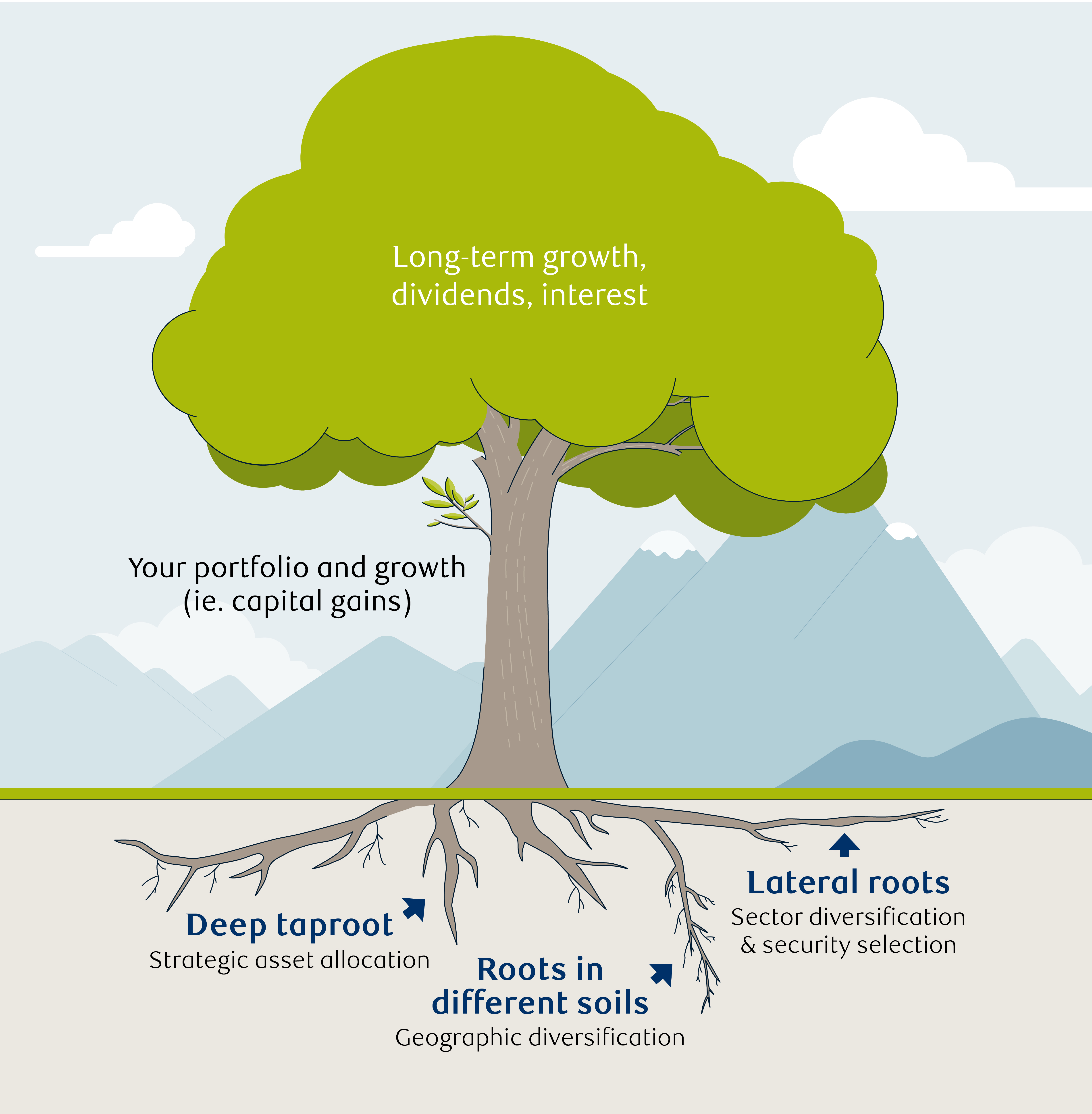
Root systems: the three types of roots to anchor your portfolio
Just as trees develop different types of roots that serve different purposes, your portfolio can leverage three distinct forms of diversification that work best together:
Strategic asset allocation: The deep taproot
Every strong tree has a central taproot that anchors it firmly in place and reaches deep for water during droughts. Your strategic asset allocation serves this same purpose. It's the fundamental decision about how much goes into stocks, bonds and other major categories of investments, and is driven by your risk profile established in partnership with your Investment Advisor.
As the inventor of modern portfolio theory, Harry Markowitz, once said, “Asset allocation is the only free lunch in investing.” Why? Because strategic asset allocation is considered to be one of the most critical factors driving a portfolio’s long-term return. According to the benchmark study published in 1986 by Brinson, Hood, Beebower,3 nearly 90% of portfolio return variation is driven by asset allocation.
Security selection: The branching lateral roots
Beneath any healthy tree, lateral roots spread outward in multiple directions, each seeking nutrients from different sources. Within each asset class, smart security selection creates this same spreading effect.
You wouldn't rely on a single root to feed an entire tree, and you don't have to build a stock portfolio with just one type of company, industry or sector. In 2025, geographic and sector diversification proved its value once again. While U.S. equities returned 12.4%, Canadian equities surged 31.7%, international equities gained 25.7%, and Emerging Markets delivered 28.1%.⁴ Investors with broader diversification across sectors like healthcare, utilities and manufacturing enjoyed steadier growth with less anxiety. Their lateral roots spread across multiple sectors and geographies, ensuring that if one area faced challenges, others continued providing nourishment to their portfolio.
Geographic diversification: Roots in different soils
A tree's roots don't recognize property boundaries – they spread wherever they can find good soil and water. Your investments doesn't have to stop at national borders either.
2025 returns tell a compelling story about geographic diversification. Again, while U.S. markets provided solid returns, international equities significantly outperformed, with Canadian equities leading, followed by Emerging Markets and international developed markets.⁵ This demonstrates the value of spreading roots into different geographic soils.
When geopolitical tensions create uncertainty in one region, portfolios with roots in different soils around the world often find stability elsewhere. If conditions dry up in one market, your roots in other geographic areas continue drawing strength from their local environments.
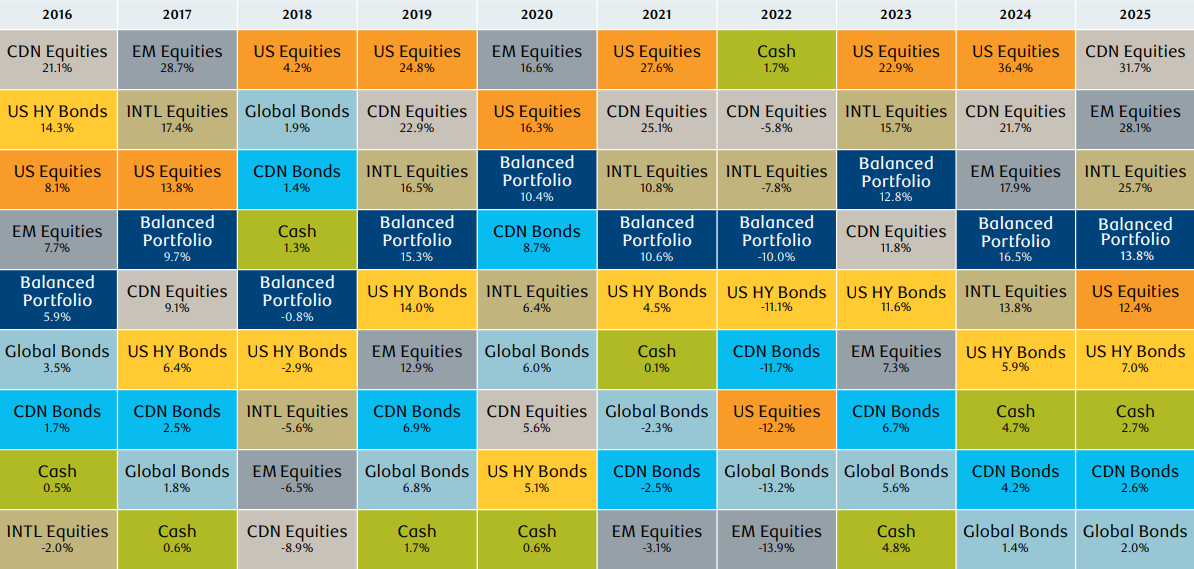
Source: RBC Global Asset Management, Morningstar Direct. Data as of December 31, 2025. Note: All returns are total returns and in Canadian dollars, unless otherwise noted. Balanced Portfolio represented by 2% Cash, 38% Fixed Income (Canadian bonds), 15% Canadian Equities, 25% U.S Equities, 15% International Equities, and 5% Emerging Market Equities. Definition of various asset classes as follows:

Weathering today's – and tomorrow’s – storms
Our current investment climate presents unique challenges that make diversification more important than ever:
- Market concentration risks: A handful of large technology companies have dominated recent returns (think the “Magnificent 7”, whose component companies – Alphabet, Apple, Amazon, Microsoft, Meta, Nvidia, Tesla – make up approximately 33% of the S&P 500 Index) creating concentration that feels uncomfortable for long-term investors.
- Geopolitical uncertainty: From ongoing conflicts to trade tensions, global events have kept the Geopolitical Risk Index at elevated levels throughout 2025 and into 2026,6 creating waves that can rock any single investment, market or region.
- Interest-rate transitions: After years of near-zero rates, we're learning to invest in a world where bonds pay meaningful income again, presenting opportunities to support the long-term investment goals of clients.
- Inflation concerns: While inflation has moderated, the concern about rising costs makes real and alternative assets valuable portfolio components.
Like a skilled gardener who plants different varieties knowing that some years favour certain species, many successful investors spread their roots across different types of investments that thrive in different conditions.
Growing stronger over time
The most powerful aspect of diversification is how it compounds over time. Each year your portfolio stays on track is another year closer to your goals. Each crisis you weather without falling prey to emotional responses to short-term market gyrations is another victory for your long-term financial success.
The investors who sleep best at night aren't necessarily those with the highest returns in any single year. They're often the ones whose portfolios are built like mighty trees – with deep, diversified roots that can find nourishment in any market environment, while standing bowing to but not breaking from the winds of volatility.
Just like caring for a tree requires periodic attention from an expert gardener or arborist, your diversified portfolio benefits from the regular attention of your Investment Advisor. Market conditions change, your personal circumstances evolve, and new opportunities emerge. Your Investment Advisor is there each step of your life to ensure you are getting the advice and expertise you need to smooth the journey to your goals.
Sources
1.RBC Global Asset Management. "Asset Class Diversification" (chart). December 31, 2025. Balanced Portfolio represented by 2% Cash, 38% Fixed Income (Canadian bonds), 15% Canadian Equities, 25% U.S. Equities, 15% International Equities, and 5% Emerging Market Equities.
2.RBC Global Asset Management. "Asset Class Diversification" (chart). December 31, 2025. S&P 500 Index total return in Canadian dollars.
3.Financial Analysts Journal, Vol. 42, No. 4: Brinson Et Al. (1986) - Determinants of Portfolio Performance | PDF | Active Management | Asset Allocation).
4.RBC Global Asset Management. "Asset Class Diversification." December 31, 2025. FTSE Canada Universe Bond Index and FTSE World Government Bond Index (CAD Hedged).
5.RBC Global Asset Management. "Asset Class Diversification." December 31, 2025. S&P/TSX Composite Index (31.7%), S&P 500 Index (12.4%), MSCI EAFE Index (25.7%), and MSCI Emerging Markets Index (28.1%).
6.Iacoviello, Matteo. "Geopolitical Risk Index." Federal Reserve Board, 2025.
This information is not investment advice and should be used only in conjunction with a discussion with your RBC Dominion Securities Inc. Investment Advisor. This will ensure that your own circumstances have been considered properly and that any action is taken based upon the latest available information. The strategies and advice in this report are provided for general guidance. Readers should consult their own Investment Advisor when planning to implement a strategy. Interest rates, market conditions, special offers, tax rulings, and other investment factors are subject to change. The information contained herein has been obtained from sources believed to be reliable at the time obtained but neither RBC Dominion Securities Inc. nor its employees, agents, or information suppliers can guarantee its accuracy or completeness. This report is not and under no circumstances is to be construed as an offer to sell or the solicitation of an offer to buy any securities. This report is furnished on the basis and understanding that neither RBC Dominion Securities Inc. nor its employees, agents, or information suppliers is to be under any responsibility or liability whatsoever in respect thereof. The inventories of RBC Dominion Securities Inc. may from time to time include securities mentioned herein.
This publication is for information purposes only. Graphs and charts are used for illustrative purposes only and do not reflect future values or changes. Past performance is not indicative of future returns.
RBC Dominion Securities Inc.* and Royal Bank of Canada are separate corporate entities which are affiliated. *Member-Canadian Investor Protection Fund. RBC Dominion Securities Inc. is a member company of RBC Wealth Management, a business segment of Royal Bank of Canada. ® / ™ Trademark(s) of Royal Bank of Canada. Used under licence. © RBC Dominion Securities Inc. 2026. All rights reserved.