Riding the bull

Portfolio Advisor
July 27, 2026
All-time highs and market ups and downs can make even steady investors feel nervous. But patience, your plan, and your Investment Advisor can help steer you through.
It’s understandable. Watching the market hit a new all-time high – and then another, and another – while also swinging up and down can feel…unsettling. Your instincts might be whispering (or shouting): "Get out now before things go sideways."
That’s one of the most common reactions in investing – and one of the most understandable. But the data and decades of market history show us that that instinct, while completely human, can lead to some of the costliest decisions an investor can make.
Why all-time highs are good news
When you hear "the market hit an all-time high today," it is easy to picture a balloon stretched to its breaking point. But markets do not work like that. New highs are not ceilings – they are milestones. They reflect a growing economy, rising corporate earnings, and investors pricing in a better future.
How common are all-time highs? Perhaps more than you might think. Since 1952, the S&P 500 Index has spent roughly 44% of all trading days within 5% of a record high.¹ In 2024 alone, the index hit 57 all-time highs.² In 2025, despite a sharp drop early in the year, it reached 37 more.²
In other words, all-time highs are not rare alarms. They are a normal part of a healthy and growing market.
What history tells us about returns from the top
Here is something that often surprises investors: buying when markets are at all-time highs has historically led to strong – and in some cases, above-average – returns.
Since 1989, the S&P 500 Index has delivered an average return of 13.5% in the year following an all-time high –higher than the 11.9% average return recorded on any other day.² Look even further out, and the picture gets more reassuring. In the 75 calendar years since 1950, the S&P 500 Index has never declined by more than 10% over a five-year period following an all-time high.³
Think about what that means: investors who stayed the course through previous all-time highs were rewarded for their patience. History suggests the same can be true today.
History may not repeat itself, but it sure seems to rhyme
Despite challenges along the way, markets have historically delivered for investors over time
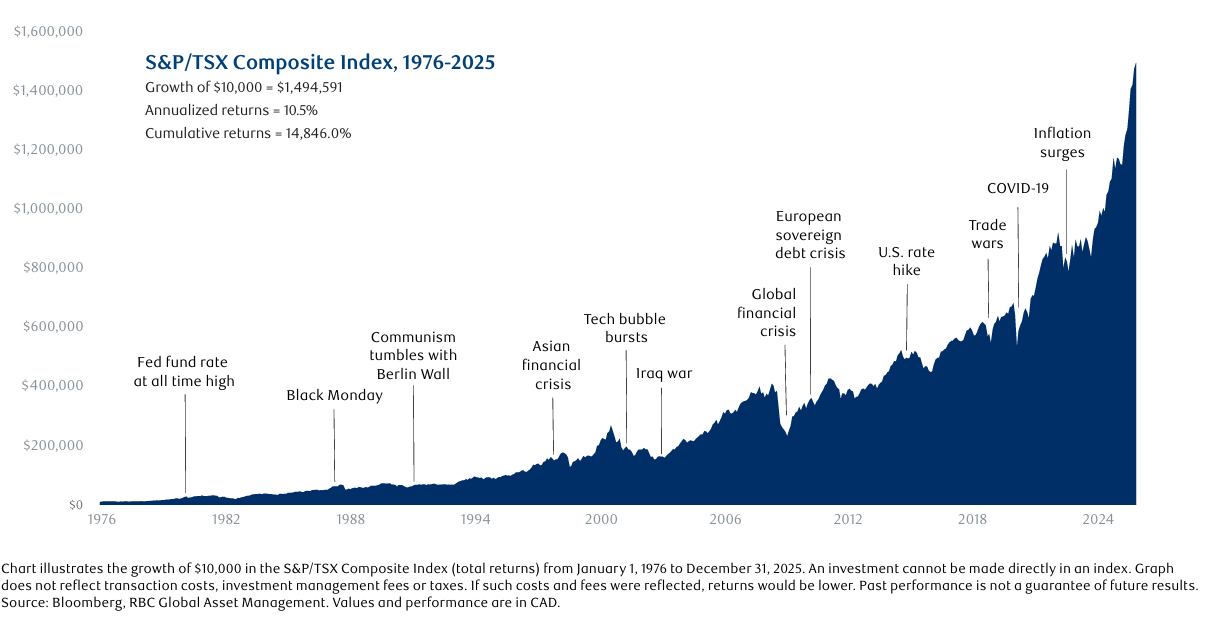
Source: RBC Global Asset Management (GAM)
The real cost of waiting on the sidelines
When markets feel rocky, the temptation to "wait it out" is strong. But trying to time the market – jumping out when things look scary and back in when they feel safer – has a well-documented cost.
The stock market's biggest gains tend to happen in short, unpredictable bursts. An investor who missed just the five best days in the S&P 500 since 1988 reduced their long-term gains by 38%⁴ – not five bad years, just five days. And over any 30-year stretch, missing the market's 10 best days would cut returns in half, while missing the 30 best days would reduce returns by 84%.⁵
Here is the catch: the best days and the worst days tend to happen close together. When markets fall sharply, the recovery often begins just days later. An investor who sells in a panic to "stop the bleeding" will likely be sitting on the sidelines when the market bounces back the hardest.6
We saw this play out in 2025. A fast, sharp market drop in the spring – driven by global trade uncertainty – pushed stocks down significantly. Yet within less than three months, the market had not only recovered but reached new all-time highs. Investors who stayed the course captured that entire rebound. Those who moved to the sidelines missed it.
Volatility is not the enemy – it is part of the deal
Here is something many experienced investors come to understand over time. Volatility is not a problem with the market. It is part of how markets work. And for patient, well-advised investors, it can create opportunity.
When prices dip, disciplined investors can buy high-quality investments at lower prices. When fear spikes, those who stay calm and focused can build long-term value. Volatility creates the conditions for some of the most powerful long-term gains – but only for those who are prepared and avoid letting short-term headlines drive their decisions.
This is where a solid investment plan – built with your Investment Advisor around your unique goals, timeline, and risk comfort – becomes your most important tool.
Your plan is your anchor
A sound investment plan rests on four time-tested pillars:
- Diversification: A well-diversified portfolio is built to absorb shocks. When one part of the market pulls back, other parts may hold steady or even rise – smoothing out the bumps along the way.
- Regular reviews with your Investment Advisor: Life changes, and so do markets. Regular check-ins ensure your plan stays aligned with where you are today and where you want to go tomorrow.
- Quality investments: Quality means not chasing trends or reacting to headlines. It means being invested in something built to last – through the highs and the lows.
- Patience: Patience is the discipline to let your plan do what it was designed to do. It is, perhaps, the most powerful tool in any investor's kit.
No plan is perfect, and no market is without uncertainty. But investors who stay invested, diversified, and connected to their advisor tend to reach their long-term goals far more often than those who try to navigate markets on instinct alone.
Going out on a high note
All-time highs can feel like a scary place to stand. But for a long-term investor, they are often just another step on a much longer journey. As history has shown, the market has always recovered from pullbacks, corrections, and even crashes and deep corrections.
If markets are making you feel anxious, or if you have questions about your portfolio or your plan, please reach out to your Investment Advisor.
Sources
- Cardinal Point Wealth Management. "Should I Buy Stocks at All-Time Highs?" Cardinal Point Wealth. February 29, 2024.
- Bilello, Charlie. "7 Lessons from 2025." Bilello Blog. 2025
- RBC Global Asset Management. "Investing at All-Time Highs." RBC GAM. August 2025.
- Fidelity Investments. "3 Reasons to Stay Invested." Fidelity Learning Center. December 31, 2025
- RBC Global Asset Management. "Time in the market vs timing the market ." RBC GAM.
- RBC Dominion Securities. “Equity volatility clusters.” RBC Wealth Management.
This information is not investment advice and should be used only in conjunction with a discussion with your RBC Dominion Securities Inc. Investment Advisor. This will ensure that your own circumstances have been considered properly and that any action is taken based upon the latest available information. The strategies and advice in this report are provided for general guidance. Readers should consult their own Investment Advisor when planning to implement a strategy. Interest rates, market conditions, special offers, tax rulings, and other investment factors are subject to change. The information contained herein has been obtained from sources believed to be reliable at the time obtained but neither RBC Dominion Securities Inc. nor its employees, agents, or information suppliers can guarantee its accuracy or completeness. This report is not and under no circumstances is to be construed as an offer to sell or the solicitation of an offer to buy any securities. This report is furnished on the basis and understanding that neither RBC Dominion Securities Inc. nor its employees, agents, or information suppliers is to be under any responsibility or liability whatsoever in respect thereof. The inventories of RBC Dominion Securities Inc. may from time to time include securities mentioned herein.
The content in this article is for information purposes only and does not constitute tax or legal advice. It is imperative that you obtain professional advice from qualified tax and legal advisors before acting on any of the information in this article. This will ensure that your own circumstances are properly considered and that action is taken based on the most current legislation.
RBC Dominion Securities Inc.* and Royal Bank of Canada are separate corporate entities which are affiliated. *Member-Canadian Investor Protection Fund. RBC Dominion Securities Inc. is a member company of RBC Wealth Management, a business segment of Royal Bank of Canada. ® / ™ Trademark(s) of Royal Bank of Canada. Used under licence. © RBC Dominion Securities Inc. 2026. All rights reserved.