
Christos Farfaras
Senior Portfolio Manager & Investment Advisor
September 1, 2026
Most people picture a number, $1 million, maybe $2 million, and treat it as the finish line for retirement. The problem is that number rarely comes from anything specific to their life. It's borrowed from a headline, a rule of thumb, or a coworker's guess. For a couple with a paid-off home in Kingston, that number might be far more than they need. For a business owner with no pension and a long list of dependents, it might be dangerously low.
The Core Question: What Does "Comfortable" Actually Cost?
"Comfortable" is doing a lot of work in that sentence, and it means something different depending on who's asking. For most Canadians, comfortable retirement income means being able to maintain roughly 70% to 80% of pre-retirement income once the mortgage is gone and payroll deductions stop. That range is the industry's working assumption, not a guarantee, someone with expensive hobbies, adult children they support, or a second property has a different equation entirely.
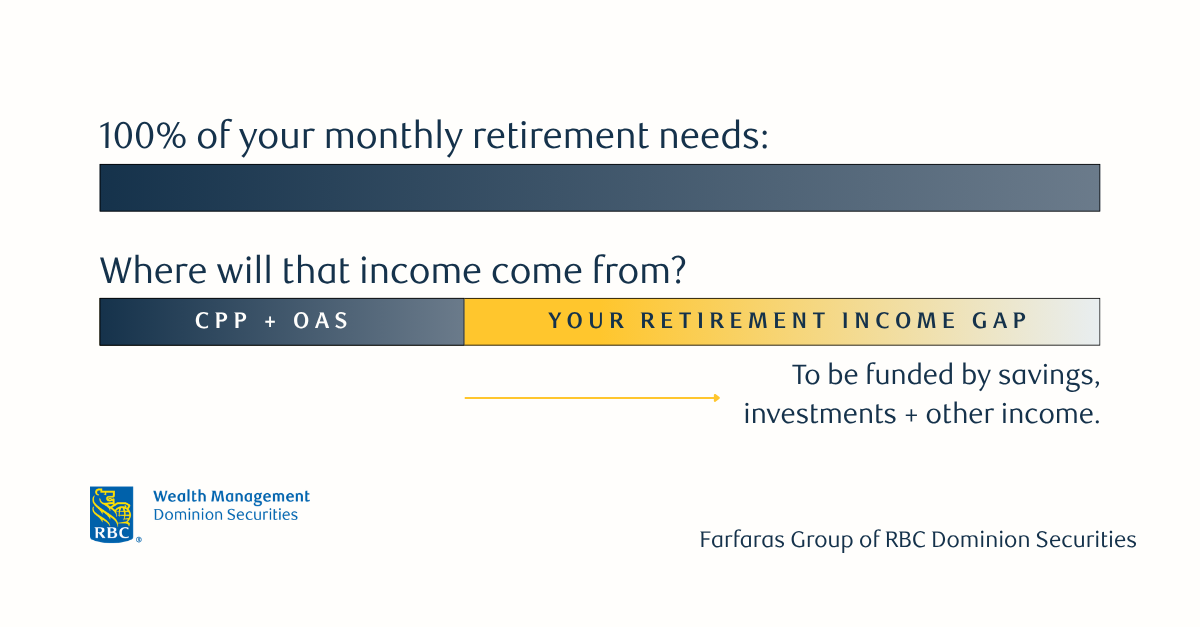
The gap between what people assume and what government programs actually pay is where most retirement plans go wrong. In 2026, the maximum monthly Canada Pension Plan retirement benefit at age 65 is $1,507.65 but that figure is reserved for the small number of contributors who earned at or above the year's maximum pensionable earnings for nearly four decades. The average new CPP recipient collects closer to $925 a month. Add Old Age Security, which tops out around $752 a month for someone aged 65 to 74 (rising automatically by 10% at age 75), and even a household drawing the maximum from both programs is looking at roughly $2,250 to $2,700 a month combined, before tax. For most retirees, that's a floor, not a plan.
There's also a ceiling worth knowing about if your income runs higher. OAS is subject to a recovery tax, often called the clawback, that begins reducing your pension once net income crosses roughly $95,000, and eliminates it entirely somewhere past $155,000. For business owners and high-earning professionals, that threshold isn't a rounding error; it's a planning variable that affects how and when you draw income in retirement.
The Technical Breakdown
Start with your income replacement target, not a lump sum
The lump-sum obsession, "I need $1.8 million", skips the step that actually matters: what income does that number need to produce? A more useful starting point is your target annual spending in retirement, worked backward from your current expenses minus what disappears (mortgage, CPP/EI premiums, retirement savings contributions) plus what appears (travel, health care, more free time to spend money). Once you have that number, the account balance follows, it doesn't lead.
The 4% guideline, and why it's a starting point, not gospel
A commonly cited rule of thumb suggests that withdrawing about 4% of a portfolio's value in the first year of retirement, then adjusting for inflation annually, gives a reasonably high probability the money lasts 30 years. Under that framework, a $1 million portfolio might support roughly $40,000 a year before other income sources are layered on. But the 4% guideline was built on historical U.S. market returns over specific time periods — it doesn't account for sequence-of-returns risk early in retirement, the tax drag of RRSP/RRIF withdrawals, or a retirement that runs 35+ years instead of 30. It's a useful sanity check, not a formula to build a plan around.
Registered accounts and the room you're not using
Tax-advantaged room resets every year, and unused room doesn't expire, which means most people are sitting on more retirement runway than they realize. For 2026, the RRSP contribution limit is $33,810 (or 18% of the prior year's earned income, whichever is lower), and the TFSA annual limit is $7,000, bringing cumulative TFSA room since 2009 to $109,000 for anyone who has never contributed. The strategic question isn't just "how much can I put in", it's which account absorbs the next dollar most efficiently, given your current tax bracket versus your expected bracket in retirement.
For Business Owners
If your retirement income has historically come from the business itself through dividends, a sale, or an eventual wind-down, the math above changes in an important way: you likely don't have decades of CPP contributions built on a T4 salary, and you may not have an employer pension at all. That makes your RRSP, TFSA, and corporate investment account carry more of the load, and it makes the eventual sale or transition of the business a de facto retirement event rather than a side project.
It's also worth revisiting how compensation is structured in the years leading up to retirement. Salary versus dividends affects RRSP contribution room (dividends don't generate any), CPP contribution history, and the personal versus corporate tax picture on the way out. Business owners who plan this five to ten years ahead of retirement, rather than the year before, tend to have meaningfully more flexibility in how and when they draw income, and in what the eventual sale or succession looks like on an after-tax basis.
What This Means for You
The honest answer to "how much do I need" is that nobody can give you a real number without knowing your spending, your health outlook, your family situation, and what other income sources, a pension, a rental property, a business sale, are already part of the picture. What the math above should give you instead is a framework: know your realistic government benefit floor, know roughly what withdrawal rate your portfolio can sustain, and know which accounts you're using efficiently versus leaving on the table.
Where this tends to go wrong isn't the math, it's the timing. Decisions about when to start CPP, how to sequence withdrawals across registered and non-registered accounts, and how to manage the OAS clawback are far easier to get right when they're made five or ten years out, with room to adjust, than when they're made the year you actually retire.

A Few Questions Worth Sitting With
- If your CPP and OAS only cover part of your monthly expenses, where is the rest of your income actually going to come from, and have you tested that plan against a longer-than-expected retirement?
- Are you contributing to your RRSP and TFSA in the order that makes sense for your current and future tax brackets, or just splitting contributions evenly out of habit?
- If your income (or your business's value) puts you near the OAS clawback threshold, do you have a withdrawal strategy that accounts for it, or will you find out the hard way at tax time?
If these questions raise more than they answer, that's exactly the conversation we're here to have. Reach out to the Farfaras Group to discuss your specific situation.
Christos
Christos Farfaras, CIM
Senior Portfolio Manager & Investment Advisor
T. 514-840-1418 | C. +1-263-770-7185 christos.farfaras@rbc.com | www.christosfarfaras.com
Farfaras Group of RBC Dominion Securities Inc.
1501 avenue McGill College, Suite 2150,
Montreal, QC H3A 3M8
This article is for general educational purposes and does not constitute personalized financial, tax, or legal advice. CPP, OAS, RRSP, and TFSA figures reflect 2026 government rates and limits, which are reviewed and adjusted periodically by the CRA and Service Canada. Speak with an advisor about how these figures apply to your specific circumstances.
This information is not investment advice and should be used only in conjunction with a discussion with your RBC Dominion Securities Inc. Investment Advisor. This will ensure that your own circumstances have been considered properly and that action is taken on the latest available information. The information contained herein has been obtained from sources believed to be reliable at the time obtained but neither RBC Dominion Securities Inc. nor its employees, agents, or information suppliers can guarantee its accuracy or completeness. This report is not and under no circumstances is to be construed as an offer to sell or the solicitation of an offer to buy any securities. This report is furnished on the basis and understanding that neither RBC Dominion Securities Inc. nor its employees, agents, or information suppliers is to be under any responsibility or liability whatsoever in respect thereof. The inventories of RBC Dominion Securities Inc. may from time to time include securities mentioned herein. RBC Dominion Securities Inc.* and Royal Bank of Canada are separate corporate entities which are affiliated. *Member-Canadian Investor Protection Fund. RBC Dominion Securities Inc. is a member company of RBC Wealth Management, a business segment of Royal Bank of Canada. ® / TM Trademark(s) of Royal Bank of Canada. Used under licence. © 2026 RBC Dominion Securities Inc. All rights reserved.