Kevin Deckert, CFA
Portfolio Analyst, RBC GAM
September 1, 2026
On August 22, the U.S. imposed 50% tariffs on $20 billion of Canadian goods after trade talks collapsed the day before. Canadian retaliation covering a similar dollar value begins September 8. You might be watching the news, wondering: "What does this mean for my portfolio?"
Here’s the context most are likely looking for:
- How tariffs theoretically impact markets.
- Why actual market performance often tells a very different story.
1: From tariffs to markets
As you know, a tariff is a tax on imported goods, leading to higher prices, supply chain disruptions, and reduced product selection. When countries retaliate with counter-tariffs, the damage is usually worse.
Tariffs raise business costs. For example, when a 50% tariff hits Canadian steel or auto parts, manufacturers must either absorb higher costs (squeezing margins) or pass them to consumers (raising prices and risking lost sales). Either way, profitability suffers and earnings compress.
Reduced economic activity amplifies the impact. Tariffs function as a consumption tax, weakening consumer spending and corporate revenues. Retaliation means exporters lose market access on both sides. So, in theory:
Rising costs → compressed margins → lower earnings → reduced GDP growth → declining valuations
2: What's actually happening in markets
While the framework above explains how tariffs should impact equities, actual market developments suggest other factors are far more influential.
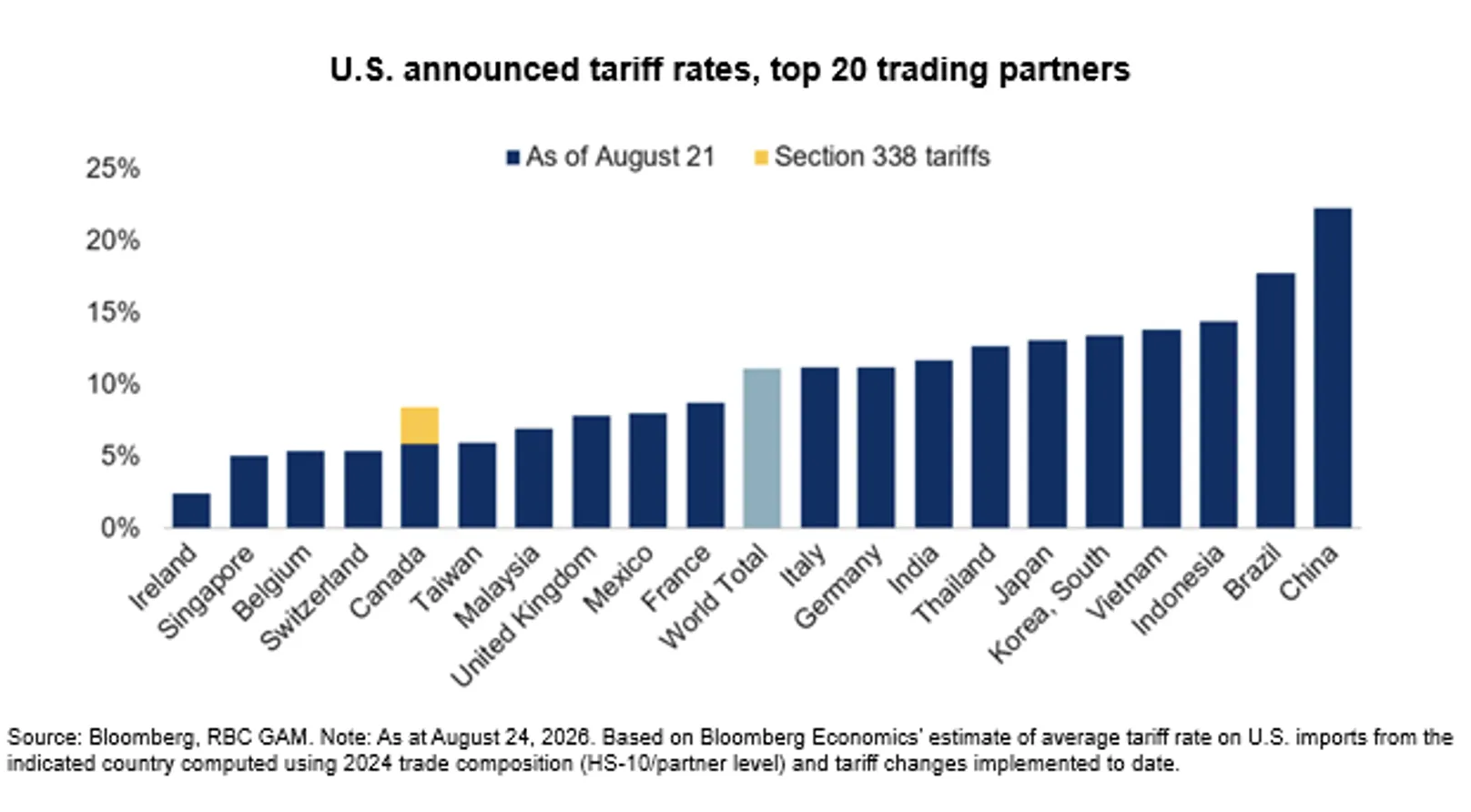
The tariff impact is surprisingly modest. Overall, about 5% of Canada’s exports to the U.S. are impacted under Section 338. At a 50% rate, that adds 2.5 percentage points to the effective tariff rate on imports from Canada. Canada previously had one of the lowest announced tariff rates among major U.S. trading partners. Although it’s now slightly higher than Mexico’s, it’s still below the weighted average. It's worth noting that we don’t expect this rate to rise by the full 2.5 percentage points, as imports of products targeted by new tariffs are likely to decline. Additionally, the federal government has announced C$7.5 billion in support measures, including enhanced employment insurance and business liquidity support, which will help cushion the blow for affected workers and companies.
The stock market isn't the economy. This distinction is critical for Canadian investors. The TSX actually rose around 3% in August, hitting record highs even after talks collapsed. This is due to the unique composition of the Canadian stock market. Roughly two-thirds of the TSX is comprised of financials, energy, and materials. Oil prices rallied in August, driven by ongoing geopolitical tensions in the Middle East, while gold rallied close to double-digits as weaker U.S. labour market data and geopolitical uncertainty supported safe-haven demand. These commodity gains, benefiting the energy and materials sectors that heavily weight the index, cushioned any tariff effects. Overall, American automakers and small and mid-size Canadian companies are hurt most by these tariffs, which simply aren't heavily represented in the TSX.
So, while real economic damage is occurring in trade-exposed sectors, those impacts don't show up prominently in Canada's benchmark equity index.
Key take-aways
A prolonged trade war would inevitably be a lose-lose for both sides. While it’s uncertain if these escalations will be sustained for an extended period, we can’t dismiss the risk of temporary disruptions. Our research team's working assumption is that these tariffs will remain in place short-term before both sides reach a resolution, as both countries have strong economic incentives to de-escalate.
While these new tariffs signal a downside risk to Canada's economy, it's important to focus on what's actually moving markets, not just headlines. Distinguish short-term volatility from long-term fundamentals. While trade tensions generate noise, the performance of the TSX in August despite escalating trade tensions demonstrates that markets weigh multiple factors simultaneously.
For most, the appropriate response remains a long-term focus, ensuring adequate diversification across sectors and geographies, and staying patient while both tariff dynamics and more influential factors continue to unfold.