Josh Nye
Senior Economist, RBC Global Asset Management Inc.
May 12, 2026
Having switched to a fall budgeting schedule, the federal government released its first spring economic update in April. It turned out to be more of a fiscal update than a mini budget with relatively few new policy announcements. Positive “economic and fiscal developments” – most significantly stronger income tax revenue assumptions – let the government increase spending while leaving future deficit forecasts little changed. Last year’s budget shortfall even came in $11 billion smaller than projected.
The update included $33 billion in net new spending over the next 5 years alongside another $16 billion in measures announced since the fall budget. That includes a $12 billion groceries and essentials benefit announced earlier this year and $2.4 billion to temporarily suspend the federal fuel excise tax. This tax relief will lower gasoline prices by $0.10/L until Labour Day.
The government’s capital investment plan was little changed. It continues to show a significant pickup in public CapEx this year (an incremental $20 billion on a cash basis).
One initiative that didn’t impact the deficit projections but still drew plenty of attention was the announcement of a sovereign wealth fund called the Canada Strong Fund. Here are some of the initial details:
- The fund will receive an initial endowment of $25 billion over 3 years on a cash basis (but considered an equity investment for budgeting purposes). This will grow as returns are reinvested and as the government potentially allocates other assets to the fund.
- The fund will operate at arms-length from the government and participate alongside other investors on a commercial basis. It will focus primarily on equity investments in strategic Canadian projects and companies with a mandate to deliver market-rate returns.
- The fund will focus on complementing efforts where the government is active through federal agencies and Crown corporations, including the Major Projects Office and Building Canada Act. These aim to accelerate the approval and development of nationally important projects.
- Beyond $25 billion in taxpayer money (or money borrowed on behalf of taxpayers) being used to seed the fund, Canadians will be able to directly participate through a new, retail investment product. Details are still being worked out, but the government claims “investors will be able to share in the upside, while their initial invested capital will be protected.”
The Canada Strong Fund differs from many of the world’s largest sovereign wealth funds (see chart below). These typically invest surplus revenues from natural resources (Norway’s GPFP and a number of Middle Eastern funds) or accumulated foreign exchange reserves (several Asian funds). These funds largely invest outside their home countries given limited domestic investment opportunities relative to the size of the funds, efforts to diversify their exposure, or to prevent domestic currency appreciation by holding foreign assets. For example, Norway’s GPFG invests just 2% of its assets in Nordic markets.
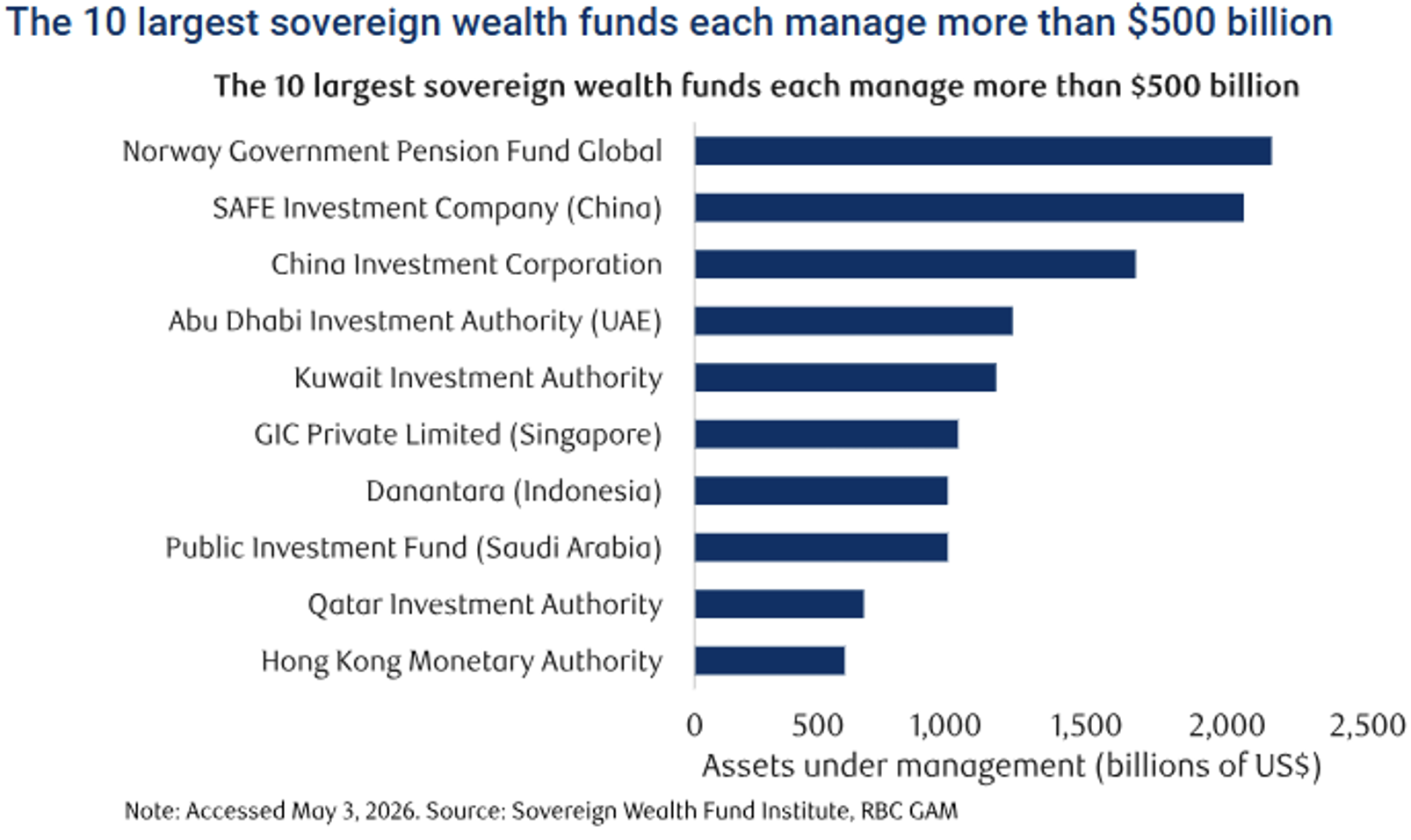
Much of Canada’s resource revenue accrues to provincial governments. Several provinces have their own wealth funds – most significantly Alberta’s Heritage Savings Trust Fund, which was set up with an initial investment of $1.5 billion in 1974 and now manages more than $30 billion. Despite Alberta’s greater oil production, that’s just a fraction of the size of Norway’s sovereign wealth fund (set up in 1990). The province has prioritized returning resource revenue to taxpayers via low income-taxes and no sales tax.
The federal government collects some royalties from offshore projects and corporate income tax from resource companies. However, it has run budget deficits for the past decade and thus doesn’t have any surplus revenue to invest. It has some $800 billion in financial assets (including taxes receivable, foreign exchange reserves and loans to Crown corporations). It also has more than $100 billion in non-financial assets. Some of the latter, including airports, may potentially be monetized to fund the Canada Strong Fund.
Canada has major institutional investors in the Maple 8 pension funds which manage combined assets worth more than $2 trillion, although they have diversified significantly in recent years and now invest roughly three-quarters of their assets outside the country. The Caisse de dépôt et placement du Québec (CDPQ) has a dual mandate to optimize returns and contribute to Quebec’s economic development. It aims to reach $100 billion in investments in the province this year. But that still falls well short of the Canada Strong Fund’s proposed domestic concentration (the CDPQ’s total assets amount to more than $500 billion).