
Kevin Deckert, CFA
Portfolio Analyst, RBC GAM
May 26, 2026
By now, you've likely heard it from clients, friends, or media: 'Just buy the index; it's cheaper and performs just as well.' While index-tracking strategies have delivered strong results more recently, the assumption that 'cheaper is always better' deserves scrutiny, especially as market conditions evolve.
Why indexing has done well more recently
Index-tracking strategies have benefited enormously from a near-perfect environment: an extended bull market, minimal stock dispersion, and concentrated leadership from mega-cap technology companies. When markets move in one direction with the winners clearly defined, tracking an index works exceptionally well.
But markets don’t stay static. We’re now seeing increased volatility, rising dispersion across sectors, regions, and names, and a potential transition away from the concentrated leadership that defined the past decade. Selectivity and active positioning matter in environments like these, as index-tracking strategies simply follow the crowd.
Two real-time risks
Today’s market presents specific challenges that magnify the inherent limitations of index-tracking strategies:
- Concentration risk:
Some pockets of the market have become heavily concentrated. Within the S&P 500, ten companies now comprise over a third of its value.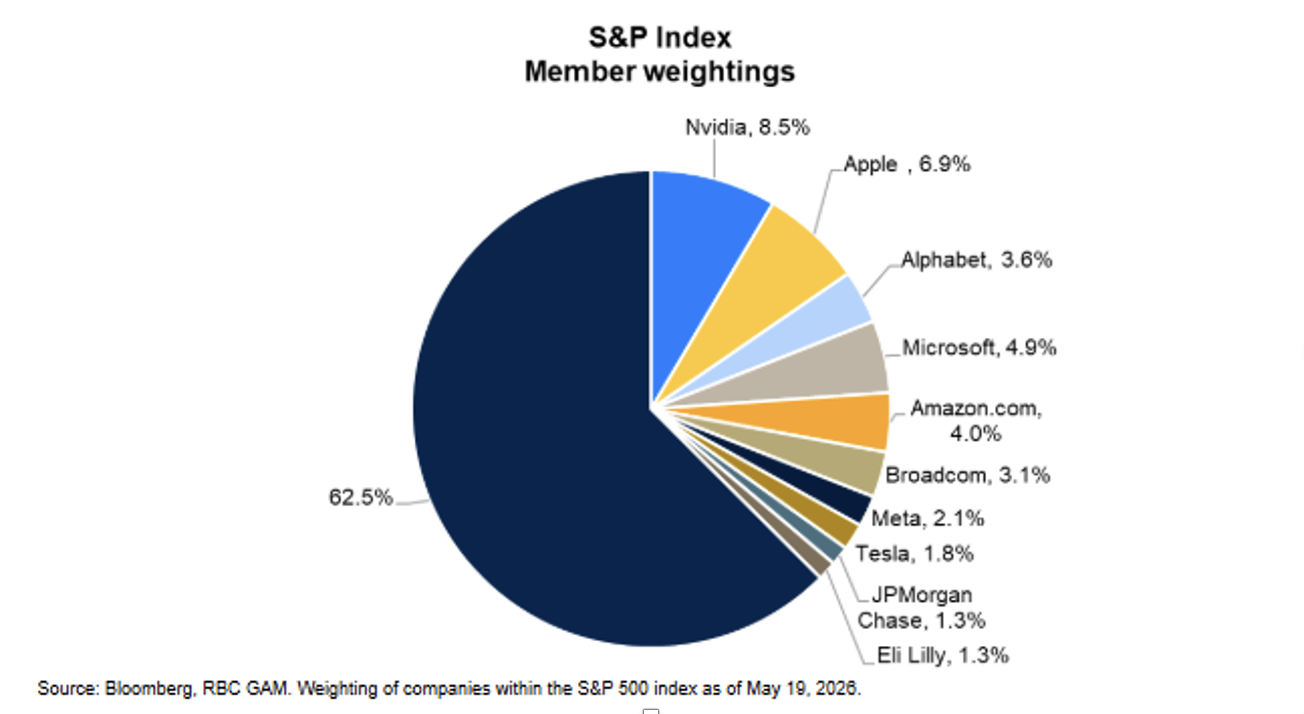
- Valuation risk:
Index-tracking strategies have no valuation discipline—they buy regardless of price. As a company’s index weight increases, index funds must purchase more shares, even when valuations reach excessive levels. This is an important consideration when we look at valuations of the S&P 500 with and without the Magnificent 7 stocks: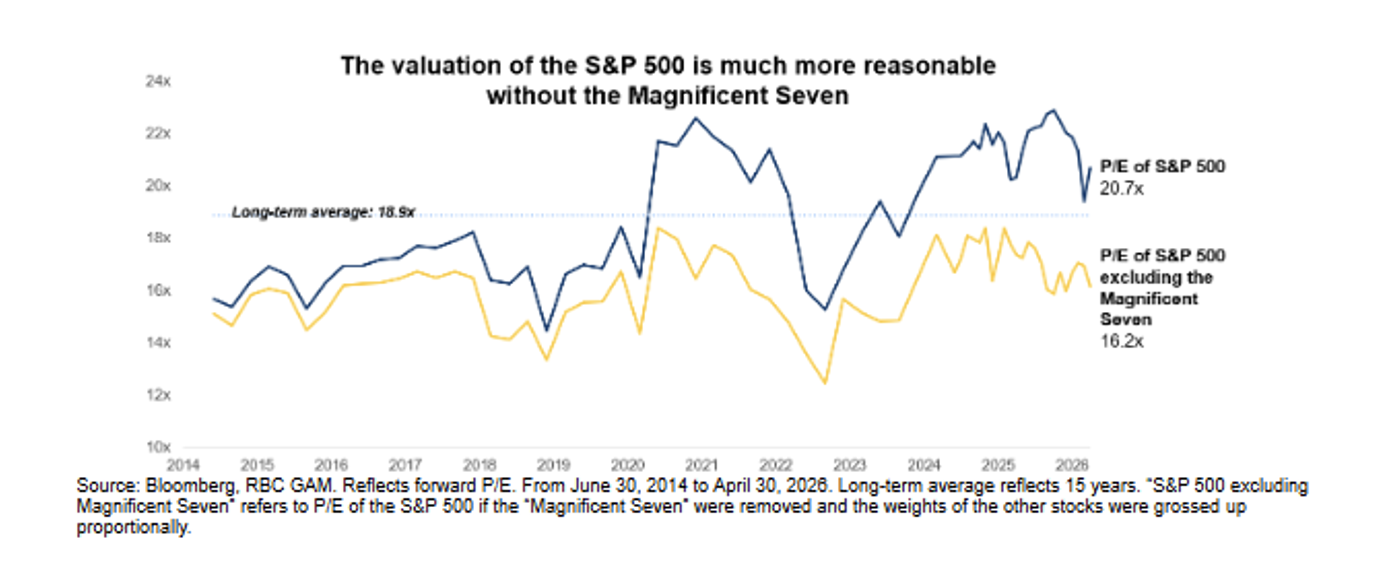
Index-tracking strategies have no mechanism to reassess or reduce exposure to expensive companies. Active managers, by contrast, can recognize when valuations have disconnected from fundamentals and adjust accordingly.
When active management proves its worth
Active management isn’t just about outperformance in the best of times; it’s about protection and adaptability when conditions shift. Current market dynamics like higher dispersion, sector rotation, and evolving economic backdrops create precisely the environment where active strategies historically excel.
Active management provides a range of benefits:
- Behavioural advantage: Active management removes emotion from the equation. When investors panic, disciplined professionals make rational, research-driven decisions—protecting clients from their own worst instincts.
- Risk management: Active managers can reduce exposure to overvalued areas, avoid concentration risk, and position portfolios defensively when warranted.
- Adaptability: Market leadership changes. Economic cycles turn. Active managers can pivot.
Both index-tracking and active strategies have their place, however, as market conditions evolve and complexity increases, the notion that 'cheaper is always better' becomes dangerously simplistic.
Active management’s value proposition is about expertise, discipline, risk management, and adaptability. And right now, as market dynamics shift, active strategies are particularly well-positioned to demonstrate their worth.