
Kevin Deckert, CFA
Portfolio Analyst, RBC GAM
September 22, 2026
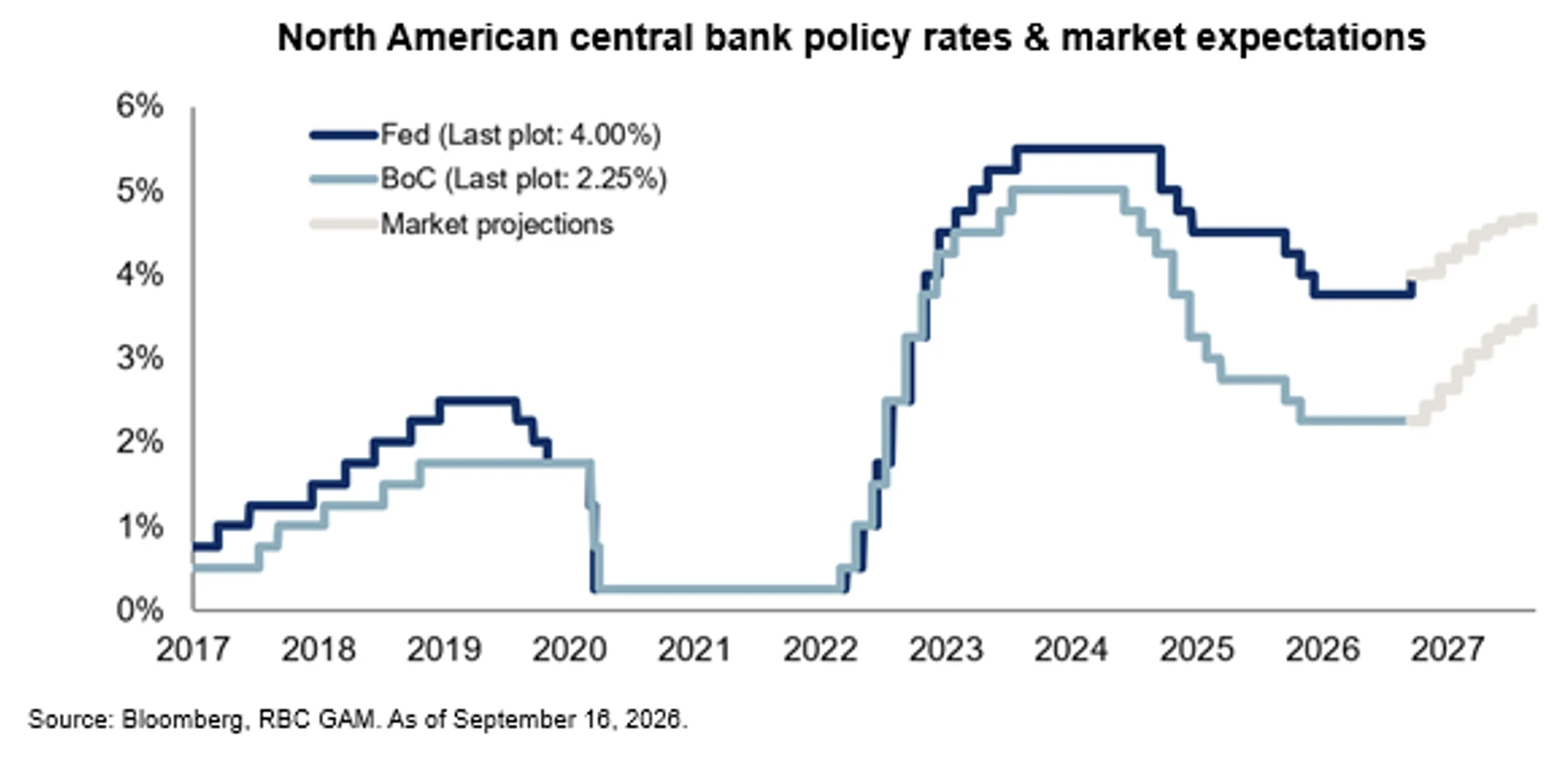
On September 16, the Federal Reserve (Fed) raised its target rate range by 25 basis points to 3.75%-4.00%. This marks its first hike in over three years. With the majority of Fed officials signaling at least one more rate increase this year, it appears we're officially entering a new era of U.S. interest rate policy. Meanwhile, the Bank of Canada (BoC) has held its key policy interest rate steady at 2.25% for nearly a year. This widening rate differential between the U.S. and Canada reshapes portfolio decisions across bonds, equities, and currency exposure.
Why a hike?
August U.S. inflation data came in hotter than expected, and with the Fed's dual mandate of maximizing employment and price stability, a rate hike was warranted. Numerous factors such as war-related disruptions, tariffs, and booming AI investment have kept inflation above the Fed's 2% target for over five years. Interest rates remain a blunt instrument - getting the balance exactly right between controlling inflation and supporting growth is harder than it sounds. But with markets pricing in over a 90% probability of a hike, this latest move helped preserve Fed credibility and demonstrated Fed independence from the White House.
Market response
After last week’s announcement, shorter-term bond yields jumped immediately. Two-year Treasuries climbed to 4.74% - the highest since 2024 - as traders priced in additional hikes. Importantly, inflation expectations actually tempered, suggesting investors have greater confidence that the Fed can get on top of price pressures.
But as we discussed in a previous note, the long end of the yield curve isn't just being driven by inflation expectations. Massive government deficits combined with hyperscaler borrowing have created intense competition for capital, pushing long-term rates higher through supply-demand dynamics.
Impact to Canada
Earlier this month, the Bank of Canada (BoC) held its overnight rate steady at 2.25%, creating a 150+ basis point spread with the Fed. This differential matters for three reasons:
- Currency flows: Capital gravitates toward higher-yielding U.S. assets, typically strengthening the USD against the CAD.
- Housing divergence: Canadian mortgages renew every five years, unlike 30-year fixed U.S. mortgages. This means Canadian homeowners face greater refinancing risk as rates rise. Variable-rate holders have stability now at 2.25%, but fixed-rate renewals are getting more expensive as bond yields climb.
- BoC pressure: With Canadian headline inflation ticking toward 3% and the Fed hiking, pressure builds on the BoC to potentially follow, particularly if the CAD weakens or inflation accelerates from more expensive imports. However, the Canadian labour market is much cooler compared to the U.S.
Investors are intently awaiting the BoC's next rate decision scheduled for October 28, with markets currently expecting at least one hike by the end of the year.
Portfolio implications
At 5% on 10-year Treasuries, bonds are offering attractive income that enhances portfolio diversification. The question for investors: is future dividend growth from stocks worth accepting lower income today compared to bond yields? At current levels, bonds provide meaningful alternatives for the first time in years.
On the equity side, market leadership remains narrow - the S&P 500 sits near highs, but returns are concentrated in select names. Beneath the surface, an increasing number of stocks are hitting multi-week lows, and rate-sensitive sectors like housing have notably underperformed. This selectivity reinforces the importance of quality and diversification rather than broad market exposure.
Looking forward
Uncertainty definitely lingers over the near term if we think about upcoming elections, questions about AI investment sustainability, elevated energy prices, and bond market tension. But there's a lot to be optimistic about over the medium-term:
- If AI hyperscaler business plans succeed, they transition from borrowers to self-funders by 2028-29, removing a major source of capital competition and easing long-term rates.
- AI productivity gains should continue flowing through to corporate earnings across industries.
- Elevated energy prices should moderate - either as geopolitical conflicts resolve and supply improves, or as persistently high costs ease demand.
- Overall, the medium to long-term outlook includes legitimate reasons for optimism that eclipse near-term investor concerns.
Final thoughts
Central banks are transitioning to a more normalized rate environment after years of extraordinary easing. This shift brings renewed opportunities: bonds offer meaningful income again, diversification across asset classes matters more, and the Canada-U.S. rate differential creates tactical advantages for well-positioned portfolios.
This environment enhances planning flexibility - higher yields support retirement income strategies, and managed portfolios can generate returns from multiple sources rather than heavily relying on equity appreciation. Ensure risk levels still align with you goals and financial plan assumptions reflect current realities. While near-term volatility persists, higher rates restore balance to portfolio construction and provide income options that enhance financial planning flexibility.