
Kevin Deckert, CFA
Portfolio Analyst, RBC GAM
August 25, 2026
Have you ever had a friend message you, "Just cashed out 800% on that penny stock I told you about!"? Or maybe it's a family member who always talks about their massive crypto gains. Or perhaps it's a colleague who brags about their heavy tech stock portfolio. Now, you're staring at your diversified portfolio wondering: "Am I the only one not getting rich fast?"
But when you hear these get-rich-quick stories, is their overall investment strategy really crushing it? Or are you just hearing a selectively curated highlight reel?
The stories you're not hearing
Triple-digit stock returns in mere months. These stories spark daydreams of early retirement and financial freedom.
But there's usually much more below the surface to consider. In fact, studies show that we're hardwired to broadcast our wins and bury our losses.
Consider what happens inside every investor's mind:
- We rewrite our own history: Investors don't just forget their losses. They actively rewrite them. Research reveals that on average, individuals remember 23% more gains and 10% fewer losses than actually occurred in their portfolios. Your brain suppresses negative financial outcomes to protect your self-image about your investment choices.
- We inflate our winners: A behavioural study analyzed thousands of real brokerage accounts and uncovered that investors routinely remember trades as being roughly 8 percentage points more profitable than reality. Worse, they completely erase losing stocks from their mental records. This distortion fuels overconfidence and drives excessive, risky trading.
- We credit skill, blame luck: When an investment pays off, we attribute success entirely to our brilliance, market savvy, and timing. When it tanks? Pure bad luck, market manipulation, or external factors beyond our control. Because we perceive losses as flukes, we only share stories of our genius.
The day-trading trap: A cautionary tale
Here's where theory meets reality.
Meet "John", a composite of real investor patterns advisors see constantly. In early 2021, after watching GameStop skyrocket 1630% in a single month, John put $50,000 into what felt like can't-miss opportunities. John was always 100% concentrated in a single position. No diversification. All in, all the time.
2021: Went all-in on AMC in February. Sold at year-end after it peaked. Return: +103%.
2022-2023: Moved everything into GameStop and sold at the end of 2023. Return: -51%.
2024: Shifted all proceeds into ARKK ETF. Sold at year-end. Return: +18%.
2025: Moved 100% into Bitcoin. Sold at year-end. Return: -6%.
2026 (through July): Now all-in on Nvidia. Current return: +10%.
John's self-assessment: "I'm pretty good at this. I caught the AMC wave, rode ARKK through its recovery, and I'm positioned perfectly in Nvidia now for the AI boom. Sure, GameStop didn't work out, but the important thing is I'm up 22% overall!"
Let's see how John compares to a buy-and-hold investor who held a diversified portfolio, including a mixture of stocks and bonds from across the globe.
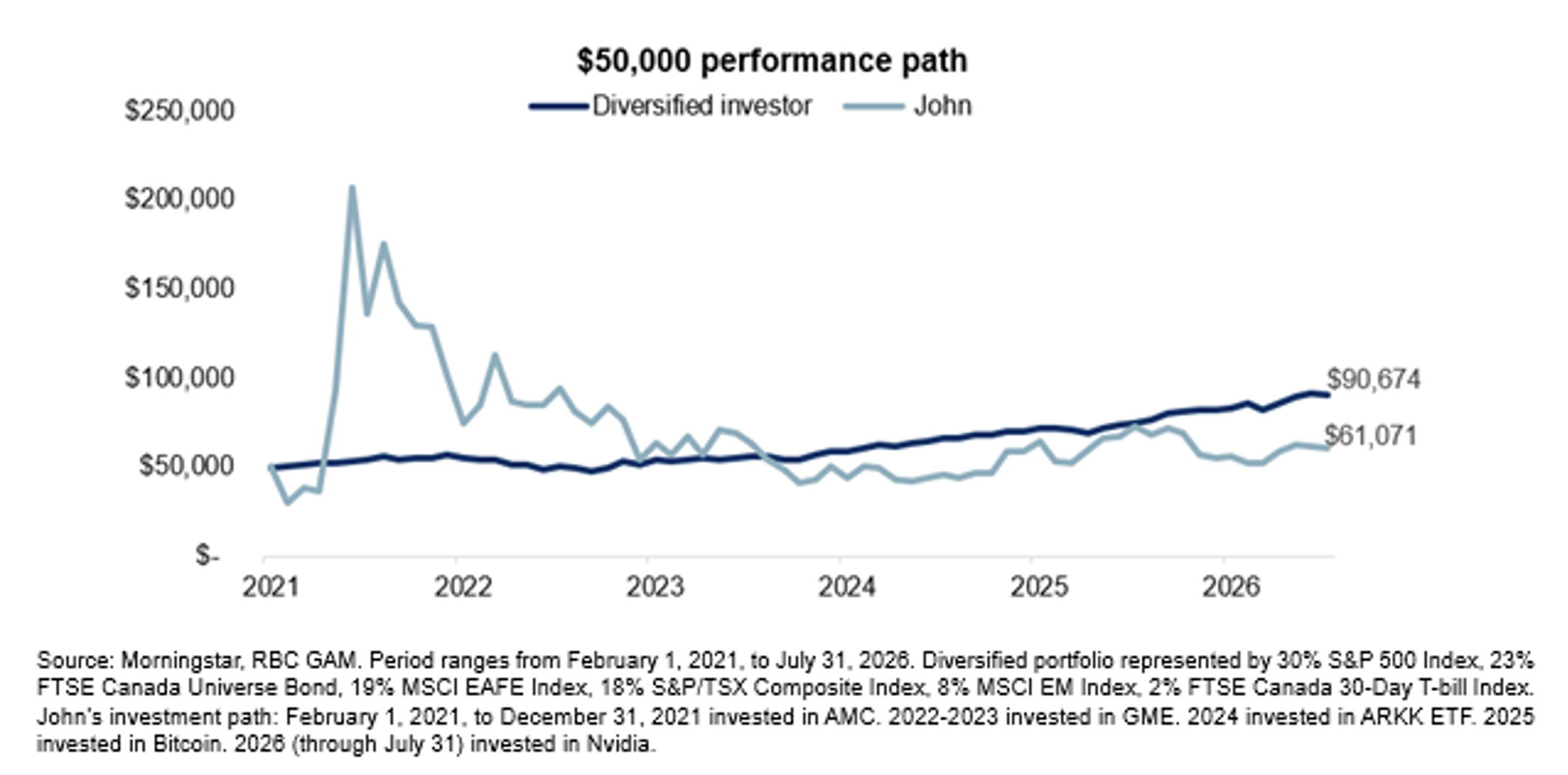
John's $50,000 grew to $61,071 over 5.5 years (+22%, or 3.7% annually). The boring buy-and-hold diversified investor? $90,674 (+82%, or 11.5% annually). That's nearly a $30,000 difference.
So, why does John feel successful? He's falling victim to the biases we discussed earlier. He remembers the AMC win, the ARKK recovery, and being up on Nvidia. But he's forgotten about his losses, crediting his successful picks to skill and his unsuccessful picks to bad luck. If you talk to John, you’ll probably only hear about his AMC and ARKK wins.
But under the surface, John spent 5.5 years stressed, watching markets constantly, to earn 3.7% annually. The buy-and-hold investor earned 11.5% annually while sitting back and living their life.
What this means in practice
While today's example is just a simple hypothetical scenario, the principles illustrate common behavioural biases many investors frequently face. This includes overconfidence after early wins, selective memory of performance, and the damaging tendency to chase the next hot investment theme.
When you have FOMO about a friend's latest "winner", anchor yourself back to evidence-based strategies: diversification, dollar-cost averaging, and staying invested. By sticking to these tried-and-true principles, we protect against our own worst instincts.
Because the question isn't who appears to be winning today. It's who actually makes it to the finish line.