
Royal Bank of Canada
July 7, 2026
TLDR
- Financial planning provides the structure and clarity to help businesses stay stable and resilient in uncertain conditions.
- Planning fundamentals like cash flow visibility, goal setting and resource allocation can support sustainable growth.
- Scenario planning can prepare businesses for change and strengthen decision-making.
- A proactive approach reduces the need to make decisions under pressure, leading to long-term stability.
Canadian small businesses operate in a landscape defined by forces they can’t control. Interest rates, supply chain disruptions, economic conditions, inflation, changing customer sentiment… the list goes on. With so much unpredictability, what can you do to keep your business stable?
The businesses that hold steady during uncertain times share one thing in common: they planned for it. Not because they predicted every challenge, but because they had a clear map of their finances, their priorities and what they’d do if things shifted. That’s the planning advantage — and it’s something any business can build.
It’s also the foundation of financial resilience – your business’s ability to withstand disruption, adapt to change and keep moving forward. You can’t control the environment around you, but you can control how well your business is positioned to respond when the unexpected happens.
In other words, it helps you control the controllables.
What is financial planning in business?
Financial planning is often thought of as budgeting or forecasting. In truth, it’s much broader than that.
Done well, financial planning lays the groundwork for how your business operates, grows and adapts over time. It ties your day-to-day financial decisions to your longer-term strategy, bringing things like cash flow, risks, funding needs and key priorities together into one place. The result is a complete picture of your business – and the high-level view you need to make informed decisions.
In simple terms, financial planning helps you:
- Understand where your business stands today
- Define where you want it to go
- Build a roadmap to get there
Together, these elements form the foundation of financial resilience, providing the clarity and flexibility to respond when the business environment changes.
Financial planning for growth and sustainability
A strong financial foundation creates the conditions for sustainable growth – and a detailed financial plan is one of the core building blocks.
Financial planning reveals how money moves through your business and, in turn, helps shape the decisions that allow it to thrive. This kind of visibility can make it easier to prioritize, invest and manage risk.
Financial planning supports several core areas:
Cash flow visibility and stability
One of the most immediate benefits of sound financial planning is cash flow visibility.
Understanding when money is coming in and going out can help you:
- Maintain sufficient liquidity to cover day-to-day operations
- Anticipate shortfalls before they become urgent
- Make more confident decisions around hiring, inventory and expansion
Because cash flow plays such an important role in day-to-day operations, this kind of transparency can keep your business running smoothly.
Clear, measurable financial goals
Financial planning translates your business objectives into defined, trackable targets. This often includes forecasting revenue, modelling different growth scenarios and setting benchmarks to measure progress over time.
Goal setting allows you to:
- Set revenue and profitability targets grounded in realistic assumptions
- Establish realistic timelines based on projected performance
- Align day-to-day decisions with longer-term priorities
Clear goals help create direction and make it easier to determine whether the business is on track or needs to adjust course.
Disciplined resource allocation
Where will investment have the most impact? Which initiatives align with your growth objectives? How should you balance short-term needs against long-term plans?
A structured financial plan gives you a framework to answer these questions. It helps you align resources with your priorities, spot areas where you can cut costs and direct capital toward high-impact initiatives. With a clear roadmap in place, you spend against your strategy rather than reacting to immediate needs.
Ongoing performance tracking
Monitoring your financial performance against a plan provides a continuous feedback loop, allowing you to:
- Compare actual results to projections
- Identify gaps or emerging issues early
- Adjust course before challenges escalate
This kind of consistent tracking can help strengthen decision-making and reduce surprises.
Improved access to funding
A detailed financial plan can build credibility with lenders and investors. It signals a strong understanding of your business’s financial position, a defined strategy for growth and a proactive approach to managing risk.
A disciplined – and evident – commitment to planning can make it easier to secure financing when opportunities or challenges arise.
A strong financial plan can also help you identify and prepare for grant opportunities. With a clear view of your finances, you’ll be in a better position to spot what you may be eligible for – and pull together a stronger application.
Scenario planning to manage uncertainty
Even the strongest plan can’t account for every variable. Markets shift, costs rise, and demand fluctuates. What you can do, instead of trying to predict the future, is prepare for it. That’s where scenario planning comes in to play.
Scenario planning, also called “what if” planning, encourages businesses to think through a range of possible outcomes – best case, worst case and everything in between. It’s an exercise that can create a more nimble approach to decision-making and greater resilience over time.
Scenario planning can help strengthen your financial resilience in several ways:
More informed decision-making
By exploring best-case, worst-case and most-likely outcomes, you can make decisions based on strategic foresight rather than gut instinct. And when change does occur, you’re not reacting under pressure – you’re drawing on scenarios and options you’ve thought about when the stakes were lower. Through scenario planning, you can:
Evaluate potential outcomes before committing to your next move
Understand trade-offs under different scenarios
Act quickly with a clearer understanding of potential impacts
The result is faster, more confident action – particularly valuable in times of stress.
Stronger risk identification and mitigation
Because scenario planning forces you to consider a wide range of possibilities and conditions, it can help reveal risks that may not be immediately obvious. This may include:
- A decline in revenue or delays in payments
- Rising input or operating costs
- Supply chain disruptions
- Changes in customer demandfs under different scenarios
- Act quickly with a clearer understanding of potential impacts
By identifying risks early, you’ll be in a better position to develop mitigation strategies ahead of time.
Greater operational flexibility
Considering multiple scenarios creates a clearer view of possible responses, allowing you to adjust pricing or spending more quickly, reallocate resources or pivot without starting over. This kind of flexibility can make a meaningful difference in fast-changing environments.
A more resilient mindset
Perhaps most importantly, scenario planning shifts how you approach uncertainty. It reinforces the importance of preparation, flexibility and awareness, rather than relying on predictions or assumptions. Over time, this mindset can become a distinct competitive advantage.
The story of two businesses: Planning for what’s next
To see how scenario planning can affect the financial health of a business, consider two companies that faced the same unexpected increase in input costs – but prepared differently.
Business A: No scenario plan in place
Business A has a general budget but hasn’t taken the time to map out different financial scenarios. When costs rise:
- Their margins shrink quickly
- They make pricing decisions under pressure
- They put hiring and investment plans on pause
Without a clear understanding of trade-offs, their decisions are rushed and reactive. Short-term fixes are put in place, but at the expense of long-term growth.
Business B: Scenario planning in action
Business B has explored multiple scenarios, including rising costs and fluctuating demand. When the same situation occurs:
- They already understand how shrinking margins will affect their cash flow
- They quickly implement the pricing and cost adjustments they had previously mapped out
- They pause non-essential spending without disrupting business – or their long-term goals
Proactive versus reactive planning
Unexpected challenges are likely to occur at some point during the life of a business. How you respond to them comes down to the strength of your plan – and how often these surprises happen in the first place.
A proactive approach focuses on anticipating change and putting processes in place ahead of time. A reactive approach, meanwhile, addresses issues after they emerge, often under tighter timelines and with fewer options.
Both have a role to play, but they lead to different experiences – and often different outcomes.
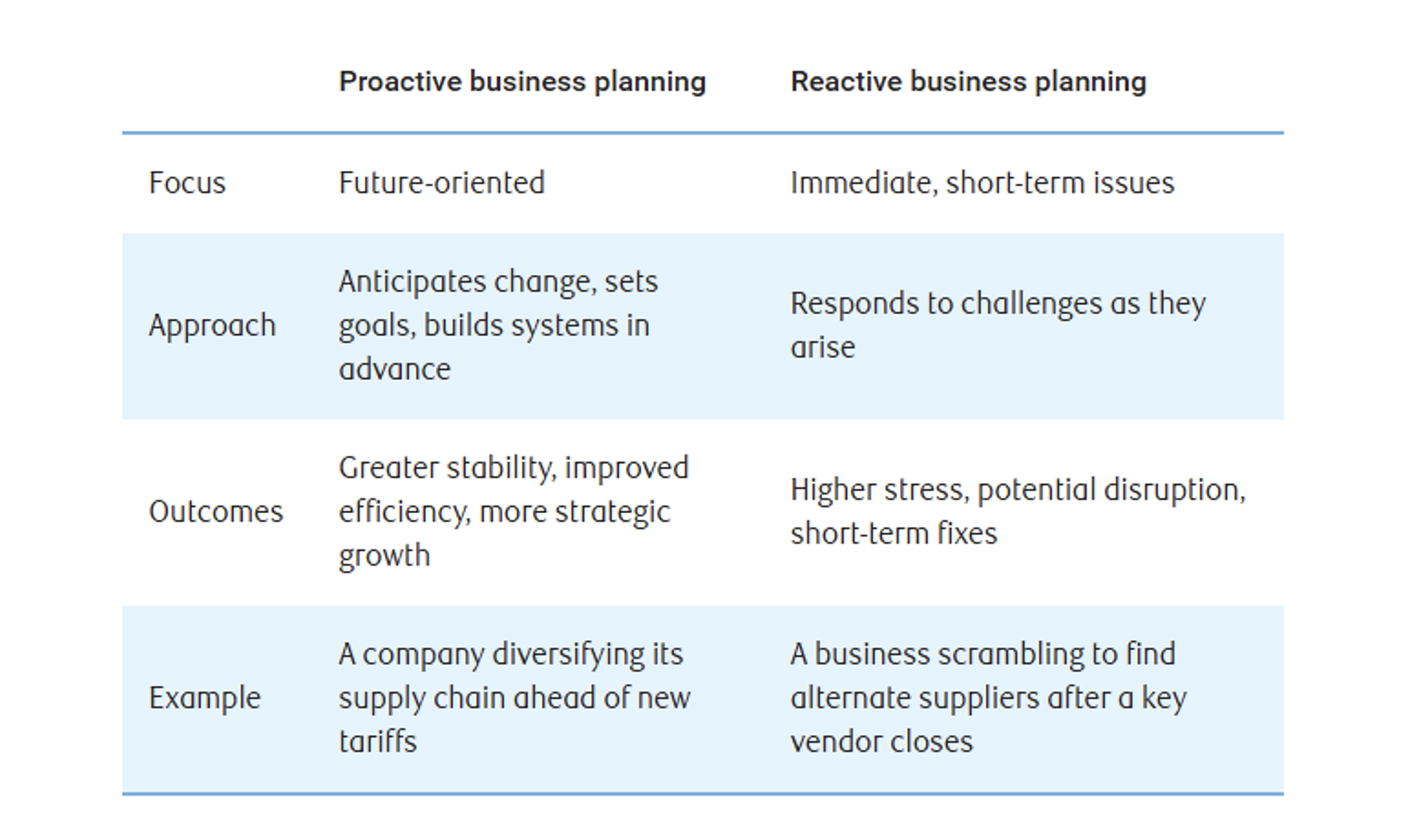
A business that proactively diversifies its supplier base, builds cash reserves or plans for different growth scenarios has more flexibility when conditions change. Decisions can be made with a cooler head, more context and a clearer understanding of trade-offs.
A business operating reactively tends to make decisions under pressure, responding to cash flow gaps, supplier disruptions or unexpected changes in demand as they happen. In these moments, the focus shifts to immediate problem-solving rather than long-term positioning.
That said, reactive planning remains part of running a business. Unexpected events can happen at any time, and the ability to respond quickly can make a real difference to the quality of decisions you make under pressure. The role of financial planning is to reduce how often those reactive decisions are needed – and to ensure that when they are, they happen from a more informed starting point.
The compounding power of planning
Financial planning isn’t a one-time exercise, but rather an ongoing discipline that evolves alongside your business. Whether you handle it in-house or work with an advisor, treating your financial plan as a living document – one that you return to regularly as conditions shift – is what keeps it useful and relevant throughout the year.
Over time, sound planning can create a compounding effect: better visibility leads to better decisions, better decisions support stronger performance and stronger performance builds resilience.
Uncertainty is part of running any business. Financial planning is what gives you a structured way to navigate it. In an environment where many factors sit outside your control, a clear roadmap for managing risk, adapting to change and making informed decisions is what turns disruption into something your business is ready for.