Hyah Alnehmi
Associate Portfolio Analyst, RBC GAM
June 9, 2026
Markets continue to reach new highs. Enthusiasm for artificial intelligence and strong earnings growth have powered performance, even as trade tensions and geopolitical conflict fill the headlines.
"How can markets keep rising when there's so much going on?"
You're likely hearing that question now. The disconnect between the noise and the numbers makes clients uneasy. But much of that discomfort comes from how we define risk in the first place.
Volatility vs. risk: A useful distinction
Here’s a helpful way to think about the stock market: it’s volatile, but not necessarily risky over longer periods.
Volatility is the temporary movement of prices. Risk is the possibility of a permanent loss of capital. While stocks can experience sharp declines in the short term, history shows that those declines have not typically resulted in permanent losses for investors who stayed invested over longer periods.
When investors view stocks as “volatile but not necessarily risky over time,” the conversation shifts away from fear and toward matching investment timelines with market characteristics.
What the numbers actually show
The best way to evaluate risk isn’t by focusing solely on current market conditions. It’s by understanding how markets have behaved across a wide range of environments.
The table below examines eight major declines of 20% or more in the S&P/TSX Composite Index. While markets are currently near record highs, these periods represent some of the most challenging environments investors have faced.
Looking at these episodes provides valuable context. If investors were ultimately rewarded for staying invested through some of the market’s most difficult periods, it helps illustrate why short-term volatility has not historically prevented long-term wealth creation.
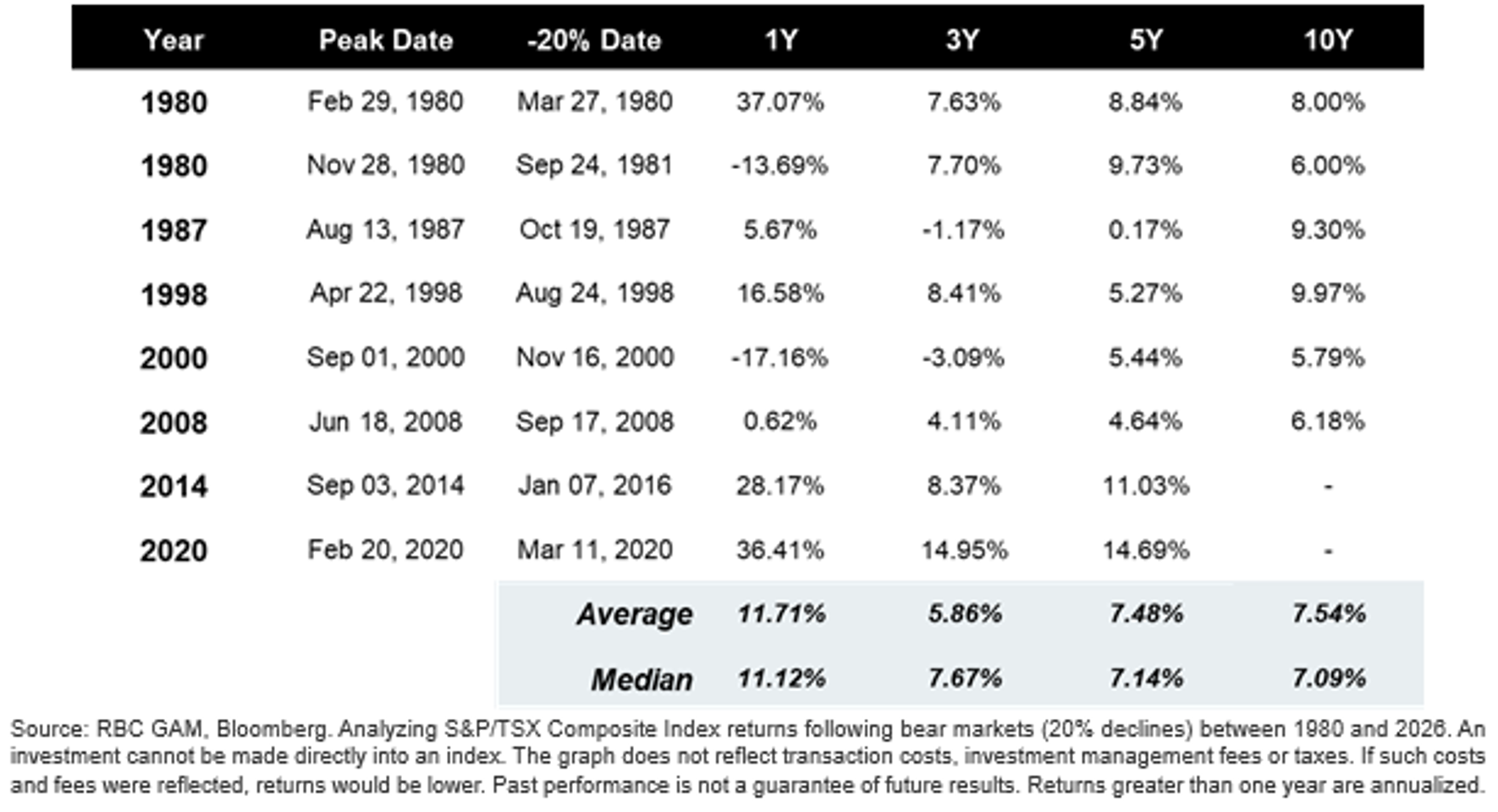
Five years after each decline, returns were positive, averaging 7.48% annually. Ten years later, every completed market decline in the study had delivered positive annualized returns, averaging 7.54% per year.
What this means for clients
The lesson isn’t that investors should ignore risk. It’s that risk should be viewed through the lens of time horizon.
A client retiring next year faces a very different reality than a client retiring in 15 years. Short-term volatility matters far more when money will be needed soon. For investors with longer time horizons, however, market declines have historically been temporary setbacks rather than permanent impairments.
Key Take-aways
- Markets rise on fundamentals, not headlines. AI enthusiasm and strong earnings have outweighed geopolitical noise, because prices ultimately reflect growth, not uncertainty.
- Volatility and risk are not the same thing. Short-term swings are uncomfortable, but they haven't historically resulted in permanent losses for investors who stayed invested.
- Time horizon redefines risk. Every ~ 20%+ TSX decline since 1980 was followed by positive returns a decade later. What feels risky today may not be risky over 10 years.