
Jamie Burak
Senior Investment and Wealth Advisor
March 1, 2026
Friends & Partners,
March arrives with two very different stories demanding attention, and both are
worth putting in perspective.
The first is a research piece from Citrini Research that has been circulating
widely on Wall Street, warning of what they call a “Global Intelligence Crisis”, a
moment where AI-driven efficiency begins to outpace traditional business
models and displace knowledge workers at a scale not seen before. Block’s
announcement last month, cutting its workforce nearly in half, citing AI tools as
the reason, became the headline case study. Markets reacted, particularly in
software and services, where investors began repricing companies most
exposed to this disruption.
The second is the situation in Iran. U.S. and Israeli forces struck Iran this past
weekend. The Strait of Hormuz , through which roughly one-fifth of the world’s
seaborne oil travels is now under threat. Oil climbed sharply Monday. Equities
pulled back.
Two very different events. One consistent message. This is not a moment to
react. It is a moment to reflect on why the plan was built the way it was.
A Word on the “Intelligence Crisis”, We Have Seen This Before
The Citrini research is serious and worth understanding. But it is also worth
remembering that we have been here before.
When the internet arrived, the same fears circulated. Entire industries were
going to be replaced. Jobs would disappear. The economy would be disrupted
beyond recognition. What actually happened was different. The internet did not
eliminate workers, it made workers dramatically more productive. It created
entirely new industries, new roles, and new forms of value that nobody had
anticipated. The companies that enabled that transformation: the
infrastructure, the platforms, the tools became some of the most valuable
businesses ever built.
Artificial intelligence is following a similar path. Yes, certain repetitive, process driven
tasks will be automated. That has always been true of transformative
technology. But the broader story is not replacement, it is amplification. The
advisor, the analyst, the architect, the engineer who learns to use these tools
well will not be replaced by AI. They will be replaced by someone who uses AI
better than they do.
For our clients, this distinction matters because it shapes where value is
created and where it is at risk. We have spent considerable time making sure
this portfolio sits firmly on the right side of that line.
Market Overview: February in Review
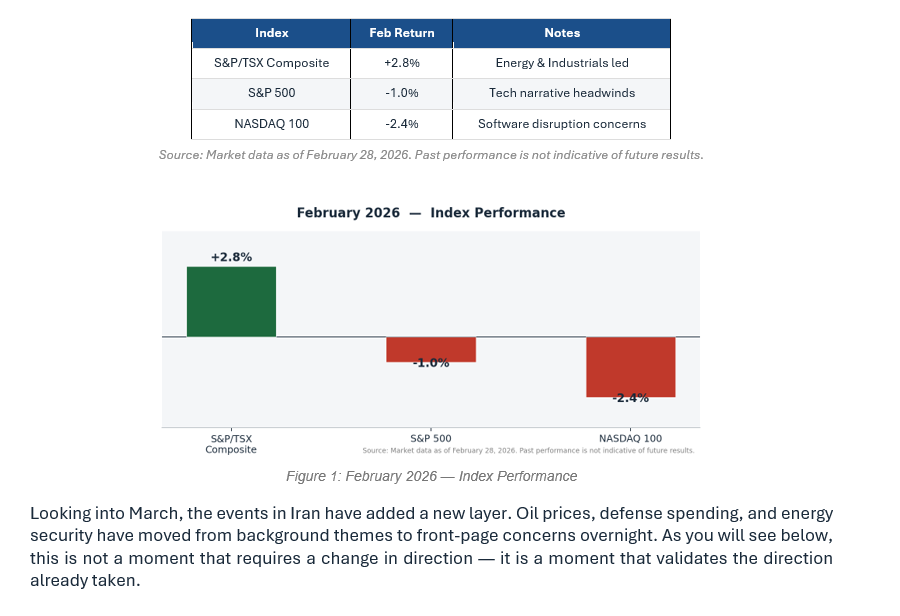
Canadian markets held their ground, supported by energy and industrial
strength. U.S markets pulled back as investors began repricing the names most
exposed to AI-driven disruption, particularly in software and services. The
adjustment was a market beginning to separate the businesses that enable AI
from the ones that being reshaped by it.
Portfolio Focus: The Right Side of the Shift
Our portfolio performance in February reflected exactly this separation. The
holdings that led were the businesses physically enabling AI, not the ones being
disrupted by it.
Portfolio Standouts — February 2026
Vertiv Holdings (VRT) +36%
As data centres pivot to high-density AI workloads, Vertiv’s liquid cooling and
thermal management systems have become essential infrastructure. Demand
is accelerating, not slowing.
Teradyne (TER) +33%
Precision chip testing is the quality gatekeeper for the complex semiconductors
powering AI. Every chip that ships through a data centre has passed through a
tester. Teradyne is the standard.
Targa Resources (TRGP) +16%
Natural gas remains the primary bridge fuel powering the AI grid. Data centres
need reliable, 24/7 baseload energy. Targa’s NGL transportation and processing
infrastructure sits at the centre of that supply chain.
Individual security performance shown for illustrative purposes only.
But I also want to be clear about something important. The software and
platform companies in this portfolio such as Nvidia, Microsoft, Meta, Alphabet,
Amazon, and Apple are not the companies being replaced.
They are the companies doing the replacing. These are the businesses that have already
won the intelligence layer of this transformation. Nvidia builds the chips AI runs
on. Microsoft and Alphabet are embedding AI into every product they sell. Meta
has deployed AI across platforms used by billions of people daily. These are not
vulnerable positions. They are the enablers and their competitive moats have
gotten wider, not narrower, as AI has accelerated.
The Citrini thesis is a risk for companies that use software. It is an
opportunity for the companies that build it.
The Broader Picture: Multiple Pillars, One Portfolio
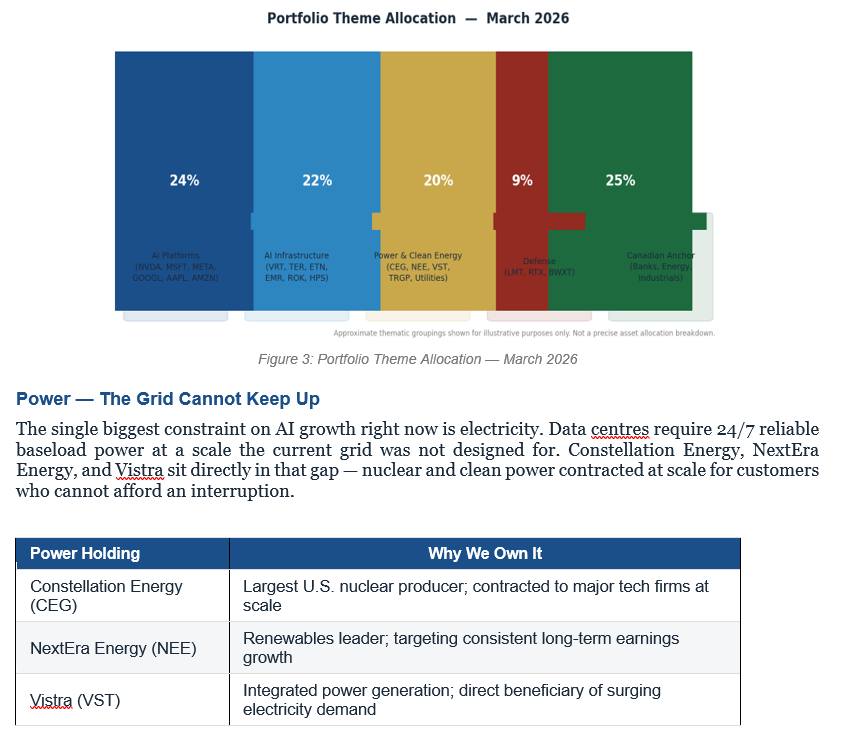
Beyond AI, this portfolio was built to work across several environments at once.
The events of this past weekend are a reminder of why that matters.
Defense and Energy Security — Already Positioned
Lockheed Martin (LMT), RTX Corporation, and BWX Technologies (BWXT) were in
this portfolio before the weekend’s events. That positioning was not a reaction,
it was a conviction built well before the current conflict, that a U.S.
administration prioritizing military readiness and domestic production creates
durable, long-term demand for quality defense businesses. This week has
made that positioning more visible. The work was done before the news cycle.
Cameco (CCO), the world’s largest uranium producer, sits in both the Canadian
and U.S. portfolios. It connects the AI power story and the geopolitical energy
security story in a single holding. That is not coincidence.
The Canadian Anchor
The Canadian side of this portfolio continues to do exactly what it was built to
do provide stability, income, and resilience. Our major bank holdings are wellcapitalized
and generating consistent earnings. Canadian Natural Resources,
Enbridge, TC Energy, Pembina Pipeline, and Tourmaline Oil are precisely the
kind of businesses that matter more, not less, in an environment where global
energy supply is suddenly in question.
March Planning Focus: Remove the Friction from Tax Season
With the RRSP deadline now behind us, the most practical step for March is
simplifying tax filing for you and your accountant. The biggest annual stressor
for most clients is the back-and-forth of collecting T3s, T5s, and monthly
statements.
Our March call to action: register your accountant for the RBC Trusted Partner
Portal. One email from you, and we handle the rest.
1. Direct Tax Slip Access — T3s and T5s available the moment they are posted,
without a call to our office.
2. Year-Round Statements — Full statement history in one secure place,
available any time.
3. Enhanced Security — No unsecured email attachments, no risk of sensitive
documents going astray.
Simply send us your accountant’s name and email address and we will send
them the invitation directly.
Closing Thoughts
The internet did not end work. It changed how work gets done, and the people
and companies that embraced it created extraordinary value. AI will follow the
same arc. The disruption is real, but so is the opportunity and the portfolios
best positioned for that opportunity are the ones already holding the
infrastructure, the platforms, and the energy behind this transformation.
As always, if any of this raises questions about your specific accounts or your
broader plan, please do not hesitate to reach out. That conversation is always
welcome and it is always about you first.