
George Stedman, CFA
Senior Portfolio Manager
October 5, 2026
Third Quarter 2026
We have been warned, notably by former Anthropic employee and whistleblower Jacob Coxon, that “reckless” development of artificial intelligence “could end in human extinction”. At the same New York City Council meeting on October 5, former Google Deep Mind Researcher Alex Turner warned that “misaligned AI is everyone’s adversary”. (CNBC, Oct.5 2026)
An example of how humans might be eliminated that has been used is an AI agent that has been prompted to make paper clips. If it becomes ‘misaligned’ with humans’ priorities it might melt us all down to make more paper clips. That existential threat reminds me of when I was in elementary school around the time of the Cuban Missile Crisis. Next door to our school was an air raid siren which was meant to warn us of a nuclear attack. It was regularly tested. I’m not sure I understood how hiding under my school desk would help. It did remind me that my grandfather, RCAF Air Vice Marshall E.W. Stedman, was killed by the fallout from the Bikini Atoll hydrogen bomb test.
In Barron’s (Sept.29) Al Root brings the AI boom back to investing: “To invest or not to invest. That’s the AI conundrum. AI is the engine of this stock market but Anthropic’s own IPO registration document raises the possibility that AI could, well, wipe out humanity. So should investors sell before a Matrix-style AI disaster which might not come, headed off by a stock-crunching regulation? Or should they go all in on AI, fatalistically believing there is little they can do about how AI will develop or impact the global economy? However things develop, the current conundrum has thrust risk management into the spotlight.”
A severe test for the stock market will come from the lock up expiry from Space X which raised $86 billion in June and the Initial Public Offerings of Anthropic Inc., maybe in December and, Open AI, whose IPO has been delayed until next year.
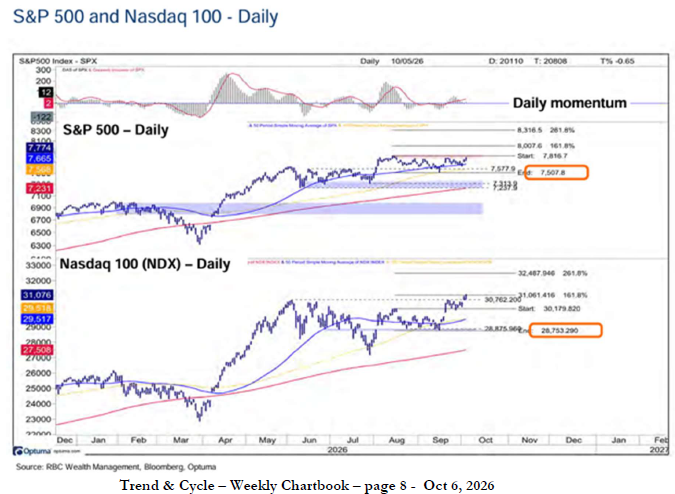
Profits for the S&P 500 companies are expected to be up 34% in 2026 as the boom in AI investment has become a pivotal spur to the U.S. economy. The S&P 500 is now trading at about 19.25 times its next 12 months of expected earnings, close to its 10-year average.
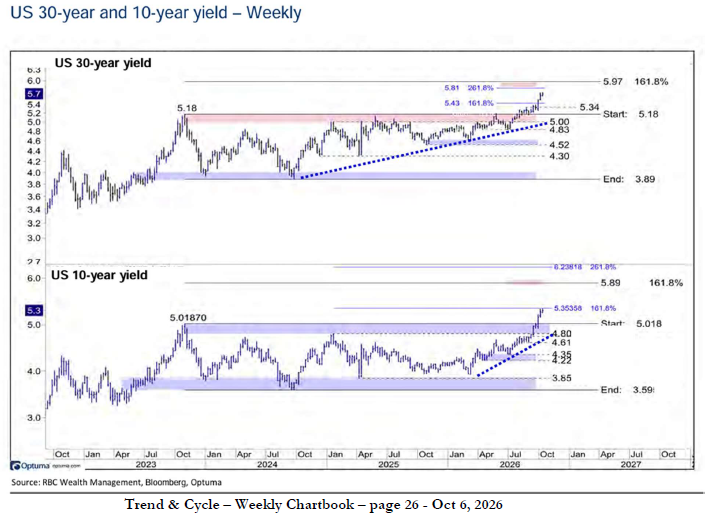
The surge in profitability may explain why the S&P 500 and NASDAQ indices, both of which are now dominated by tech stocks, are near all time highs even though U.S. Treasury bond yields have shot up to 5.34% on October 5, the highest level since 2002. France’s 10-year yield approached 5% and Britain’s 30-year Gilt rose above 6%. Bond yields have been rising around the world because of persistent inflation driven by the wars and by the AI investment boom that is keeping the U.S. economy strong, concerns about U.S. government borrowing to finance a growing U.S. deficit, and borrowing by hyperscalers to finance the AI boom.
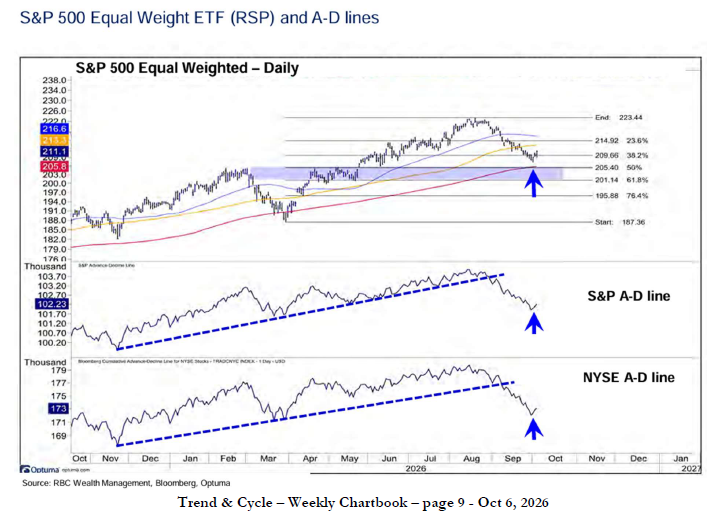
More than 200% of the S&P 500’s gain in the 3rd quarter came from four stocks (MSFT, NVDA, AAPL, META). The extent to which that index is dominated by a few mega-massive technology companies can be illustrated by comparing the S&P 500, which is capitalization weighted (meaning the more valuable a company is the larger percentage of the index it is), to the S&P 500 Equal Weighted Index. The Advance-Decline Line (A-D Line) in the second chart below shows most stocks have been in a stealthy bear market since the summer.
Rising bond yields negatively impacted interest sensitive stocks such as Utilities, REITS and Pipelines. They threaten a regime change from TINA (there is no alternative to stocks), which arose after governments slashed interest rates in response to the Great Financial Crisis of 2008-2009, as bonds now offer competitive returns.
Yesterday’s Quebec election resulted in no majority for the Parti Quebecois and continuing low support for a referendum. We can now focus our political worries on the upcoming referendum in Alberta and, the U.S. mid-terms. Its conclusion should remove substantial uncertainty. If it results in the Democrats taking the House and the Republicans retaining the Senate that will substantially reduce the likelihood of major spending bills or legislative initiatives that don’t have bipartisan support. One month to go!
I hope you have been enjoying fall. We’ve had a lot of changes at our house, with our daughter off to Dalhousie University and our son having taken over the car. I am especially looking forward to the long Thanksgiving weekend as our daughter will be home and racing for the Dalhousie Sailing Team. Go Tigers Go! Happy Thanksgiving. I hope to talk with you soon.
Sincerely,
George Stedman, CFA
Senior Portfolio Manager
Please visit us at www.georgestedman.com
RBC Dominion Securities Inc.* and Royal Bank of Canada are separate corporate entities which are affiliated. *Member-Canadian Investor Protection Fund. RBC
Dominion Securities Inc. is a member company of RBC Wealth Management, a business segment of Royal Bank of Canada. ® / ™ Trademark(s) of Royal Bank of
Canada. Used under licence. Used under licence. © RBC Dominion Securities Inc. 2023. All rights reserved.