Hewson's Q2 2025 Outlook
In this edition, we explore how Liberation Day tariff measures spooked the markets, leading to the next leg of the ongoing correction in stock prices. The below Q2 review will be briefer than normal as we are still searching for clarity in the newly announced tariff levels.
In this edition, we explore how Liberation Day tariff measures spooked the markets, leading to the next leg of the ongoing correction in stock prices. The below Q2 review will be briefer than normal as we are still searching for clarity in the newly announced tariff levels.

David Hewson
Senior Portfolio Manager & Wealth Advisor
April 4, 2025
Looking for Hewson's 2025 Q3 Quarterly Outlook? Click here for the latest edition - 2025 Q3 Outlook
Hewson's Quarterly Outlook
2025 Q3 | April 4, 2025
In this edition, we explore how Liberation Day tariff measures spooked the markets, leading to the next leg of the ongoing correction in stock prices. The below Q2 review will be briefer than normal as we are still searching for clarity in the newly announced tariff levels.
How did we get here?
Five months ago on election night, after Trump won the swing states in a resounding fashion, our equity outlook had investors feeling positive about the year ahead in 2025, given that Trump’s administration would bring a pro-growth, easier fiscal policy, tax cuts, and less red tape in deal making. Now, this positive feeling has been completely overcome by confusing trade policies that threaten a global economic recession.
Increasing Risk of Recession
We began the year with a 20% probability of recession, which is notably only 5% higher than the average risk that a recession occurs in any year (15%, i.e. every 7 years). Understanding that the April 2nd Liberation Day speech had the potential to increase volatility, we increased our recession risk probability to 35% (from 20% at the start of the year). After Trump’s comments on April 2nd, we are increasing this risk further to 50% and rising.
Recession is by no means a forgone conclusion; positive momentum could form if:
- these tariffs could be negotiated lower.
- the time frame tariffs remain in place is short.
- special deals with specific companies/countries are available.
- the resilient labour market continues to support consumer balance sheets.
It also must be noted that at this time, the situation is incredibly fluid. All cards both positive and negative are on the table. It is hard to believe the Trump administration would force a recession in a short-term pain for long-term gain tradeoff, but this administration is unpredictable to say the least.
However, what is undeniable now is that these tariffs, left in place, will cause an economic slowdown and softness in all economies. Perhaps the U.S. will be less impacted, but they will still be negatively impacted in the short-term as supply chains shift and businesses and consumers look for substitutes where possible.
Upcoming Earnings Season
Adding to our pessimism is that we are two weeks out from the start of Q2 earnings season. It is entirely possible that earnings and revenues perform well this quarter BUT, it is unbelievable to me that any CEO is going to do anything but CHOP full year guidance dramatically for the rest of the year. How could a CEO say that they expect to perform at the same level they projected when the economic landscape has changed so significantly, might change again, and with little forewarning from the Trump administration?
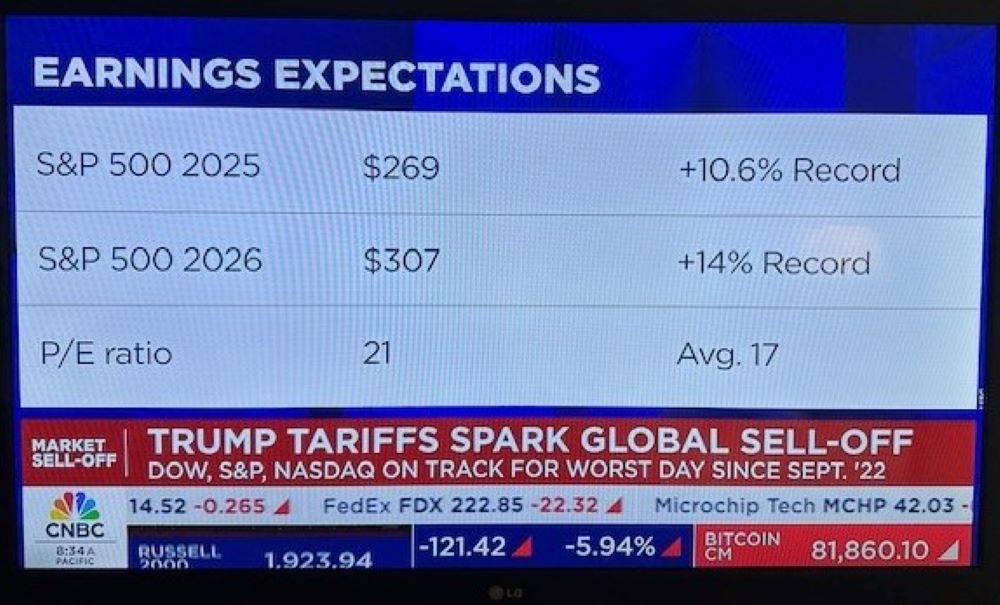
As written about many times previously, guidance often directs stock price performance more than actual earnings. Below, you can see a screenshot I took on a CNBC news cast that highlights what is currently expected in terms of earnings levels. These earnings levels are in my mind, completely unachievable if the current framework stays in place. This is why even if we avoid a recession, stock prices may have further to fall, in the short-term, before stabilizing and adjusting to a slower economic pace.
This is a consequential time, and we at Hewson Wealth Partners are taking it very seriously. We were well positioned in our portfolios prior to the Liberation Day speech, but now we feel further action is needed to protect capital even if the risk for lower stock prices exists for a short-term timeframe. Below we explain the actions we are currently undertaking.
Asset Allocation
We have been underweight equity all year waiting for clarity on trade policy. The clarity we got was much worse than what we had expected and much worse than what anybody was positioned for. Prior to the Liberation Day speech, we sold off 3-5% of equity and post-speech, we sold off a further 4-5% of equity. We are now dramatically underweight on our long-term equity targets.
Sector Selection
If you recall, in our equity strategy, we have both a long-term big ideas strategy, and a shorter-term tactical strategy. Our long-term big ideas are the themes that we believe are long-term growth ideas that we will not be pushed away from, in any market. We will use lower prices as opportunities to increase positions and average our cost base lower when we feel the time is right.
Our big idea strategies include:
- AI & Virtual Reality
- Software & Cybersecurity
- Data
- E-commerce
- ONSHORING everything back to the U.S.
Stock Selection
Given our positioning heading into this year, our stock selection criteria has not, and will not change. We still favor large companies with excellent management teams, strong balance sheets, that operate in competitive markets with high barriers of entry, and the power to pass pricing increases onto consumers.
Every stock that we currently own is well suited economically and fundamentally for whatever markets deliver in the next few quarters.
The Bottom Line
The next few weeks will likely bring increased volatility and portfolio fluctuation. It is important to remember that our fixed income portfolio is performing very well, as the flight-to-safety out of stocks and into bonds, lowers the yield but increases bond prices and thus offsetting some of the violent short-term losses in stock prices. It is also a good time to remember that your financial plans that we have designed for you assume that market drawdowns, such as the one we are living through, may occur from time to time and to varying degrees. Sticking to a plan ensures that we remain disciplined in our approach which is particularly important during periods of market duress, where emotions can often get in the way.
Hewson Wealth Partners of RBC Dominion Securities Inc. | ||
David Hewson | ||
| ||
| ||