Jeffrey Jones
B.Sc., CIM
August 13, 2026
The Buyer Checklist
August is upon us! The S&P 500 has recorded multiple all-time highs this year, yet we continue to climb a wall of worry due to concerns surrounding valuations, geopolitics, interest rates, inflation, and the sustainability of the AI investment cycle.
When a market reaches a new all-time high, human nature creeps in and asks the question: what could cause it to fall?
Yet I think there is another question worth asking: who could become the next buyer?
That distinction matters because several forces that were working against markets earlier this year have begun to reverse. Earnings are improving, valuations have actually become more reasonable, market participation (breadth) is broadening, corporate buybacks are about to start, and lower volatility is creating room to invest more.
Taken together, the backdrop may be somewhat more constructive than the constant negative headlines suggest.
Let's take a look at some of the different areas of the market and see if we can put the pieces of the puzzle together.
Earnings are doing more of the work
The most important support for the market continues to come from corporate earnings.
Second-quarter S&P 500 earnings growth is 33% higher than this time last year, one of the strongest readings outside of recession recoveries. More importantly, analysts have been revising estimates upward at the steepest pace seen since at least the year 2000.
This strength is broader than simply AI and the largest technology companies. Despite economic uncertainty, corporate America continues to deliver better results than investors expected. Markets ultimately follow earnings over time. For now, the earnings trend remains supportive.
A rising market doesn’t necessarily mean rising valuations
One of the more interesting developments this year is that the S&P 500 has continued making new highs while becoming less expensive based on forward earnings.
The index currently trades at approximately 20.1x forward earnings, down from roughly 23.1x last October. That represents approximately 15% multiple compressions even as the market has moved higher.
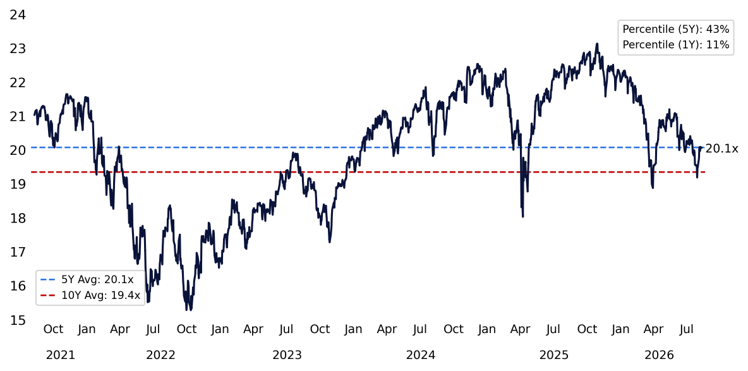
The explanation is straightforward: earnings estimates have been rising faster than stock prices.
That doesn’t make the market cheap. At 20x earnings, valuations remain above long-term averages. But there is an important difference between a market rising because investors are willing to pay increasingly higher prices and one rising because corporate profits are growing.
So far, this has been the latter.
There are also opportunities outside the biggest companies. The equal-weighted S&P 500 trades closer to 17.1x forward earnings, highlighting a considerably wider valuation opportunity outside the largest companies.
The market underneath the index is improving
For much of the past few years, one of the primary concerns surrounding the bull market has been narrow leadership.
That picture is changing.
More than 70% of S&P 500 companies are now trading above their 200-day moving averages, the strongest reading since December 2024.
At the same time, correlations between individual stocks are near historic lows, meaning they aren’t all moving as a herd.
This combination—improving breadth but falling correlations—is interesting. More companies are participating in the market advance, but they aren’t all moving together. That creates a healthier environment for diversification and, importantly, a better opportunity for individual stock selection.
It also reinforces something often heard, that the S&P 500 is not necessarily “the market.” The way an index is constructed means the enormous weights of the largest companies can disguise significant differences occurring underneath the surface. The TSX and S&P 500 are a collection of stocks.
The list of potential buyers is growing
Markets move on fundamentals over the long term, but supply and demand can matter enormously over shorter periods. And the current demand picture is unusually interesting.
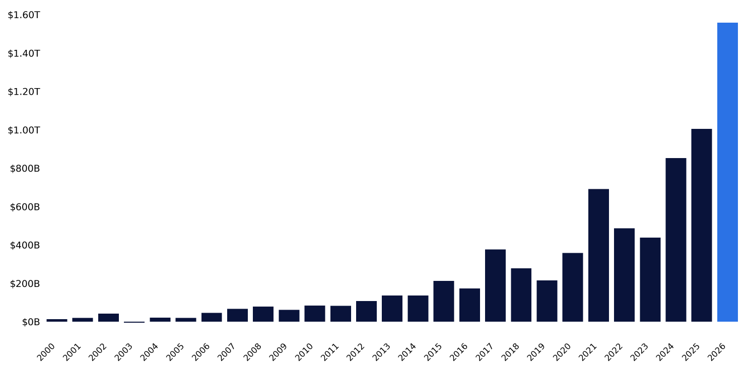
Passive ETF flows – those who are on automatic buy each month - have reached approximately $1.6 trillion year-to-date, or roughly $7.5 billion per day. July alone attracted almost $350 billion, the largest monthly inflow on record.
Corporate America is becoming another important buyer. More than $1 trillion of announced share repurchase authorizations are moving into a buyback window, with August historically being a strong month for execution. Interestingly, nearly 70% of the largest buyback authorizations this year have come from companies outside the technology sector.
And then there are systematic investors.
Earlier this year, elevated volatility forced many rules-based strategies to reduce exposure. Much of that selling is done. As volatility falls, the same mechanisms can reverse, allowing these strategies to gradually increase equity exposure.
That creates the possibility of a reinforcing cycle:
Lower volatility → increased buying capacity → stronger market trends → additional investor participation.
Investors are beginning to hedge against something unusual: upside
Perhaps the most fascinating change is occurring in the options market. Investors traditionally purchase options to protect against losses. Today, an increasing amount of activity is aimed in the opposite direction.
Long option volumes recently reached record levels, and approximately 35% of S&P 500 companies now have record call volumes. Basically, investors are increasingly willing to pay a premium for protection against missing an upside move. That doesn’t guarantee stocks will continue higher. But it represents a meaningful shift in investor psychology.
Earlier this year, the dominant concern was another decline. Now, some investors appear concerned about being underinvested if the market continues to advance.
Where does that leave us?
There are still legitimate risks. In my last note, I discussed some of the potential headwinds that were upon us. For ex. A newly elected Federal Reserve Chair and a midterms election cycle in the U.S. We know valuations aren’t cheap, geopolitical uncertainty remains elevated, parts of the market remain highly concentrated, and September has historically presented a more difficult seasonal backdrop. But there is an important distinction between acknowledging those risks and assuming they must immediately translate into falling markets. Right now, several underlying forces are moving in a constructive direction at the same time: Earnings are rising. Valuations have compressed. Market breadth is improving. Corporate buybacks are returning. Passive flows remain exceptionally strong. Volatility is falling. And investors who had previously reduced risk are gradually rebuilding exposure. No single factor determines where markets go next. The significance is that more of these factors are now reinforcing one another. For much of this year, markets were forced to absorb selling pressure and deleveraging. Today, that pressure has diminished while buying capacity is rebuilding. That doesn’t eliminate the possibility of corrections—and we should expect them. No one knows where the markets will head in the future, but for the moment, taking into account what is known, affords us the opportunity to make informed decisions. |
Hill Medeiros Jones Wealth Management Group
RBC Dominion Securities Inc.
519-337-6033
Privacy & Security | Legal | Accessibility | Member-Canadian Investor Protection Fund
RBC Dominion Securities Inc.* and Royal Bank of Canada are separate corporate entities which are affiliated. *Member-Canadian Investor Protection Fund. RBC Dominion Securities Inc. is a member company of RBC Wealth Management, a business segment of Royal Bank of Canada. © / ™ Trademark(s) of Royal Bank of Canada. Used under licence. © RBC Dominion Securities Inc. 2026. All rights reserved.
This information is not investment advice and should be used only in conjunction with a discussion with your RBC Dominion Securities Inc. Investment Advisor. This will ensure that your own circumstances have been considered properly and that any action is taken based upon the latest available information. The strategies and advice in this report are provided for general guidance. Readers should consult their own Investment Advisor when planning to implement a strategy. Interest rates, market conditions, special offers, tax rulings, and other investment factors are subject to change. The information contained herein has been obtained from sources believed to be reliable at the time obtained but neither RBC Dominion Securities Inc. nor its employees, agents, or information suppliers can guarantee its accuracy or completeness. This report is not and under no circumstances is to be construed as an offer to sell or the solicitation of an offer to buy any securities. This report is furnished on the basis and understanding that neither RBC Dominion Securities Inc. nor its employees, agents, or information suppliers is to be under any responsibility or liability whatsoever in respect thereof. The inventories of RBC Dominion Securities Inc. may from time to time include securities mentioned herein.