Jeffrey Jones
B.Sc., CIM
July 29, 2026
Mid-Year Market Update: Staying Constructive While Broadening the Playbook
One of the most common questions I’ve received recently is whether the artificial intelligence sector represents a sustainable investment opportunity or the beginnings of a speculative bubble.
My view remains largely unchanged. A.I. continues to be supported by strong earnings growth rather than valuations alone. Yes, there are some circuitous financing arrangements and leadership has become increasingly concentrated, but history suggests that markets rarely rely on a single group of companies indefinitely. As concentration increases, diversification becomes even more valuable.
A useful analogy comes from skyscrapers in Japan, which use a huge mass-dampeners to stabilize the building during strong winds and earthquakes. Well-constructed portfolios should work the same way—maintaining exposure to long-term growth themes while also including assets that can help stabilize returns when leadership inevitably broadens.
One encouraging development has been the improvement in market breadth. While many of the largest AI-related companies have paused after an exceptional run, leadership has expanded into areas such as international markets, small-cap companies, and energy. Broader participation is generally a healthy sign and creates a wider range of investment opportunities.
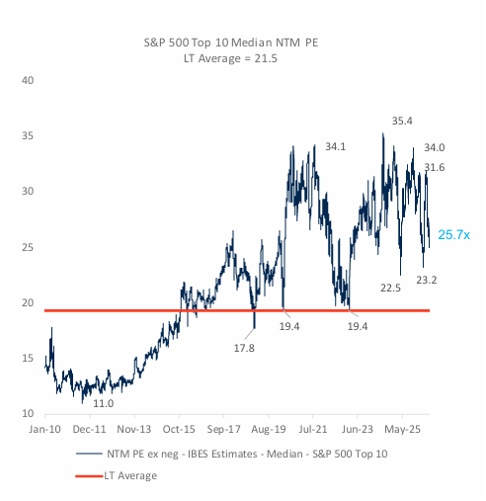
Valuations in the top 10 stocks in the S&P 500 have been trading in the middle of their historical average range since 2016, when technology became a much larger part of the market. These valuations have been met with continued earnings growth and are therefore deserved.
The overall S&P 500 currently trades at approximately 21 times forward earnings, while the equal-weight version of the index is closer to 19 times. These are elevated relative to history, but not outrageous.
The recent quarter saw some of the largest increases in earnings that we’ve seen in years. The upcoming second quarter will be particularly important as investors assess whether AI-related capital spending continues to translate into more broad-based growth. To be honest, “let’s see the return on the investment” will be heard more going forward.
The good news is that diversification opportunities continue to improve. Healthcare, energy and financials have shown significant improvement over the last couple of months, so we don’t necessarily need to reduce equity exposure to build ‘stronger’ portfolios. Rather than making one dramatic portfolio shift, the objective is to build multiple engines of return that can perform under different market environments.
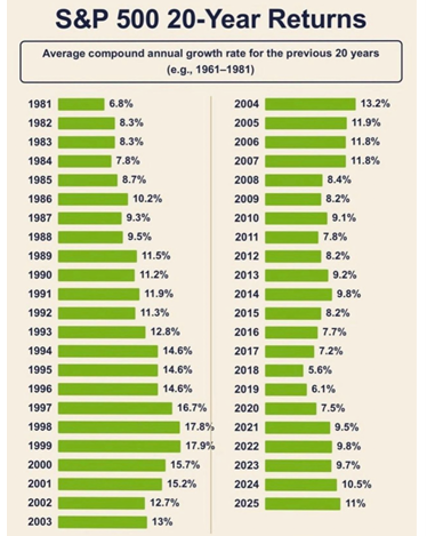
The chart below suggests that trailing 20-year returns in the S&P 500 will ebb and flow, but that’s due to leadership changes from year to year. As you can see, those trailing returns are varied by quite a bit, but the trend is still intact.
Employment remains relatively steady, but consumer purchasing power has weakened over the last few months, limiting the ability of businesses to pass through higher prices. Inflation therefore remains a risk, but the absence of a meaningful wage-price spiral may reduce the likelihood of a sustained reacceleration.
There is a limit to what the consumer will endure and we’re very likely at that limit now. Bond yields are creeping higher, but at a very slow rate, so it’s something we are watching very closely.
Pricing power does vary considerably across industries, with technology remaining resilient, but many consumer-facing businesses are experiencing greater resistance. The recent revisions in the weekly jobs numbers have shown a slight downturn in seasonal hiring as well as services seeing a drop off.
From an asset allocation perspective, we continue to favour a selective, rather than defensive, approach. The emphasis on a modest overweight to equities, with a meaningful exposure to complementary diversifying assets. The objective is not to reduce risk indiscriminately, but to be deliberate about where that risk is taken.
Looking Ahead
As we move through the second half of the year, my outlook remains constructive, but increasingly focused on balance. AI continues to represent one of the most significant long-term growth opportunities available to investors, yet portfolios should not rely exclusively on one source of market leadership.
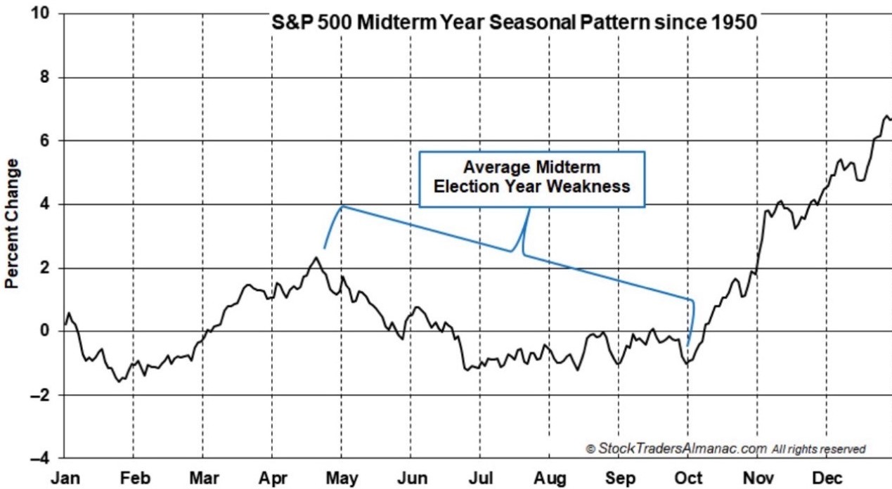
There are some seasonal head winds that appear during mid-term election years. The reason for this is during periods of uncertainty, markets tend to pull back until that uncertainty is removed. But the 4th quarter of year two and the 1st and 2nd quarters of year 3 are the best of all 16 quarters in an average Presidential election cycle.
Markets continue to present attractive opportunities, but disciplined diversification, thoughtful portfolio construction, and selective security selection remain as important as ever.
Hill Medeiros Jones Wealth Management Group
RBC Dominion Securities Inc.
519-337-6033
Privacy & Security | Legal | Accessibility | Member-Canadian Investor Protection Fund
RBC Dominion Securities Inc.* and Royal Bank of Canada are separate corporate entities which are affiliated. *Member-Canadian Investor Protection Fund. RBC Dominion Securities Inc. is a member company of RBC Wealth Management, a business segment of Royal Bank of Canada. © / ™ Trademark(s) of Royal Bank of Canada. Used under licence. © RBC Dominion Securities Inc. 2026. All rights reserved.
This information is not investment advice and should be used only in conjunction with a discussion with your RBC Dominion Securities Inc. Investment Advisor. This will ensure that your own circumstances have been considered properly and that any action is taken based upon the latest available information. The strategies and advice in this report are provided for general guidance. Readers should consult their own Investment Advisor when planning to implement a strategy. Interest rates, market conditions, special offers, tax rulings, and other investment factors are subject to change. The information contained herein has been obtained from sources believed to be reliable at the time obtained but neither RBC Dominion Securities Inc. nor its employees, agents, or information suppliers can guarantee its accuracy or completeness. This report is not and under no circumstances is to be construed as an offer to sell or the solicitation of an offer to buy any securities. This report is furnished on the basis and understanding that neither RBC Dominion Securities Inc. nor its employees, agents, or information suppliers is to be under any responsibility or liability whatsoever in respect thereof. The inventories of RBC Dominion Securities Inc. may from time to time include securities mentioned herein.