Mark Krygier
Senior Portfolio Manager & Wealth Advisor
November 30, 2025
We enter the last month of 2025 with so many changes having taken place, many of which could not have been predicted at the beginning of the year. In truth, to make it through the year is itself reason enough to be thankful, and really, anything on top of that is “gravy.” Despite the pundits’ predictions, neither the North American nor the global economies collapsed. The capital markets did stumble, but they rebounded for most investors, except perhaps for the Bitcoin groupies. President Trump has unsurprisingly continued to remain in the spotlight, between ICE arrests and protests, Russia and the Ukraine perhaps nearing a deal to stop that long-standing war, with almost all of the hostages in Gaza having been released, including the remaining 18 live hostages, and while the Iranian nuclear threat to world peace has been set-back for years. Prime Minister Carney in Canada went from campaigning on a platform to curtail Canadian energy production to a “180” reversal, as in less than a year in office he announced a deal with the Province of Alberta to expand energy production and to extend pipelines. Gold cracked through $US4,000 an ounce for the first time ever, and the Toronto Blue Jays went from cellar dwellers to missing being World Series champions by one run in extra innings of the seventh game. We still have a month to go in 2025 and anything can happen, but to not pause for a moment and reflect on what has been a whirlwind of a year seems a shame.
Reflecting over the past is a great way to increase one’s confidence by first appreciating what you have and by acknowledging how far you have come, whether at work or in your personal life. Recognizing that you were able to meet a challenge or get through a difficult situation can be the first step in moving forward towards your goals. As Dan Sullivan, the founder of the “Strategic Coach” workshops is fond of saying, measure your success by looking at what you have accomplished in the past, rather than by comparing where you are now to where you would like to be. Where you would like to be requires setting goals, in both business and in your personal life, and it is those goals which create the direction to which you can focus your energy. Frustration usually results from not meeting your targeted goals – “I want to have $ (fill in the blank) in savings or investments by year (fill in the blank),” or “I want to lose (fill in the blank) pounds by (fill in the blank) year.” Mr. Sullivan suggests that this method makes no sense, as it is bound to create frustration since we are imperfect beings living in a real world. Such goals are simply there to help guide the direction of our actions, and they are not meant to be used to judge our success. Achieving 80% of our goal is what he defines as success. Once 80% is achieved, reset your goals, and keep moving along. If the 80% is not achieved after much effort, one may need to reset one’s goals to be more realistic, or one may have to exert more effort or examine one’s strategy for achieving those goals. At the end of the day, as long as we are fortunate to live out another year, then we have the opportunity to keep striving!
On a different note, I recently received a call from someone who sold property and is now seeking investment advice. We met to discuss his needs, his fears, and to see what I could offer him, as previously he had bad experiences investing. Firstly, I was saddened to hear about losses he experienced through fraud in a privately-run mortgage fund – a reminder that one always needs to take steps to protect oneself from being victimized. More shocking to me, however, was his surprise reaction as I described my method for investing, none of which I thought was particularly earth-shattering, but apparently to some it is out of the ordinary. I described my approach to investing as firstly, keeping things simple. We manage model equity (stock) based portfolios for both growth-oriented investors as well as for income-oriented investors. Each model holds between 25-30 individual stock positions to properly diversify, and we run both CAD$ and USD$ portfolios of each. By using this approach, we can focus on our clients’ needs and manage risk by staying on top of our investments and making changes when necessary. In the middle of this brief description, he stopped me to ask, “if you hold 25-30 positions, how much does each position make up in a portfolio – 3-5%?” I answered in the affirmative, and mentioned the adage, “don’t put all of your eggs in one basket.” With the look of shock still on his face (I can only imagine what others have proposed to him in the past…), I explained that my method for investing will not make someone wealthy overnight. Our goal is to take someone’s wealth, and both preserve and grow it reasonably over market cycles. Reflecting on his look of shock, I think I now understand why so many people don’t really trust the stock market as a tool for building wealth. Despite the tremendous wealth that has been created for generations (think Warren Buffett, one of the world’s richest individuals), if the stock markets are viewed primarily as a source for speculative investing, or for gambling short term on what is ultimately a long-term vehicle for building wealth, then of course terrible experiences will occur. How many people leave Las Vegas with money still left in their pockets? If, however, sound business principles are applied to the business of investing, the probability of being successful increases exponentially!
Bottom line
As we near another year-end, take a moment to appreciate what you have and where you are today. We could always have done something different and made better choices than we did, but dwelling on the past often bogs down our minds and destroys our confidence. As Dan Sullivan says, plan for a bigger future in all aspects of your life, but don’t forget to stop and appreciate each moment. If someone you know could benefit from simple, yet effective wealth planning strategies, let us know how we can help and enjoy the rest of the year!
Global benchmarks
As of November 30, 2025 (Canadian $ Returns – except where noted)
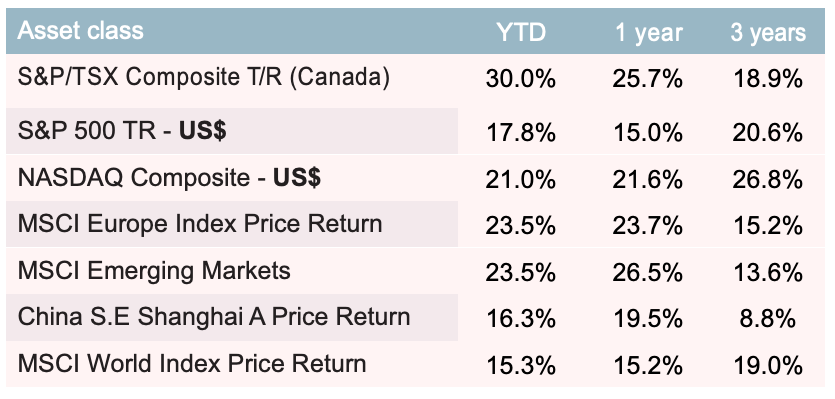
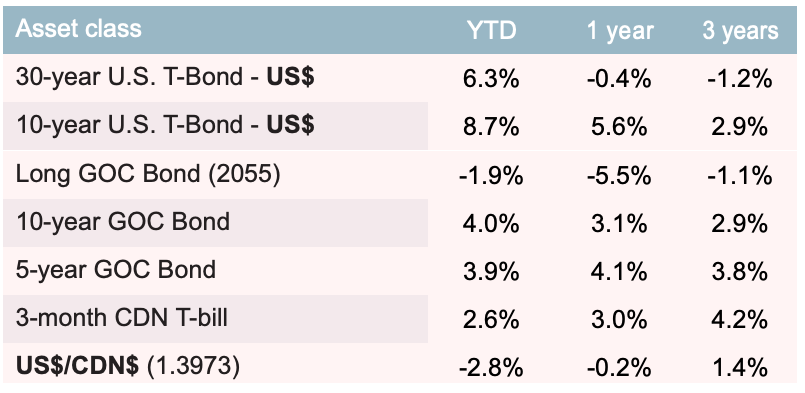
Source: RBC Capital Markets Quantitative Research