
Mark Krygier
Senior Portfolio Manager & Wealth Advisor
October 31, 2025
Blue Jays fever has taken over the City of Toronto and most of Canada. At the time of this writing, the Jays lead the World Series 3-2, after a thrilling win, in good part thanks to their rookie phenom pitcher, Trey Yesavage, who bested the previous record of a rookie in the World Series by striking out 12 batters in a single game. The series turns back to Toronto for the final one (hopefully) or two games, and many are hoping that the home crowd in the Rogers Centre will help provide the team with added energy to keep their momentum going. For long-standing Jays fans, it has been 32 long years of suffering since they last won the World Series, back in 1993 – an era before not only “AI”, but before the internet itself. The last time the Jays won the World Series, following the Joe Carter “walk-off” homerun, no one could take a picture of that winning hit with their phones because cell phones were not yet in use. How times have changed!
There is nothing like a winning home team to bring out all sorts of viewers, many of whom would otherwise not be interested in watching a game. Being part of the “in-crowd” is super exciting and the energy created is contagious. Coming up on almost 30 years of being an investment professional, I have seen my share of “excitement” in the markets which has at times been contagious and has brought out many “viewers” who would otherwise not be interested in investing. A story which I have told on many occasions, occurred to me during the last big technology boom, in 1999-2000, as the advent of the internet was the hype de jour. Two months before the technology laden NASDAQ stock-market index peaked in March 2000, a technology company in Canada went public (i.e. transitioned from being a private company to a publicly traded company) in January 2000 – talk about timing! The hype about the internet was equal to or more than we see with “AI” today, and everybody had an opinion about how the internet would change the way we do…everything (sound familiar?). Weeks before that Canadian technology company went public, several clients, including a young health professional, called me up about “needing to buy” shares in the company’s “IPO” (initial public offering), as her relative in the U.S. told her she “had to get some.”
There will undoubtedly be plenty of fans in Rogers Stadium this weekend who spend thousands of dollars on a ticket to the World Series game, to join in the excitement of a winning team, without knowing the difference between a bunt and a balk. Such a novice fan can appreciate the thrill of a win, but for them to follow the team for 162 games in the regular season is a bit much of an “ask.” While investing in a “hot” sector like the internet or AI can certainly be exciting, to expect a novice investor to consider what is a normal “valuation” for even a “growth” company may be a bit much of an ask.
The stock markets are probably the only place in which somepeople are more excited to buy when prices are high, and on the flip side are too depressed to buy when prices are low. When I go into a store to buy a new suit or a pair of shoes I am absolutely thrilled if I can get a good deal. When is the last time you walked into a store and saw a sign next to the product you wished to buy stating, “30% added”? If you did see such a sign, would you be eager to purchase the item? What if instead the sign stated, “30% off”? Would that be more enticing, assuming there are no flaws in the product and the value is what you were expecting?I heard an expression years ago that sums up the way we “should” be thinking when investing, “When prices are high you should think like a banker and reduce your exposure, and when prices are low you should think like an investment banker and fill up the proverbial wagon.”
Psychologically, it is hard to “jump off” the bandwagon when times are good. If “everybody else” is doing it, then it must make sense – right? However, even a short trip through memory lane of a bit of investing history finds plenty of examples of people who stayed too long in a hot sector – whether its technology, oil, gold, silver (remember the Hunt brothers?) or real estate, only to see their fortunes wiped out or severely diminished. I often tell clients that in managing money for others we “wear” our risk management “hats” as often or more than we wear our investment hats. To return to our story about the peak in March 2000, it is worth noting, that investors who purchased the NASDAQ index or related stocks at that time had to wait about 15 years just to break even. Investors who purchased real estate in Toronto in the late 1980s had to wait about 12 years just to break even. The lesson? When one buys a very overpriced item, they are unlikely to get much return on their money for a very long-time. Want to just “buy the index?” Consider that an investor in the U.S. S&P 500 index in January 2000 had a 10-year compound return in USD$ of 0% by December 2010. A Canadian buying that same index in CAD$ with the low Canadian dollar in January 2000 (sound familiar?) had a -5.0% annualized return for 10 years by December 2010. Just sayin…
Bottom line
Everybody loves a winning team, and I hope by the time this newsletter is published that we are celebrating a Blue Jays World Series victory. Even for those fans that ignored 32 seasons of 162 games each can enjoy the excitement. So too, while AI will undoubtedly change the way many things are done in our lives, successful investing for the long-time requires a commonsense approach and a bit of perspective. Let us know if someone you know would like to discuss how to participate in the amazing long-term returns the markets can provide, without having to jump on the latest bandwagon!
Global benchmarks
As of October 31, 2025 (Canadian $ Returns – except where noted)
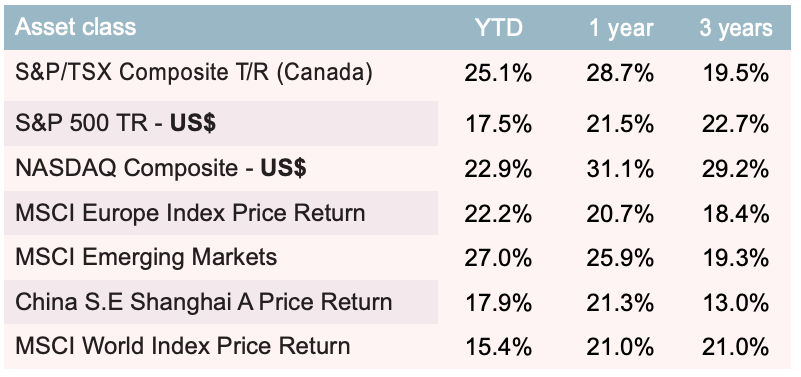
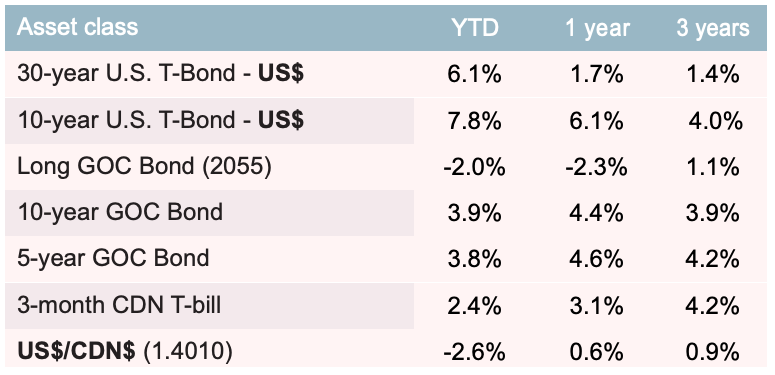
Source: RBC Capital Markets Quantitative Research