Michael Capobianco
RBC Wealth Management
October 8, 2026
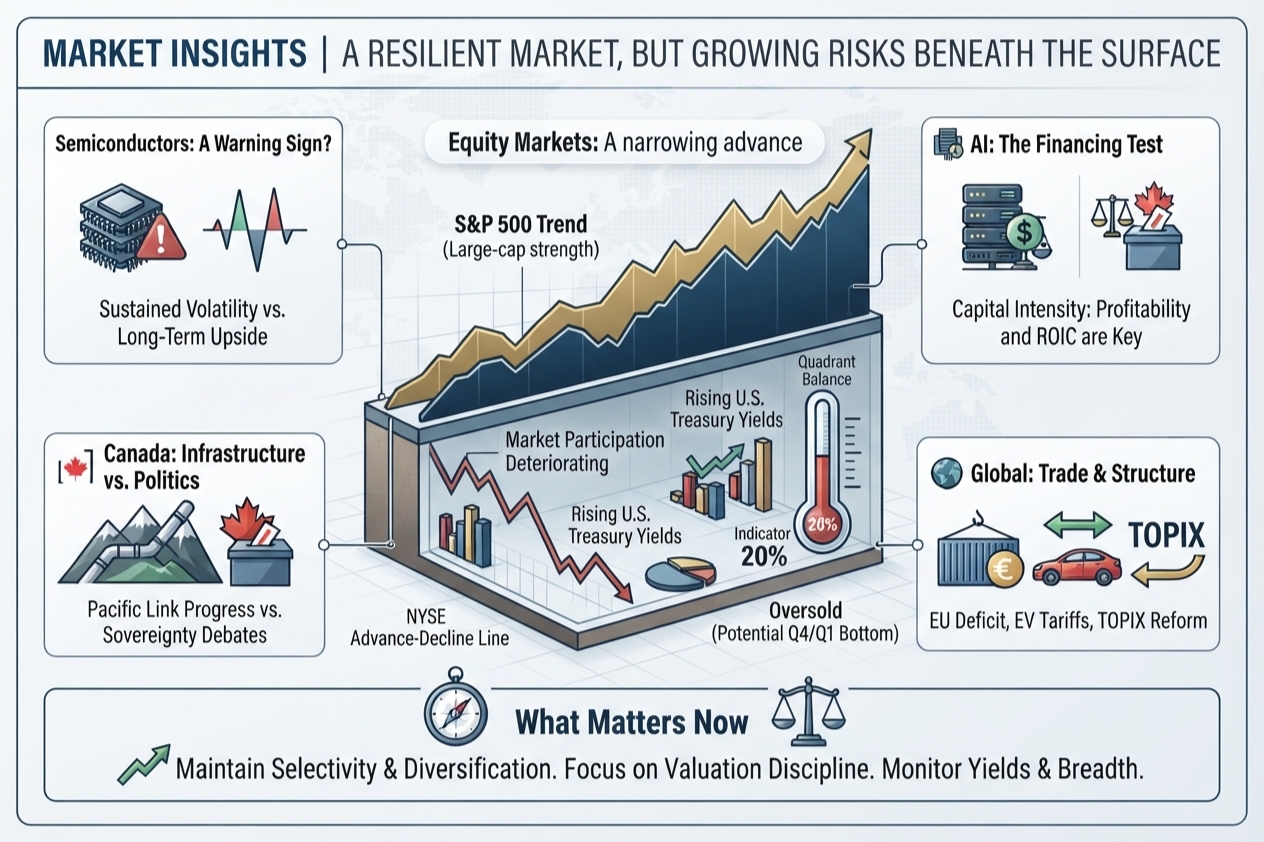
The S&P 500’s upward trend remains intact, supported by strength in large-cap technology and growth stocks. Beneath the surface, however, market participation has deteriorated.
Rising long-term U.S. Treasury yields have pressured many sectors, while the NYSE Advance-Decline line—a measure of the number of stocks advancing relative to those declining—has reversed its uptrend that began in late 2022.
This divergence matters.
A market increasingly dependent on a narrow group of large-cap leaders is more vulnerable to disappointment, particularly amid elevated valuations, geopolitical uncertainty and rising borrowing costs.
There are, nevertheless, reasons not to dismiss the possibility of a year-end recovery.
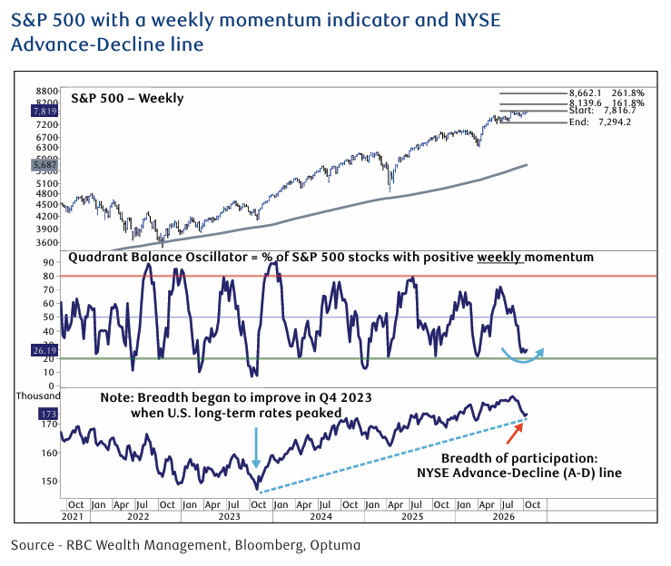
The third-quarter pullback has pushed the weekly Quadrant Balance Indicator, which measures the proportion of S&P 500 stocks exhibiting rising momentum, toward 20%—a level considered oversold. Historically, this indicator has helped identify market swings over one- to two-quarter periods. Its current reading suggests the potential for a bottom to develop in the coming weeks, although oversold conditions alone do not guarantee a rebound.
Interest rates remain the key variable.
The U.S. 10-year Treasury yield is approaching a technical level near 5.35%, while the 30-year yield is nearing a potential pause zone of 5.8%–6.0%. A stabilization in yields, combined with improving market breadth, would strengthen the case for a recovery. Until then, the headline index may offer a misleading picture of the broader market’s health.
Semiconductors: Another Advance Or A Warning Sign?
The semiconductor sector remains an important barometer for the broader technology cycle. The Philadelphia Semiconductor Index has surged approximately 600% from its late-2022 low, including a gain of more than 300% since the second quarter of 2025.
Despite this extraordinary advance, the longer-term trend remains positive. Following a 29% correction in June and July, many semiconductor stocks rebounded from support near their rising 200-day moving averages. The current recovery could lead to new highs in the fourth quarter of 2026 or first quarter of 2027.
The risk is that the rebound fails. A subsequent decline would establish a lower high, a pattern often associated with major market peaks. A break below the recent third-quarter lows would provide stronger evidence of a more significant deterioration. Given the sector’s influence on market performance and its substantial gains, investors should monitor price behaviour closely rather than assume the rally will continue uninterrupted.
Artificial Intelligence: The Financing Test
The AI investment cycle continues to expand, but the cost of funding that expansion is becoming increasingly important.
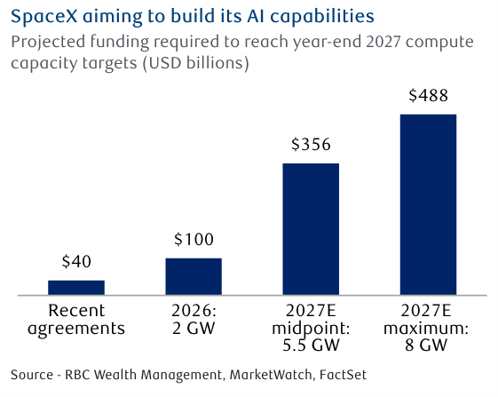
SpaceX is reportedly seeking approximately US$40 billion in financing to acquire NVIDIA processing units for its planned data-centre infrastructure, including ambitions for orbital data centres. Looking further ahead, estimates cited by MarketWatch suggest that achieving the midpoint of Elon Musk’s stated computing-capacity target for the end of 2027 could require more than US$300 billion in funding during that year.
The broader implication extends well beyond SpaceX. Major technology companies are increasingly using debt to finance AI infrastructure, raising the stakes for returns on invested capital. Borrowing can accelerate development, but it also creates obligations that must be serviced regardless of whether anticipated returns materialize.
AI remains a potentially transformative investment theme. However, as capital requirements grow, investors will increasingly distinguish between companies that can translate spending into sustainable earnings and those whose valuations depend primarily on future expectations. The next phase of the AI cycle may be judged as much by financial discipline as by technological progress.
Canada: Infrastructure Ambition Meets Political Uncertainty
Canada has taken a significant step toward expanding energy exports beyond the United States. The proposed Pacific Link pipeline has been designated a project of national interest, allowing an accelerated federal approval process. The 1,250-kilometre project would transport an additional one million barrels of crude oil per day from Alberta to a proposed export terminal on British Columbia’s coast.
Preliminary construction estimates range from C$35.2 billion to C$43.7 billion, with construction not expected to begin before September 2027. The project aligns with Ottawa’s goal of doubling non-U.S. oil exports over the next decade. Its ultimate economic impact, however, will depend on financing, execution, approvals and access to global markets.
Political uncertainty also bears watching. Quebec’s Parti Québécois has returned to power with a minority government and has committed to a sovereignty referendum under specified circumstances. Alberta is preparing to hold a referendum on whether to pursue secession on October 19. While the eventual implications remain uncertain, renewed sovereignty debates add another layer of policy risk to Canada’s investment landscape.
Global Developments: Trade And Market Structure
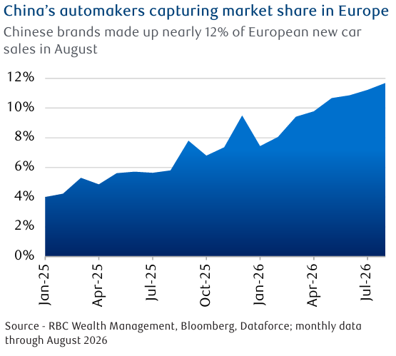
In Europe, France’s proposed 2027 budget targets a deficit of 5% of GDP, above the European Union’s 3% reference level. Meanwhile, the EU is considering restrictions on Chinese hybrid vehicle imports as competition intensifies. Chinese brands accounted for approximately 12% of European new-car sales and one-quarter of hybrid sales in August, underscoring the growing challenge to established manufacturers.
Japan is also reshaping its equity market. A major restructuring of the TOPIX benchmark will remove 683 companies and add 35 in the next phase of a multiyear effort to improve liquidity and investability. The reforms may strengthen corporate governance and shareholder returns, but smaller companies facing removal could experience additional selling pressure as market leadership shifts further toward larger firms.
What Matters Now
The equity bull market remains intact, but weakening breadth and rising interest rates argue for greater selectivity. Oversold conditions create the potential for a year-end rebound, though stabilization in yields and broader market participation would provide more convincing confirmation.
At the same time, the AI investment opportunity remains significant, but rising financing requirements make profitability and returns on capital increasingly important. Across Canada and international markets, infrastructure investment, political developments and trade policy will continue to create both opportunities and risks.
The priority is to remain positioned for opportunity without becoming complacent about risk. In a market where headline performance can conceal underlying weakness, diversification, valuation discipline and attention to changing market conditions remain essential.
As always, please let me know if you have any questions or comments.
Many Thanks