
Michael Capobianco
August 27, 2026
This week was important from not only an earnings standpoint, but also allowing for a spot check on the state of the tech industry.
AI: From Enthusiasm to Evidence
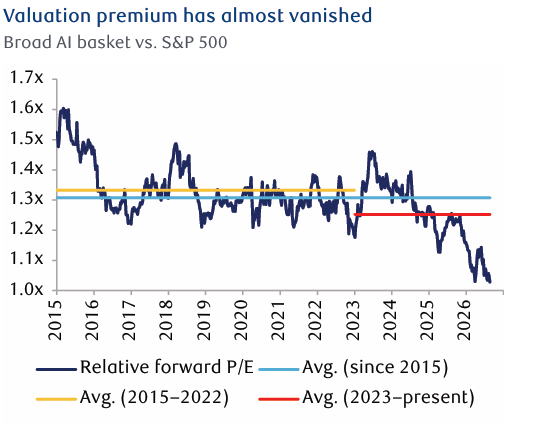
The AI investment story is entering a more disciplined phase. While concerns around enormous capital requirements, uncertain monetization and disruption risks are justified, valuations have already adjusted significantly. AI-related companies now trade at roughly 20x forward earnings, versus 28.5x in October 2025 and a 24.5x long-term average.
Key Points To Consider:
- AI valuations have reset: AI-related equities now trade at roughly 20x forward earnings, down nearly 30% from October 2025 and close to their historical valuation relationship with the S&P 500.
- The burden of proof has shifted: With AI capex by eight major U.S. technology companies expected to exceed $1 trillion in 2027, investors increasingly need evidence that spending is translating into sustainable revenue growth and returns.
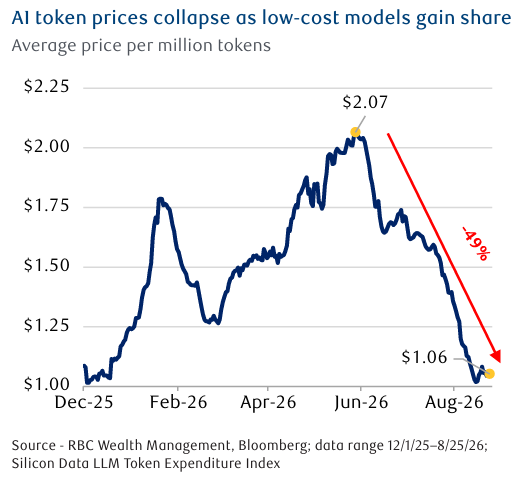
- AI costs are falling rapidly: The effective price of AI inference has fallen 49% since late May as lower-cost models improve. This should accelerate adoption, but could pressure pricing power and profitability for model providers.
- Regional trends remain supportive: Canadian growth faces renewed tariff pressure, European activity remains resilient, and Asian semiconductor stocks have rebounded strongly on continued AI infrastructure demand.
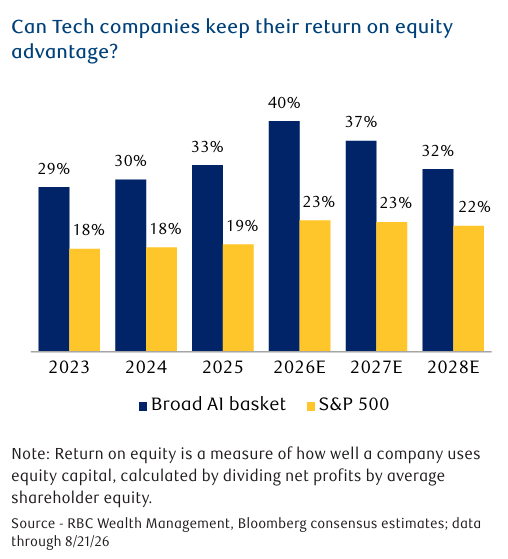
The key question is no longer whether companies will spend heavily on AI, but whether that spending can generate attractive returns.
Recent results from Microsoft, Amazon and Alphabet provided encouraging evidence, with accelerating revenue, strong margins and record backlogs. Continued earnings momentum will be critical to sustaining confidence in the AI infrastructure cycle, particularly for semiconductor and memory companies whose exceptionally high profitability could prove vulnerable if supply constraints ease.
At the same time, the economics of AI are changing rapidly.
Inference costs have fallen nearly 50% since May as increasingly capable, lower-cost models enter the market. Lower prices should broaden adoption and make more applications economically viable, but they also challenge the pricing power of frontier-model providers. Ultimately, the investment opportunity may extend beyond the companies building AI to the businesses using it to improve productivity and reduce costs.
Regional Outlook
Canada: The breakdown in U.S.-Canada trade negotiations has resulted in new 50% U.S. tariffs on certain Canadian imports and corresponding Canadian counter-tariffs. While the impact should be meaningful for affected industries, RBC Economics estimates the new U.S. tariffs cover roughly 5% of Canadian exports and 0.4% of GDP. The growth impact may reinforce expectations that the Bank of Canada keeps rates on hold through 2026.
U.K. / Europe: Eurozone activity remains resilient, with the August Composite PMI rising to 52.1. German manufacturing showed particular improvement, supported by defense spending and data-center investment. However, energy prices remain an upside risk to inflation, with markets increasingly expecting an ECB rate hike in September.
Asia-Pacific: Asian equities have rebounded sharply, led by semiconductors following NVIDIA’s strong outlook. Chinese AI developers are also making progress, with Z.AI emphasizing ultra-low-cost models and domestically produced chips, while MiniMax continues to post rapid revenue growth. Meanwhile, Kioxia and SanDisk’s planned US$31 billion NAND investment highlights the strength of long-term demand for AI-related memory capacity.
Investment Takeaway: AI remains a powerful long-term investment theme, but the market is becoming more selective. With valuations more reasonable, the next phase will depend on durable demand, improving monetization and evidence that extraordinary levels of AI investment can translate into sustainable earnings and cash flow.