
Michael Capobianco
May 21, 2026
The U.S. stock market has challenges coming from all sides yet continues to rally. At first glance the market may seem disconnected from reality.
Corporate earnings have been the great stabilizer.
While mindful of Middle East risks, what do earnings growth prospects mean for the equity outlook ?
The S&P 500 has surged 17 % since the late March Iran war low and is up 8.6 % year to date through May 20. This impressive run has materialized despite a barrage of challenges:
- Energy and fertilizer supply problems
- Uncertainties about whether the U.S.-Israeli war with Iran could reignite
- Another domestic and global inflation wave linked to high energy prices
- Treasury yields jumping to multi-year highs
- Market-based expectations about Federal Reserve policy shifting from a rate cut to at least a long pause – or even the small possibility of a rate hike later this year
- Consumer sentiment in the U.S. dropping to the lowest level since 1978
- Americans’ poor attitudes about the economy in multiple opinion polls.
So, is this misplaced optimism ? No. The market is grounded where it normally is - on corporate profits.
This is why it has defied the challenges thus far:
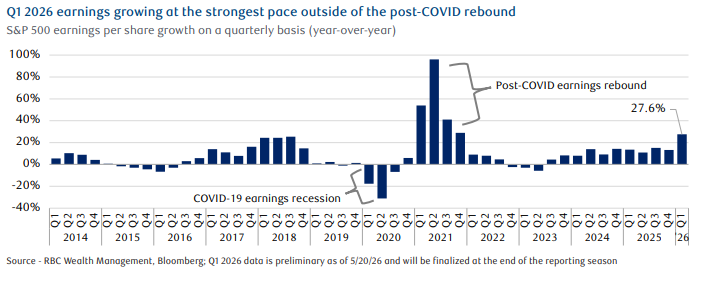
- S&P 500 earnings growth is pacing at 27.6 % year over year in Q1 – 2 times higher than the 12.4 % consensus forecast
- Outside of post-recession rebounds, earnings growth rarely exceeds expectations by such a large margin
- The ongoing AI infrastructure buildout is by far the main contributor
- S&P 500 AI basket of stocks saw its Q1 consensus earnings growth forecast surge from 23.6 % in early January to 66 %
Inside the AI group, semiconductor and semiconductor capital equipment stocks have led, delivering 85 % year-over-year earnings growth in Q1.
When AI stocks are excluded from the S&P 500 data, at first glance the earnings growth rate looks much less impressive at 14.4 % year over year – however – very important to keep in mind that non-AI profit growth rate is also above the S&P 500’s long-term average - and it is rather high on a historical basis.
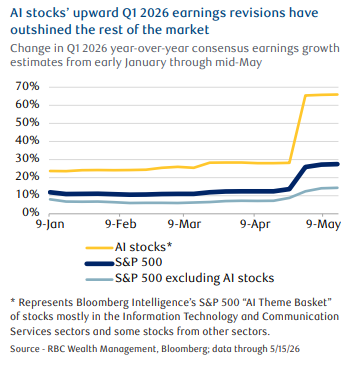
7 of 11 sectors are on pace to grow earnings at double-digit rates in Q1, including Materials at 44 % and Financials at almost 23 % year over year.
The S&P 500’s overall 27.6 % earnings growth rate in Q1 is also impressive compared to most years since 2014. It’s the strongest growth rate outside of the highly unusual post-COVID period, which followed abrupt and deep earnings and economic recessions and included unprecedented fiscal stimulus.
As long as S&P 500 earnings growth has the potential to rise at a respectable clip over the next 12 months or more, the bull market can persist, notwithstanding some turbulence along the way.
A strong relationship between earnings growth and stock market returns has historically played out over time.
When profit growth rises over several quarters, the stock market tends to remain elevated or push higher. Conversely, when earnings growth falls during periods of economic weakness or recession, the market tends to wobble or decline.
The consensus forecast currently calls for double-digit profit growth in each of the next six quarters, driven by the AI infrastructure boom amid a non-recessionary environment.
At this stage, RBC Economics forecasts U.S. GDP growth of 2.1 % in 2026 and 1.9 % in 2027. Risks to this scenario largely center on the Middle East:
- Whether the region’s energy and chemicals infrastructure are further damaged due to a renewed military clash
- Whether Strait of Hormuz commodity flows remain constrained for a prolonged period.
While the consensus earnings growth prospects look attractive, the chances that shipping traffic through the Strait could remain throttled for additional months are too big to ignore.
It is reasonable to continue to hold U.S. equities up to, but not beyond, a Market Weight allocation.
If you have any questions or comments, please feel free to let me know.