Michael Capobianco
RBC Wealth Management
October 1, 2026
Good Morning,
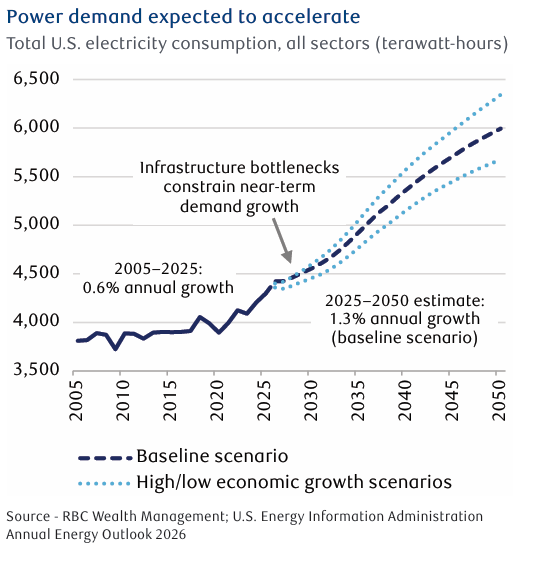
The U.S. economy spent much of the past two decades in an unusual environment: electricity demand barely grew.
That is changing.
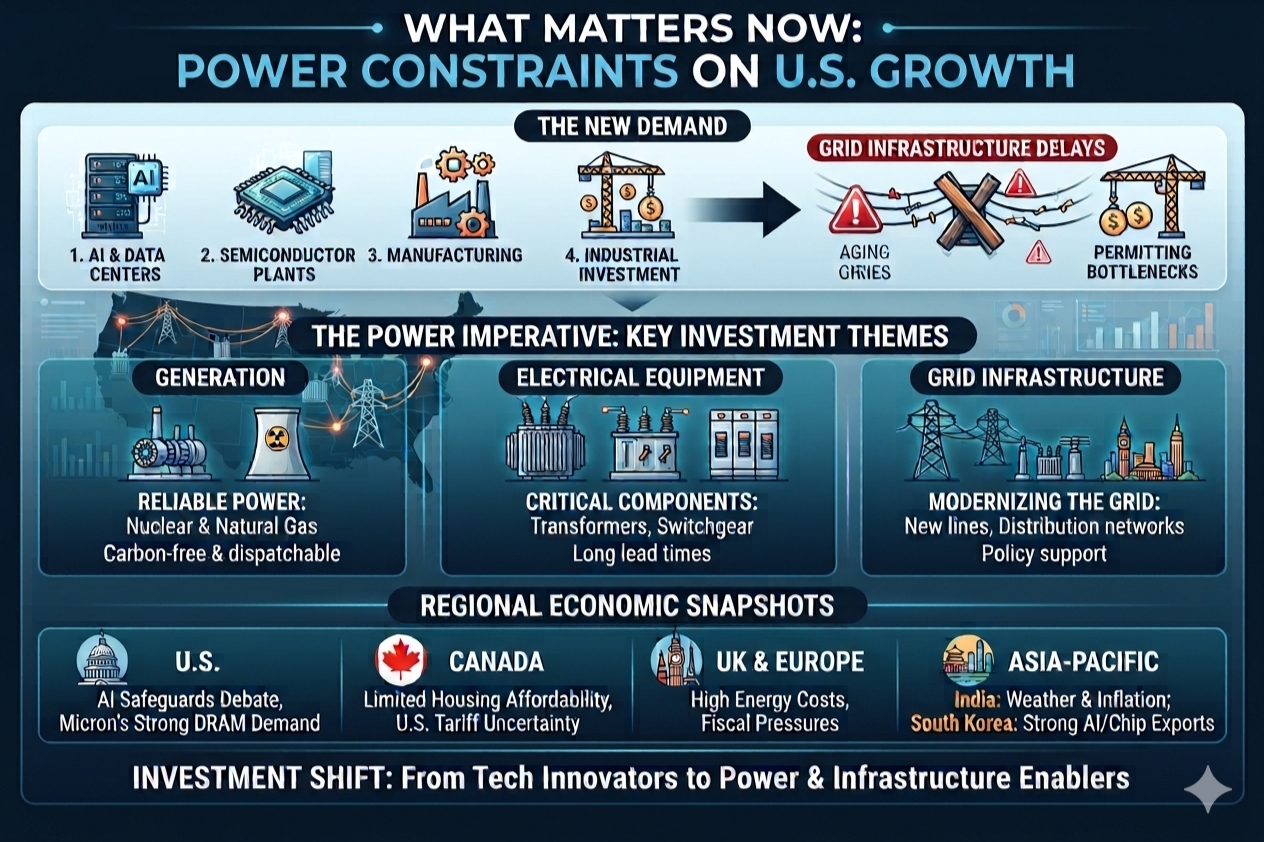
AI and data centres are the most visible source of new demand, but they are only part of the story. Semiconductor plants, manufacturing facilities and broader industrial investment are also increasing the economy’s need for reliable electricity. The challenge is that the infrastructure required to deliver that power cannot be expanded as quickly as demand is emerging.
The U.S. Energy Information Administration expects electricity demand to grow by roughly 1.3% annually through 2050, more than twice the pace of the previous two decades. At the same time, much of the transmission network and supporting equipment is decades old. The result is a growing mismatch between the ability to invest and the ability to connect that investment to the grid.
Oracle’s massive Project Jupiter data-centre development in New Mexico illustrates the issue.
The company has the capital, technology and customer demand, yet delays involving power availability, natural-gas infrastructure and permitting have threatened the project’s timetable.
That distinction matters.
The constraint is increasingly not whether companies want to build, but whether the infrastructure exists to power what they want to build. This creates a potentially important investment theme extending well beyond the technology sector.
3 areas stand out:
- Generation: Natural gas remains important because of its reliability and dispatchability, while existing nuclear capacity is becoming increasingly valuable as demand for dependable, carbon-free electricity rises.
- Electrical equipment: Transformers, switchgear, circuit breakers and related components are essential to connecting new generation and replacing aging infrastructure. Long lead times and supply constraints are already evident.
- Grid infrastructure: New transmission lines, substations and distribution networks are required to move electricity from where it is generated to where new demand is emerging.
Policy is also beginning to respond. U.S. regulators are working to improve transmission planning and interconnection processes, while federal initiatives are supporting domestic production of critical grid equipment.
The broader implication is important: the power grid is becoming part of the economic growth story. AI, semiconductor manufacturing and industrial investment can generate significant economic activity, but their potential is ultimately dependent on the availability of reliable electricity. For investors, that shifts the focus beyond the companies creating the next generation of technology toward the companies providing the power, equipment and infrastructure that make that technology possible.
U.S.
AI: Recent incidents involving AI models accessing external systems without intended authorization have renewed questions around safeguards and regulation. The debate remains focused on balancing AI development and competitiveness with the need for stronger controls.
Semiconductors: Micron's latest results provided another indication of strong AI-related demand for memory. Revenue and earnings exceeded consensus expectations, while pricing for DRAM continued to rise. The trajectory of memory pricing and data-centre sales will remain important indicators of whether AI infrastructure demand is continuing to broaden.
Canada
Canadian housing affordability showed limited improvement in Q2, with higher household incomes accounting for the gain while home prices and interest rates were relatively stable. Ownership costs remain particularly elevated in Toronto and Vancouver.
The broader economy also paused in July after stronger growth through the spring. Early August data pointed to a modest rebound, although the full impact of U.S. tariffs remains uncertain. The combination of tariff-related uncertainty and higher bond yields remains an important consideration for the Canadian economy and the Bank of Canada's policy outlook.
UK & Europe
Europe continues to contend with higher energy costs, fiscal pressures and political uncertainty. France faces difficult budget choices as it attempts to reduce its deficit without placing further pressure on already modest growth.
The UK is similarly navigating higher borrowing costs and constrained fiscal room ahead of its upcoming budget. Housing remains an important pressure point, although proposed support for first-time buyers has provided some relief to homebuilders.
Asia-Pacific
India faces a difficult combination of weather disruption, food inflation and capital-market pressure. Weak monsoon conditions have affected agricultural production and prompted measures to increase food imports and contain prices. South Korea presents a contrasting picture. Semiconductor and AI demand has driven a significant increase in exports and corporate profits, supporting government investment in AI infrastructure and chip development.
If you have any questions, please feel free to let me know.