Michael Capobianco
July 16, 2026
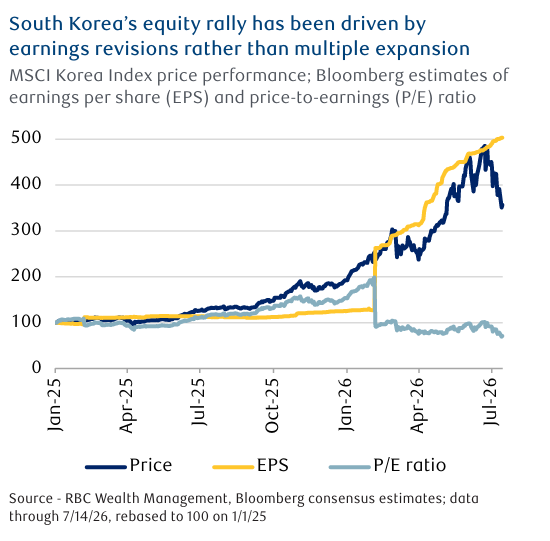
The MSCI Korea Index surged 150 % to its June peak before a sharp selloff of 25 % within a month.
Today we’ll explore the overstated moves and where the market may be heading.
South Korea’s stock market was off the radar of most investors until the AI narrative emerged. From 2025 onwards South Korea’s pivotal role in the AI semiconductor supply chain prompted a reassessment of the market.
Since then, South Korea has surpassed the UK to become the world’s eighth-largest stock market. Its 23 % weighting in the MSCI Emerging Markets Index now exceeds that of China, who are at 19 %.
The remarkable rally has been propelled by improved performance from Korea’s two giant memory chipmakers, which account for approximately 67 % of the MSCI Korea Index’s weighting.
The Korean equity rally represents the most extreme expression of the AI story, The narrow concentration is creating significant macroeconomic spillover effects.
Investor participation and leveraged ETFs Korean household assets are predominantly anchored in real estate. Equities represent a modest 20 % of financial assets, translating to roughly 7 % of total household wealth.
Important to note - individual investors drive nearly half of all market trading volume.
 Since late last year, individual investors emerged continue to move capital into local stocks in pursuit of market momentum. These inflows were recently amplified by leveraged exchange-traded funds (ETFs).
Prior to May, the country lacked single-stock leveraged ETF products; investors seeking exposure by purchasing leveraged Korean ETFs through overseas exchanges such as Hong Kong.
Recognizing this outflow, South Korean regulators moved to repatriate individual trading activity by launching the country’s first single-stock leveraged ETFs in late May. Leveraged ETFs with underlying Korean equities have since swelled to US$50 billion in assets under management, generating considerable market volatility.
What sets today’s volume surge among individual investors apart from previous episodes is the focus on sectors driving benchmark performance, particularly semiconductors and broad-based ETFs, rather than the more dispersed participation in previous cycles.
When equity prices decline, individual investors often shift from accumulation to “protection,” moving to lock in gains and reduce losses. This dynamic underscores why an analysis of fundamentals may not be able to predict near-term price movements.
Daily rebalancing requirements mean leveraged ETFs adjust positions to maintain their target leverage ratios. This serves to amplify price movements in both directions:
- During uptrends, this can enhance returns.
- During downturns, the forced adjustment of positions can intensify, accelerating market declines
This week, Korean financial regulators announced measures to tighten regulations on these products with the aim to better protect investors. The Bank of Korea raised its benchmark policy rate by 25 basis points to 2.75 %, which is the first increase in over three years.
While these measures may help stabilize markets over the longer term, they are likely to trigger increased market swings in the short term as investors may rush to reduce their positions.
What makes the current circumstance special is that Korea’s equity rally has stemmed from strong corporate earnings growth and upward revisions to management guidance for earnings rather than valuation expansion. As AI workloads grow in complexity, memory bandwidth has emerged as a critical constraint on system performance, providing strong pricing power for Korea’s memory producers.
Demand for high bandwidth memory should remain robust over the next 6–12 months.
Expanding edge AI applications and on-device processing capabilities should sustain structural demand for advanced memory well beyond the data center cycle. Robust earnings growth makes the benchmark MSCI Korea Index valuation look reasonable even after the sharp rally.
Korean stocks currently trade at a forward price-to-earnings ratio of around 6x, which is at a discount compared to major regional peers. This suggests to us that investors have not assigned a premium valuation to Korean equities despite their strengthened earnings trajectory and outlook.
Will this discount stay in place ? If so, for how long ?
Drawing on Japan’s corporate reform experience, the Korean government launched the “Corporate Value-Up Program” in 2024 to address these structural impediments, strengthen governance standards, and support equity valuations.
Korea’s strategy combines direct corporate engagement with market infrastructure improvements. Authorities have introduced incentive frameworks to encourage participation, established the Korea Value-Up Index with accompanying ETFs, and worked to expand the investor base while fostering more stable, long-term capital deployment.
Early momentum is evident.
Since mid-2025, foreign investor inflows into Korean equities have accelerated. Shareholder return metrics have strengthened, with dividend payments and share buybacks consistently trending upward.
These governance improvements and capital market reforms should provide sustained support to valuations going forward.
Market concentration, elevated individual investor participation, and leveraged ETF positioning have amplified the recent moves in Korean equities. The unwinding of speculative positions may extend volatility in the near term.
The unfolding AI growth story provides investors with an opportunity to reassess Korean equities and identify sustainable, longer-term growth drivers beyond the current cycle.
If you have any questions or comments, please feel free to let me know.
Many Thanks,