
Michel Capobianco
April 16, 2026
The U.S. stock market’s resilience was on display again after it powered to a new all-time high as Middle East crisis risks de-escalated. Still, inflation and economic growth headwinds shouldn’t be dismissed, and we examine how the investment environment is taking shape.
The S&P 500 experienced a 7.8 % pullback from the onset of U.S. and Israeli strikes on Iran through March 30 compared to the 6.0 % average decline. A quick V-shaped recovery then followed, bringing the index to a slightly higher level than it was before this conflict began.
This journey took only 30 trading sessions. The average is 28 sessions in 19 of the prior episodes. Then the S&P 500 climbed to a new all-time high on Wednesday on further optimism about the ceasefire and U.S.-Iranian negotiations, and the related decline in crude oil prices.
Likely the most important factor has pushed the market higher:
- Upward revisions to S&P 500 consensus earnings estimates (especially in the technology sector)
- A good start to the Q1 earnings results reporting season from the Financials sector.
There is evidence that some fast-money hedge funds were not well-positioned for the snapback rally. As the market ticked higher and higher, it likely created short-covering buying pressure.
Energy Effect
The price of physical Brent oil sold to buyers retreated to about $116 per barrel on Thursday, , down from a peak of $144 per barrel on April 7. While that is still quite lofty and well above the Brent futures (paper) price, the latter has retreated as well, to around $99 per barrel in midday trading during the same session.
RBC Capital Markets, LLC’s Head of Global Commodity Strategy and Middle East and North Africa Research Helima Croft wrote, “From our standpoint, we certainly see scope for the continuation of the ceasefire, as a respite from drone and missile attacks is likely advantageous for both sides.” However, as long as oil barrels are not moving through the Strait, the economic cost will mount ahead of summer, even if market participants continue to price in an off-ramp.
Inflation Strength
Despite signs of de-escalation in the Middle East crisis, many developed and emerging economies are now grappling with inflation and economic growth headwinds caused by the energy price shock.
The impact appears less acute for the U.S. but is not immaterial.
The Consumer Price Index (CPI) rose to 3.3 % in March, surging nearly 1.0 % compared to the previous month, a pace reached only during serious bouts of inflation, including those in the 1970s and early 1980s.
No surprise, the culprit was mainly higher gasoline prices, which shot up 21.2 % month over month.
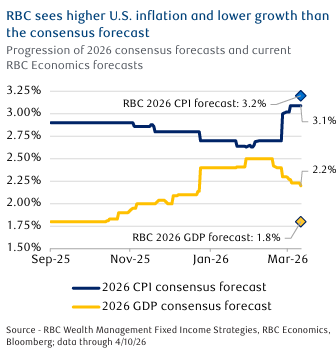
Following the inflation report, RBC Economics raised its full-year 2026 CPI forecast to 3.2 %, a bit higher than the 3.1 % consensus forecast. Assuming oil prices don’t leap again and the crisis is resolved soon, our economists expect inflation to peak at 3.7 % in Q2 before pulling back to 3.0 % by year end, not much higher than where it stood earlier this year.
Normally, a brief bout of 3.0 %-plus inflation can be absorbed by households and businesses without much trouble. This is, however, happening on top of a significant inflation wave.
Consider that on a cumulative basis, consumer prices have risen over 27 % since COVID hit in early 2020— and that’s just the official data. If energy prices remain elevated for a prolonged period or increase again, and a lengthy energy supply shock unfolds, strains on global supply chains could surface.
Slower GDP
When the Middle East crisis began, the U.S. economy looked like it was on relatively solid footing. However, downward revisions to prior data by the Bureau of Economic Analysis indicate the economy instead had been somewhat wobbly.
In April, Q4 2025 GDP growth was revised lower for the second time, to only 0.5 %, whereas the initial reading had been 1.4 % back in February.
RBC Economics recently cut its 2026 GDP growth forecast to 1.8 %, beneath the 2.2 % long-term average and consensus forecast. By way of comparison, GDP growth was 2.1 % in 2025.
Since 1990, below-trend GDP growth between 1.1 % and 2.0 % has delivered mid-single-digit S&P 500 price returns (ex- dividends), on average, according to RBC Capital Markets.
Our economists still don’t see elevated recession risks at this point.
Households should be able to tap into savings to blunt the immediate inflation impact before pulling back on spending on non-energy goods and services.
High-income households—those that benefit the most from the “wealth effect” associated with stock market gains are unlikely to rein in spending much despite the challenging inflation period.
The stock market rally has helped, and this group has significant savings and is the biggest beneficiary of the
One Big Beautiful Bill Act’s approximately $50 billion of additional income tax refunds.
Looking Forward
RBC Global Asset Management Inc.’s Chief Economist Eric Lascelles wrote, “The economic rule of thumb is that spillover effects should be limited until an energy shock has lasted for 3–6 months, at which point the danger starts to grow. This war is currently just 1.5 months old and has a good chance of being resolved before that danger zone is entered.”
We continue to recommend that investors remain committed to equities in portfolios up to but not beyond the long-term strategic asset allocation level.
If you have any questions or comments, please feel free to let me know.
Many Thanks,