The China-U.S. AI Race: Who Is Leading ?
8 major U.S. hyperscalers will spend more than US$780 billion on capital expenditures in 2026, up 76% year over year. China’s major internet companies and telecom carriers plan roughly US$85 billion in data-centre spending—about one-tenth of the U.S. total. Rising memory-chip prices further constrain purchasing power. U.S. export controls restrict access to advanced equipment, particularly extreme ultraviolet lithography machines. Chinese chipmakers are responding through chip stacking and system-level optimization, but supply constraints may persist.
8 major U.S. hyperscalers will spend more than US$780 billion on capital expenditures in 2026, up 76% year over year. China’s major internet companies and telecom carriers plan roughly US$85 billion in data-centre spending—about one-tenth of the U.S. total. Rising memory-chip prices further constrain purchasing power. U.S. export controls restrict access to advanced equipment, particularly extreme ultraviolet lithography machines. Chinese chipmakers are responding through chip stacking and system-level optimization, but supply constraints may persist.

Michael Capobianco
RBC Wealth Management
October 15, 2026
China’s AI models increasingly rival leading U.S. alternatives, but semiconductor constraints remain a major obstacle. Since the “DeepSeek Moment” in January 2025, Chinese developers have narrowed the performance gap. Moonshot’s Kimi K3, for example, approaches advanced U.S. models at a fraction of the cost. Chinese models are also among the most downloaded on Hugging Face.
Open-source availability and lower costs have helped Chinese models, but not all firms compete on price. Moonshot positions Kimi as a premium model; Qwen and Z.AI offer advanced and lower-cost tiers; DeepSeek emphasizes affordability. U.S. providers are cutting prices too, while premium models target complex enterprise needs.
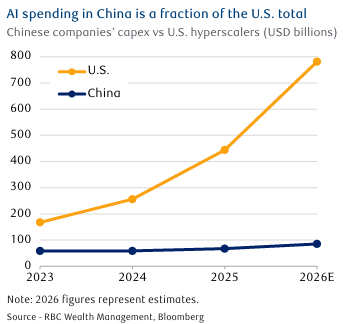
Semiconductors remain China’s biggest constraint. Bloomberg projects eight major U.S. hyperscalers will spend more than US$780 billion on capital expenditures in 2026, up 76% year over year. China’s major internet companies and telecom carriers plan roughly US$85 billion in data-centre spending—about one-tenth of the U.S. total. Rising memory-chip prices further constrain purchasing power. U.S. export controls restrict access to advanced equipment, particularly extreme ultraviolet lithography machines. Chinese chipmakers are responding through chip stacking and system-level optimization, but supply constraints may persist.
Public attitudes differ, too. Stanford University’s 2025 AI Index found 84% of Chinese respondents were excited about AI, compared with 38% of Americans. Workforce composition, trust and expectations of personal benefit may explain the contrast. Engineering talent, affordable energy and industrial applications will help shape China’s long-term competitiveness.
U.S.
Inflation remains stickier than expected. September’s Consumer Price Index suggested higher energy costs are spreading into broader goods and services inflation. Treasury yields initially rose on rate-hike concerns, then eased after Fed speakers urged patience despite a stronger-than-expected Producer Price Index.
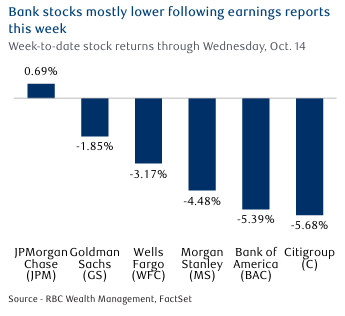
Earnings season began with disappointing reports from major banks. A flatter yield curve and delayed IPOs, debt offerings and mergers have weighed on results, though most sectors have yet to report.
Technology shares weakened as investors questioned returns on AI infrastructure investment in a higher-rate environment. Progress by China’s ChangXin Memory Technologies raised concerns about a potential new competitor to major memory-chip makers. Higher borrowing costs have pressured leveraged cloud and server suppliers. Despite supportive commentary from Broadcom, ASML and Taiwan Semiconductor, AI-related stocks remained under pressure. Investors may be resetting expectations.
CANADA
Canada lost 68,000 jobs in September, far below expectations for a 9,200 increase. Employment has fallen by 110,000 over two months and is down 41,000 year to date. Losses were concentrated in the public sector, particularly education and health care, while private-sector employment was broadly unchanged. Those aged 15–24 accounted for about 70% of the decline. Quebec lost 49,000 jobs, British Columbia and Ontario each lost 20,000, while Alberta added 23,000. Unemployment rose to 6.5% from 6.4%.
Aging and lower immigration are weighing on labour-force participation. RBC Economics remains cautiously optimistic, citing job postings as evidence of resilient hiring demand and expecting unemployment to decline toward year-end.
Canadian equities have returned 15% year to date, broadly keeping pace with U.S. and global markets. Energy, Materials and Financials—just under 70% of the S&P/TSX Composite—have led, supported by bank earnings and higher commodity prices. Lately, trade uncertainty and elevated bond yields have pressured rate-sensitive sectors. These risks may persist. With analysts expecting roughly 20% year-over-year Canadian earnings growth in Q3, corporate results and guidance will shape the near-term outlook.
U.K. and Europe
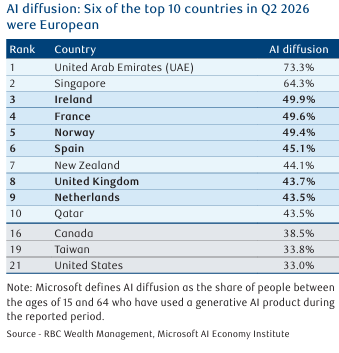
Ireland hosted an AI summit in Dublin on October 14, bringing together policymakers and technology leaders including Microsoft President Brad Smith and Google DeepMind chair Demis Hassabis. Its low corporate tax rate and English-speaking workforce have attracted 16 of the world’s 20 largest technology companies to establish their main EU bases there. Clearer data-centre grid rules could support capacity; Ireland ranked third globally in Q2 2026 AI adoption, according to Microsoft.
Analysts expect eurozone Q3 earnings to rise 17% year over year, led by energy companies benefiting from elevated prices and stronger refining margins. Excluding energy, expected growth remains 10%, supported by mid-single-digit revenue growth and a weaker euro that may benefit exporters. Margins are expected to widen as companies pass on higher prices and benefit from operating leverage and restructuring. Automakers and suppliers remain exceptions amid stronger Chinese competition.
ASML, Europe’s largest company by market capitalization, reported better-than-expected Q3 results and raised its 2026 guidance. AI investment is extending lithography-equipment order visibility into 2029–2030. Management expects planned 2027–2028 supply to fall short of demand and is exploring ways to expand capacity. RBC Capital Markets expects double-digit growth in the wafer-fab-equipment industry through 2028.
Asia-Pacific
South Korea’s KOSPI has fallen about 16% since October 8 amid concerns about U.S. monetary tightening, technology valuations and the sustainability of AI spending. Semiconductor leaders Samsung Electronics and SK Hynix have been hit hard despite strong operating-profit growth. In our view, the selloff reflects investor pessimism and leveraged-position unwinding more than deteriorating industry fundamentals. Results point to continued demand for high-bandwidth memory and AI infrastructure.
The correction has pushed the KOSPI’s forward price-to-earnings ratio below 5x. Resilient earnings and structural demand may create opportunities for medium- and long-term investors. However, macroeconomic uncertainty, foreign selling and cautious sentiment could drive further volatility. We remain constructive but favour a selective, gradual approach to increasing exposure.