Michael Capobianco
May 14, 2026
Good Morning,
Until quite recently, the AI boom had been viewed in an almost entirely positive light.
The extremely large data center expansion provides material support to near-term U.S. economic growth, and the technology is likely to deliver significant productivity gains over time.
For all of this promise, fears are now growing that AI could also disrupt sectors, hurt workers, and pose a risk to the economy.
Let’s walk through the most likely scenario analyses:
Minor Use: 25% Probability:
At the cautious end of the spectrum, perhaps large language models prove to be a minor general use technology—useful, but not revolutionary. In this scenario, the rate of AI improvement slows significantly, or even stops.
Productivity growth picks up even in this conservative scenario, but perhaps by only 0.25 % per year.
The tech giants that spent massive sums end up with a poor return on their investment, AI adopters fare somewhat better, and the world is not wildly different from today.
General Purpose Technology: 45 % Probability:
AI could become a major general-purpose technology, on par with the invention of electricity, the internal combustion engine, or the computer.
This leads to notable job displacement, and some sectors suffer, but the potential prosperity resulting from AI also creates new sectors and job opportunities.
There is ample historical precedent for this.
Improvements in farm efficiency caused the U.S. agricultural share of employment to collapse from 41 % in 1900 to 21.5 % in 1930 and then to just 12 % in 1950, all while food production rose and unemployment remained stable. Those farmhands moved to cities and secured better jobs.
Importantly, demand would rise as products became less expensive.
Some sectors, including management consulting, architecture, investment banking, and marketing, have such elastic demand—meaning demand increases as prices fall—that it is theoretically possible AI could even increase the need for humans rather than reduce it.
Past predictions of technology-driven doom have reliably been exaggerated:
- Brick-and-mortar stores still account for 84 % of retail spending
- Airplanes did not completely replace the train
While AI appears theoretically capable of disrupting a large share of employment, it may ultimately falls short of doing so.
AI accelerates productivity growth by a substantial 0.5–2.5 % per year, unleashing a golden age of growth like the 1990s–2000s computer boom.
The tech giants earn a solid return on their investment, AI adopters benefit substantially, and as with prior technological leaps, unemployment does not permanently increase.
Extraordinary Disruptor: 30 % Probability:
In this scenario, AI proves to be an unprecedented disruptor due to its capacity for self-improvement, the speed of its adoption, the scale of its impact, and its destruction of high-skill jobs. This could lead to a range of quite different outcomes.
The dystopian AI scenario envisages companies replacing a significant share of their workforce with AI, with displaced workers cutting spending – leading to a decline in demand that could be severe enough to overwhelm the productivity gains from AI, rendering workers and businesses worse off.
A deep recession ensues, triggering further layoffs and creating a vicious cycle that ends with the economy collapsing and even AI developers impoverished. AI displaced workers would face a variety of unique challenges.
Historically, technological advances reduced the number of difficult, dangerous, tedious, and low-paying jobs. By contrast, AI is more likely to replace the interesting, engaging, high-paying jobs, disrupting workers into positions down the income hierarchy, rather than up, as has usually been the case in the past.
This is problematic, as the top 10 % of U.S. households by income— disproportionately white-collar workers—generate nearly half of consumer spending.
AI is seemingly capable of disrupting many different sectors all at once.
Even if other jobs do eventually prove available to displaced workers over the long run, it is unlikely the rest of the economy can absorb them quickly enough to avoid significant pain. In this scenario, humans are essentially the horses that never found another purpose after the automobile was popularized.
Utopian scenario: 3 % probability
There are other ways the “unprecedented disruptor” scenario could unfold. At the opposite extreme, there is a utopian scenario rooted in the idea that AI-driven productivity gains will be so large that they create a world of abundance.
If the annual productivity growth rate accelerates by 5 % or even 10 %, the global economy is doubling or better in size every decade. The resulting positive supply shock lowers business costs, inducing falling prices and surging corporate profits. Real wages rise while government coffers swell, allowing policymakers to amply compensate displaced workers via basic income or unemployment transfers.
Displaced workers effectively retire early or work part time. People also enjoy access to an unprecedented amount of high-quality knowledge and advice, improving their quality of life. At the societal level, AI makes breakthroughs in fields such as drug development and medical treatments, materials science, and nuclear fusion. Human life expectancy soars and climate change slows.
Mixed AI outcome: 24 % probability
It has to be conceded that the aforementioned dystopian scenario feels more plausible than the utopian one.
So why the ascription of a low likelihood?
This is because if the world were to find itself steering toward the dystopian sub-scenario, governments would likely intervene.
A tax on AI’s “compute” would make using AI relatively more expensive for businesses, rendering human labour comparatively more competitive, and generating tax revenue to retrain and at least partially compensate structurally displaced workers.
Productivity growth remains rapid in this mixed income scenario despite being somewhat dimmed by the AI tax. Businesses are the disproportionate beneficiaries, while displaced workers are somewhat worse off even after the government remedy.
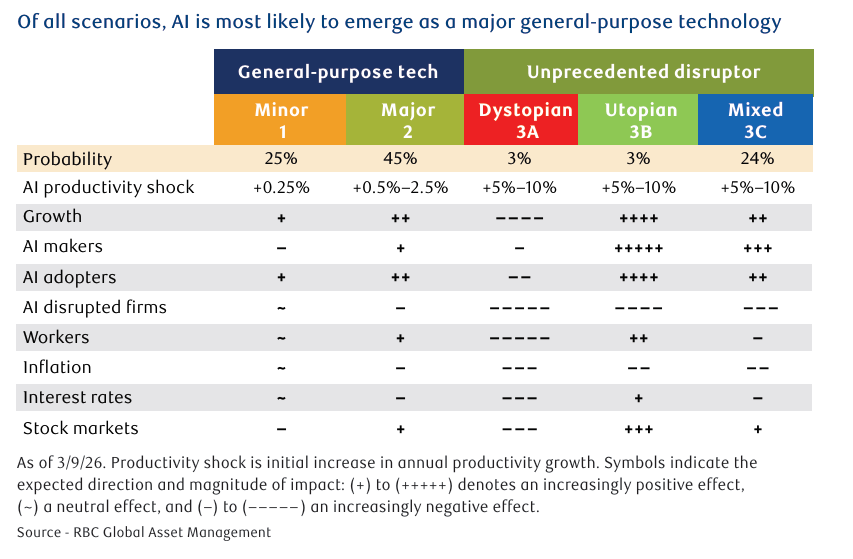
There are a number of ways this AI revolution could unfold. The table on the previous page provides a preliminary attempt at quantifying the impact of the scenarios on key variables.
The most likely outcome, albeit with only a 45 % probability, is that AI technology proves to be a “major general-purpose technology,” accelerating the rate of productivity growth, increasing corporate profits, and displacing some workers—but without permanently increasing the unemployment rate.
If you have any questions or comments, please feel free to let me know.