Michael Capobianco
April 30, 2026
A new era is at hand at the Fed with Kevin Warsh poised to become the central bank’s next chair. Today we’ll look at how this may affect monetary policy ahead, while providing a comparison to past regimes.
Given that AI is all the rage, what does it have to say about the Fed’s current stance?
Large Language Models from Bloomberg that scores the Fed chair’s opening statement in terms of what it perceives to be hawkish sentences and dovish sentences, as well as an overall score—and covers the span of Jerome Powell’s tenure as chair from March 2018.
Clearly, the model flagged a significant shift in tone at this week’s meeting from mildly dovish in March to the most hawkish since 2023.
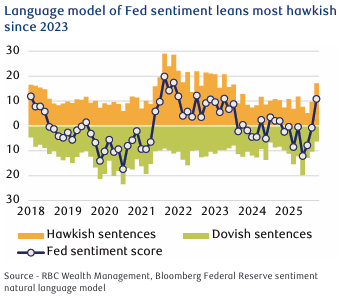
Perhaps that’s unsurprising given the ongoing risks posed to inflation from the emergence, and duration, of higher oil and gas prices.
This however is not just an energy price story.
Back in January, some policymakers were already seeing the need to communicate to markets that there are “two-sided risks” to the outlook for rates—or that a rate cut could be just as likely as a rate hike.
As the official policy statement currently reads: “In considering the extent and timing of additional adjustments to the target range for the federal funds rate, the Committee will carefully assess incoming data, the evolving outlook, and the balance of risks.”
After a series of rate cuts, that implies a further easing bias.
When asked why the change in language wasn’t made at this meeting, Powell noted the significance of such a shift, most at the Fed still wanted to wait and assess further economic data before making the pivot.
Now the stage is set for a new Fed chair in Kevin Warsh (Senate confirmation is expected in the coming weeks) and the next phase of monetary policy setting.
Key Questions:
- Will that amendment be made at the next meeting in June?
- Will there be interest rate forecasts?
- Will there even be a press conference?
- Will there be anything at all?
Warsh has often spoken of his desire for “regime change” at the Fed, specifically with respect to how it makes policy decisions, what those decisions are based upon, and how those decisions are communicated to the public.
He has explicitly stated that he is not much of a fan of forward guidance, feeling that the Fed communicates too much, and that a press conference after every meeting might not be necessary.
He has even stated that the Fed—at eight meetings per year—meets too often.
It is unlikely to see any major changes by his first meeting at the helm in June.
Part of Warsh’s disdain for forward guidance, and forecasts such as those in the Fed’s interest rate “dot plot,” seemingly stems from the idea that it relies too greatly on economic forecasts, that it ties the Fed’s hands, and that it confuses markets.
It was Powell who increased the frequency of press conferences to every meeting, compared to only the quarterly meetings that featured updates to the Fed’s Summary of Economic Projections.
Then there’s also the matter of Warsh’s desire to see a smaller Fed balance sheet.
While the Fed controls short-term interest rates, it has less influence on longer-term rates, such as the 10-year Treasury yield, which tend to affect consumer and business lending rates more directly.
Forward guidance, the balance sheet at times, and public communication are all tools at the Fed’s disposal to anchor yields modestly lower when desired. A rejection of those tools could cause market participants to demand greater yield compensation to buy longer-dated bonds.
Ultimately, while Warsh will likely come in with a bias toward further rate reductions, some of his proposals could actually harm that objective.
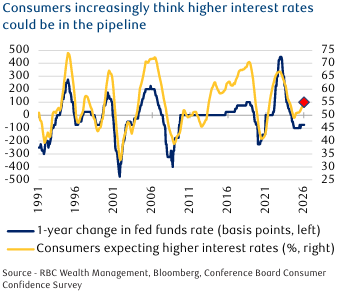
While Warsh faces what appears to be an increasingly divided voting committee, it’s not just policymakers who are flagging the possibility that the Fed could pivot to rate hikes, so too are consumers.
This week, the Conference Board’s Consumer Confidence Survey found that 63 % of those surveyed expected higher interest rates ahead, up from barely 50 % last fall.
The average reading of the survey over the past year has now risen to 55 %, continuing a higher trend that had already begun back in January 2024.
Consumers have a solid track record of getting the Fed call right, and with more consumers expecting higher rates, that’s now at odds with a Fed that at a minimum is likely to keep rates unchanged this year.
Above all else, perhaps the key takeaway for investors is this: The Fed chair’s influence has been waning for decades. This will likely continues with Warsh’s likely confirmation.
Past Fed chairs, such as Paul Volcker, Alan Greenspan, and Ben Bernanke, arguably held outsized stature and influence over the institution they served seems to have faded under Powell.
Perhaps that will be his legacy—not just the defense of the independence of the Fed, but the elevation of the broader voting committee and consensus-based decision-making that is bigger than any individual.
If you have any questions or comments, please feel free to let me know.