
Michael Capobianco
June 25, 2026
Markets have exhaled, and inflation fears have eased. For governments and corporation however, the drive towards self-sufficiency remains a deliberate priority.
The Memorandum of Understanding (MoU) between the U.S. & Iran reduces the risks of conflict-driven economic weakness and market volatility. The truce, however, remains precarious.
What are the macroeconomic implications of the MoU and the strategic priority it leaves untouched ?
The MoU signals the cessation of hostilities and includes an agreement to open the Strait of Hormuz, and the start of negotiations.
Most observers maintain that the full reopening of the Strait and normalization of commercial flows will be met with difficulty. The scale of the backlog, with some 600 vessels trapped in the Persian Gulf, and the alleged presence of mines present significant challenges.
RBC Capital Markets, LLC’s Head of Global Commodity Strategy Research Helima Croft sees multiple reasons to view the agreement cautiously. RBC Global Asset Management Inc. Chief Economist Eric Lascelles takes a more constructive view.
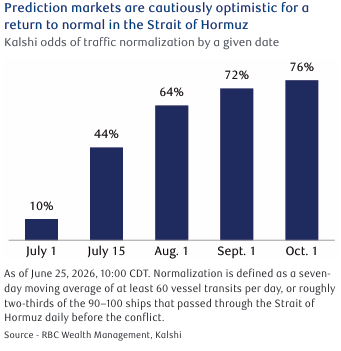 Eric notes that while official data shows that commercial traffic through the Strait has stalled since the beginning of the war.
Satellite data suggests a shadow fleet—vessels operating with their transponders turned off—went undetected by traditional trackers even before the MoU was signed.
This may explain why the prediction markets are cautiously optimistic about the formal reopening.
A lasting truce could have important implications for inflation, interest rates, and growth:
- Oil prices have already corrected to close to $74.00 per barrel – 1/3 less than their March peak, although above pre-war levels.
- Natural gas prices have fallen similarly yet remain some 33 % above pre-war levels in Europe.
- In the U.S., average national gasoline prices are falling closer to $4.00 per gallon. The fall in energy prices from their peak does not mean the inflation shock is over.
- Jet fuel inflation may edge up further before inventories are replenished, even as U.S. gasoline price inflation has likely peaked.
In Europe, energy bills are often indexed to natural gas, which will likely push inflation up over the coming months.
Other commodities may yet feel a lagged effect of the war.
With energy prices still above pre-war levels, inflation may still rise modestly in the near term. However, the spike looks set to be shorter-lived than markets had anticipated before the truce.
Developed market central banks such as the European Central Bank and the Bank of England that were considering tightening monetary policy in response to energy-driven inflation, may face less pressure to do so. By contrast, those operating in stronger cyclical conditions with tight labour markets, such as the Federal Reserve and the Bank of Japan, may well consider raising rates despite inflation waning.
If negotiations remain on track and the Strait stays open, the global economy is likely to regain its pre-war momentum by the autumn.
For Asia and Europe, the two regions most affected by the disruption to Middle East energy, the truce comes as a particular relief. Even if negotiations prove successful and peace endures, governments and the corporate sector will remain focused on improving self-sufficiency to navigate the increasing uncertainties of a multi-polar world order.
Other countries will also be increasingly wary of depending on Middle East energy flows. Expect this to accelerate investment in diverse energy sources including nuclear and renewables, as well as in power grid infrastructure.
The Middle East conflict has equally reinforced the importance of national defence spending. Governments will not only sustain elevated defence budgets, but increasingly direct them towards modern precision capabilities:
- Offensive Strike Drones
- Hypersonic missiles
- Drone and Missile Defence Capability
- AI-integrated systems.
For Europe in particular, the conflict has accelerated the push for strategic autonomy, reducing dependence on U.S. security guarantees. Our Head of U.S. Equity Strategy Lori Calvasina partly ascribes the strength of Q1 2026 U.S. corporate results to companies having taken these steps in advance.
Management teams have also absorbed the lessons of COVID-19 and abrupt shifts in U.S. tariffs. Companies have replaced “just in time” supply chain management—or minimizing inventory to reduce costs—with a “just in case” approach, prioritizing resilience over efficiency.
The MoU is a meaningful step back from the brink, but it falls well short of a lasting settlement. Markets have initially responded with cautious optimism.
Global bond yields have eased marginally as inflation fears have receded. Stock markets exhaled, suggesting to us that despite their recent strength, the conflict had weighed on sentiment.
A lasting agreement could unlock further upside potential, though a breakdown in talks would likely reverse these gains.
Regardless of the outcome, the structural priority that defined the pre-war landscape—the drive towards self-sufficiency—remains firmly in place.
If you have any questions or comments, please feel free to let me know.
Many Thanks,