Michael Capobianco
August 13, 2026
When investors buy a sector-focused ETF, it’s natural to assume they are getting essentially the same exposure as the sector benchmark the ETF is designed to track.
That assumption isn’t always correct.
A sector benchmark and the ETF that tracks it are closely related, but they are not the same thing. One of the most important reasons is a set of regulatory requirements known as the Regulated Investment Company (RIC) rules.
Understanding this distinction can help investors better understand what they actually own—and why an ETF’s performance can sometimes differ meaningfully from its benchmark.
An index isn’t an investment
Sector benchmarks, such as the S&P 500 Information Technology Index or the S&P 500 Communication Services Index, are theoretical portfolios. They are designed to represent the companies and performance of a particular sector.
You can’t invest directly in an index. It simply provides a reference point for measuring how that segment of the market is performing.
An ETF, however, is an actual investment product. It trades on an exchange and attempts to replicate the performance of its underlying index.
That sounds straightforward—until regulatory requirements enter the equation.
The RIC rules can change what an ETF owns
Most ETFs are structured as Regulated Investment Companies for tax purposes. This structure allows them to pass income and capital gains through to investors without the fund itself being subject to corporate income tax.
But there is a trade-off.
To maintain RIC status, an ETF must meet certain diversification requirements. Among them are limits on how much of the fund can be concentrated in a single issuer and how much can be held in positions representing more than 5% of the portfolio.
A benchmark index does not face these same restrictions.
That can become particularly important in sectors dominated by a handful of very large companies.
A real-world example
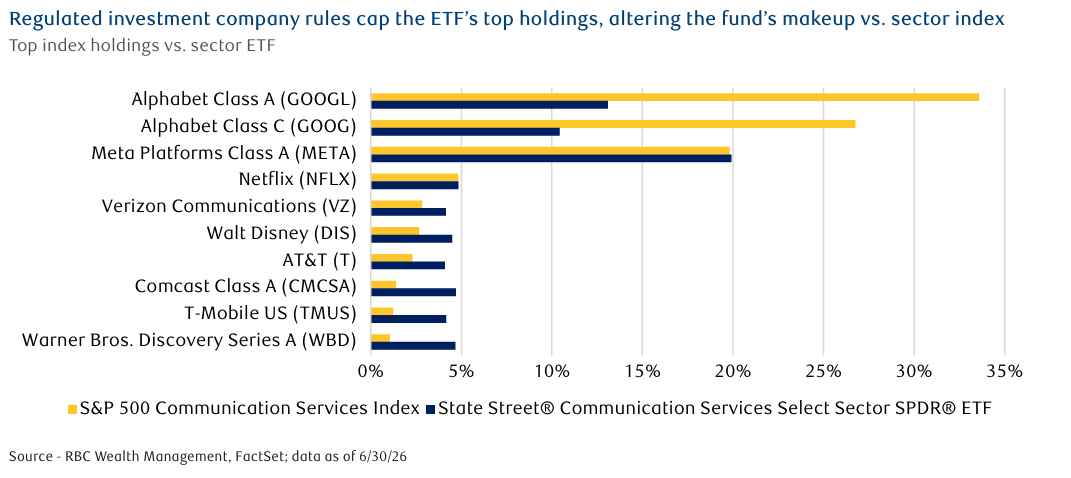
Consider the S&P 500 Communication Services Index and the State Street® Communication Services Select Sector SPDR® ETF.
Alphabet is the largest position in the benchmark, with its Class A and Class C shares treated as a single issuer. At one point, Alphabet represented approximately 60% of the benchmark.
The ETF, however, held approximately 23.5% in Alphabet.
Why the enormous difference?
The ETF has to operate within the RIC diversification requirements. As a result, it cannot simply replicate the benchmark's concentration.
Instead, it must reduce its exposure to the largest position and allocate more of the portfolio to other companies, such as Verizon and Walt Disney.
The result is an ETF that may look similar to its benchmark—but isn't actually the same portfolio.
Why does this matter to investors?
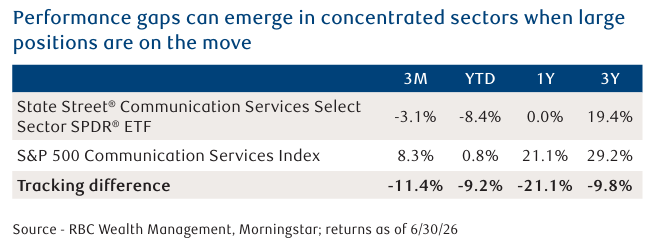
The difference can create what is known as tracking difference: the gap between an ETF's performance and that of its benchmark.
Most of the time, the difference may be relatively modest. But when a sector is highly concentrated, it can become much more significant.
If the largest company in a sector dramatically outperforms, an ETF that is required to underweight that company may capture considerably less of the upside.
That happened in the first half of 2026. The State Street® Communication Services Select Sector SPDR® ETF underperformed the S&P 500 Communication Services benchmark by approximately 9% year to date, in large part because Alphabet significantly outperformed the broader sector.
Of course, the reverse can also be true. If the dominant company falls sharply, the ETF's lower weighting could help cushion the decline.
The takeaway
Sector ETFs remain an efficient and useful way to gain targeted market exposure. But investors should understand that an ETF designed to track an index isn't necessarily identical to the index itself.
Regulatory requirements, portfolio construction and market concentration can all influence what the ETF actually owns—and ultimately how it performs.
The next time you look at a sector ETF, don't just ask, "What index does it track?"
Also ask:
"How closely can the ETF actually replicate that index?"
That distinction can matter more than investors realize.