
Nick Milau
August 13, 2026
Weekly Wrap
Markets moved up again this week on the back of strong earnings, decent economic data and an inflation picture that seems to be less bad than feared. Canadian stocks are up 1%, led higher by energy stocks after oil prices rallied 2.5%. While the world is focused on supply disruptions out of the Middle East, the International Energy Agency issued a report predicting a drop in demand next year which should limit how high oil prices go if Iran and Washington can’t make nice. Speaking of which, tensions in Iran continued as Iranian negotiators, taking a page from the Art of the Deal, have clearly established that the Strait of Hormuz is an effective pain point in negotiations with Washington. US markets are up 0.75% on the back of continued strong profit reports. Developed International markets gained 1% while the Emerging Markets shed 0.5%. News was slow otherwise as investors seem to be in Summer mode!
Market Insights
Does the US have an inflation problem or just a shelter inflation problem? The battle to cure the global inflation disease has been a long and painful one…and in the US, more (and perhaps different) medicine may be needed. For decades, the go-to inflation remedy has been monetary policy (central bankers hike rates to get inflation down). But the US’s current inflation problem may be developing an immunity, or even a worse reaction, to rate hikes. In order to figure out what to do we need to dig a little deeper into what has driven long term inflation concerns; have a look at the chart below. I think it’s fair to say that if you get shelter inflation under control, you get inflation under control.
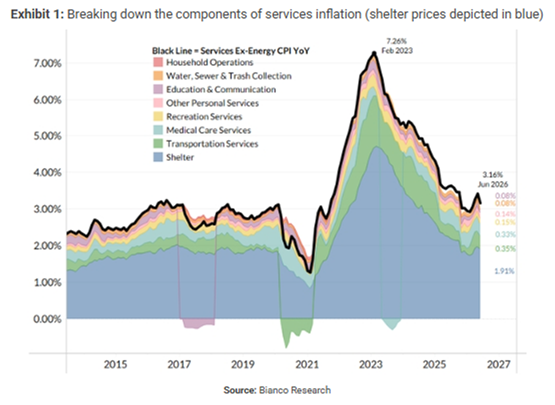
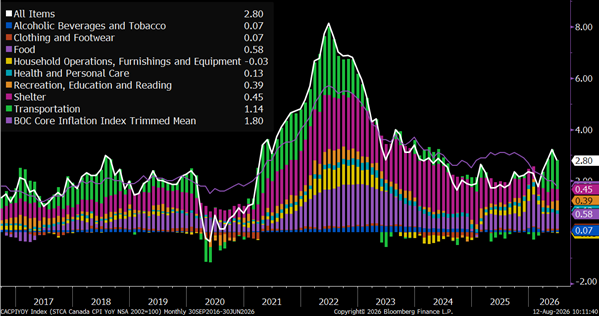
Recent concerns around higher energy prices leading to inflation and rate hikes to address such concerns seem misguided to me: energy prices are a small contributor to inflation, energy prices can get under control in short order (and have) and changing interest rates will do NOTHING to curb energy inflation. The reality is this: the US has a shelter inflation problem and needs to cure this instead. Canada offers a glimpse into what to do. Have a look at the chart below; our inflation picture is much healthier and the big difference is that shelter inflation is far lower. But why the difference? One big reason is that immigration has slowed (this lessens demand) and another big reason is that we have cut interest rates more than the US which has made it more affordable to build (which creates housing supply). In the US they have not cut rates as much as we have and they had a bigger shelter inflation and general inflation problem to begin with. So the purported cure for curbing inflation (hiking rates) may very well have made things worse for them…despite this, central bankers keep going back to rate hikes as a cure. As an interesting side note, while inflation is the enemy of those who don’t own assets it is the friend of those who do. Canada’s falling shelter inflation is very good news for wage earners and the younger generation looking to get in the market. But for Canadian residential real estate investors looking for things to turn in their favor, the drop in rent and limited outlook for higher home prices is reason to remain on the sidelines.
Strong US earnings continued in Q2 2026. Second quarter earnings season continues to deliver strong results for the S&P 500, with 88% of companies now done reporting. Of those, 86% have exceeded earnings estimates and 76% have topped revenue expectations, both above longer-term averages. The blended earnings growth rate (combining actual and estimated results) has risen to 50.4% year over-year, up from 23.1% expected at the end of June, while revenue growth has reached 15.0%, its strongest pace since Q4 2021. Encouragingly, results have been broad, with ten of eleven sectors reporting earnings growth and all eleven posting revenue growth, led by Energy, Technology, and Communication Services. Of note, headline earnings are being boosted by large gains from Alphabet and Amazon; excluding those two companies, Q2 earnings growth would still be 32.0% and the aggregate earnings surprise falls to a more reasonable 10.9%, though still above historical averages. Looking ahead, analysts expect earnings growth of 27.4% in Q3 and 25.2% in Q4, while the S&P 500 trades at roughly 20x forward earnings, modestly above its five- and 10-year averages. During the upcoming week, nine S&P 500 companies are scheduled report earnings for the second quarter. Indeed, such strong earnings results can go some way to justify lofty US market valuations. However, years with such high growth tend to be followed by much lower growth at which point investors may question valuations.
Portfolio Update
Not a change to the portfolio per se but a change in structure for one of your companies (your accountants will be happy to hear this!!). Brookfield Infrastructure Partners has now made it official that they will be collapsing the corporate / L.P. structure to form a corporate entity. This was foreshadowed in Q1 2026 results and now is official. The move is more about reading the room with investors than impacting on the fundamentals of BIP. BIP has been alienating potential shareholders who either didn’t want to, or couldn’t, own L.P.s. By simplifying, it is likely their shareholder reach will broaden, and better index ownership may arise. These measures may also improve their borrowing costs. Further good news is the simplification will likely be tax deferred for investors involved, and the tax reporting will be much simpler going forward. The healthy, stable mid-single-digit dividend yield and growth of BIP is reasonable and thus the attractive valuation may now be better appreciated.
Please note any changes apply to our PIM Portfolios Only, subject to restrictions. Please call to clarify if you have any questions.
Planning On
TFSA Changes for Surviving Spouses/Partners
Spouses and common-law partners enjoy the tax-free rollovers when one spouse passes away. It is a significant tax benefit…deferring any taxes that would have been otherwise payable. TFSAs, while not taxable, allow for beneficial or survivor designations. Typically, beneficiary designation is reserved for non-spouses/common-law partners but occasionally may be a useful tool when inheriting a TFSA outright isn’t preferred. Naming the spouse as a survivor results in a much smoother and easier experience for the surviving spouse, as the account just became theirs. If named a beneficiary, however, the spouse had a more complicated road to the inherited account. First, they could only make an ‘exempt contribution’ of the fair market value on the date of passing. If the account had grown from that date until ‘distribution’ the surviving spouse would not be allowed to contribute that part (unless they had their own unused contribution room). They would also be taxed on the earnings after passing. This is changing a little now.
With the recent enactment of Bill C-15, beneficiaries can now transfer the deceased's TFSA balance plus any earnings into their own TFSA tax-free. This brings beneficiaries closer to having the same tax benefits as successor holders. It is still considered an exempt contribution and must be made within the rollover period which is the period from when the TFSA holder dies until the end of the calendar year that follows the year of death. Paperwork is still required, though, by way of Form RC240 Designation of an Exempt Contribution and must be submitted within 30 days of making the contribution.
If you would like a review of your designations, please let us know. It is also a good time to check any other accounts you may have elsewhere. This is especially true of self-directed accounts that may not prompt you for beneficial designation. Other good times to review designations are after major life changes such as the passing of a spouse and a new marriage.
This information is not intended to provide legal, tax, or insurance advice. To ensure that your own circumstances have been properly considered and that action is taken based on the latest information available, you should obtain professional advice from a qualified lawyer or accountant, as applicable, before acting on any of the information.
Charts of the Week
Feel free to share this newsletter with anyone who might benefit from it or find value in it. Thank you for reading our commentary. We welcome your feedback!
Return to homepage
This information is not investment advice and should be used only in conjunction with a discussion with your RBC Dominion Securities Inc. Investment Advisor. This will ensure that your own circumstances have been considered properly and that any action is taken based upon the latest available information. The strategies and advice in this report are provided for general guidance. Readers should consult their own Investment Advisor when planning to implement a strategy. Interest rates, market conditions, special offers, tax rulings, and other investment factors are subject to change. The information contained herein has been obtained from sources believed to be reliable at the time obtained but neither RBC Dominion Securities Inc. nor its employees, agents, or information suppliers can guarantee its accuracy or completeness. This report is not and under no circumstances is to be construed as an offer to sell or the solicitation of an offer to buy any securities. This report is furnished on the basis and understanding that neither RBC Dominion Securities Inc. nor its employees, agents, or information suppliers is to be under any responsibility or liability whatsoever in respect thereof. The inventories of RBC Dominion Securities Inc. may from time to time include securities mentioned herein. This publication is for information purposes only. Graphs and charts are used for illustrative purposes only and do not reflect future values or changes. Past performance is not indicative of future returns. This commentary is based on information that is believed to be accurate at the time of writing and is subject to change. All opinions and estimates contained in this report constitute RBC Dominion Securities Inc.'s judgment as of the date of this report, are subject to change without notice and are provided in good faith but without legal responsibility. Interest rates, market conditions and other investment factors are subject to change. Past performance may not be repeated. The information provided is intended only to illustrate certain historical returns and is not intended to reflect future values or returns. This publication is not intended as nor does it constitute tax or legal advice. Readers should consult their own lawyer, accountant or other professional advisor when planning to implement a strategy. Insurance products are offered through RBC Wealth Management Financial Services Inc.("RBC WMFS"), a subsidiary of RBC Dominion Securities Inc.* RBC WMFS is licensed as a financial services firm in the province of Quebec. When providing insurance products in all provinces except Quebec, Investment Advisors are acting as Insurance Representatives of RBC WMFS. In Quebec, Investment Advisors and Estate Planning Specialists are acting as Financial Security Advisors of RBC WMFS. RBC Dominion Securities Inc., RBC WMFS and Royal Bank of Canada are separate corporate entities which are affiliated. *Member-Canadian Investor Protection Fund. RBC Dominion Securities Inc. and RBC WMFS are member companies of RBC Wealth Management, a business segment of Royal Bank of Canada. â / ™ Trademark(s) of Royal Bank of Canada. Used under license. RBC Dominion Securities Inc. 2026 All rights reserved.