Nick Milau
August 27, 2026
Weekly Wrap
While Trump and Carney were unable to pull off a trade agreement, Trump was able to execute on his plan to Make the Great Lakes Greater (which was the actual headline he used when he ‘renamed’ Lake Ontario). All silliness aside, while North American investors are fretting about the impacts of new tariffs, this didn’t stop them from buying. Canadian stocks were up 0.25%, led higher by strong Canadian bank earnings. Many analysts worry, however, that with banks firing on all cylinders and benefiting mightily from AI capital raising, the good times can’t carry on like this (I share this concern). US stocks are up 0.8%, half of which is the result of one stock (Nvidia moved up 5% and accounts for nearly 8% of the S&P 500). The Emerging Markets gained 1.75%, encouraged by the continued gorging on AI infrastructure goodies. Oil fell 5% with some small agreements to increase oil flows out of the Strait of Hormuz. Interest rates crept down 0.06% and the Loonie lost last week’s gain after last weekend’s trade disappointments, shedding nearly 1%.
Market Insights
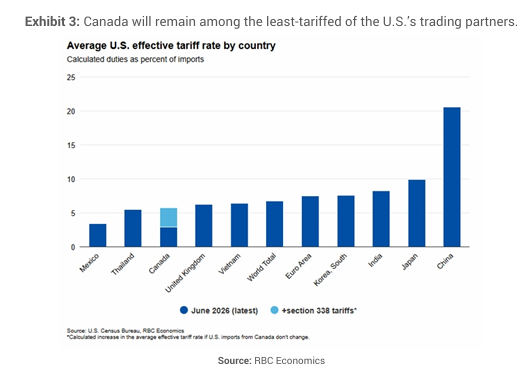
Canada likely to withstand tariff shock, though escalation risks persist. Canada’s economy appears capable of weathering the new 50% tariff the US has imposed on roughly $28 billion of Canadian goods, according to economists (including some from Canada’s largest banks) who met with Finance Minister François-Philippe Champagne this week. While some forecasters have reduced growth estimates, recession risk is not really a concern, with broad agreement that the damage should remain concentrated in tariff-exposed industries. RBC Economics maintains their base case outlook for national growth, though they acknowledge slightly greater downside risks. The key risk is further escalation and Ottawa is readying itself for a potentially prolonged dispute. Meanwhile, this week saw Canadian Q2 GDP bounced back nicely to a 3.3% annualized pace, rebounding after nearly a year of sluggish growth. RBC estimates the tariff measures to affect 5% of Canadian exports to the US, or 0.4% of Canadian GDP. The average effective tariff rate on Canadian imports to the US will increase from 3% to 6% (which is low compared to other victims of Trump’s trade war, see below). Indeed, more than 80% of goods trade tariff-free under CUSMA. These new tariffs are more likely to negatively impact Canadian growth than to apply upward pressure on Canadian inflation, depending of course on the scope and distribution of any retaliatory tariff measures. This means that the Bank of Canada probably has even less reason to hike rates any time soon and can comfortably remain on-hold for the remainder of the year. It may also push back the timeline for any future hikes. With that said, support for affected industries is more likely to come from fiscal support rather than rate cuts, and indeed we expect announcements from the Federal and Provincial governments in the coming days/weeks.
More evidence that currency hedging does more harm than good for equity investors. One thing Canadian investors love to do is convince themselves that they can, and should, protect themselves from fluctuations in foreign currencies (especially the US Dollar). And for a small fee, you can hedge your equity portfolio and reduce the impact of currency fluctuations on your foreign stock holdings…but should you do so?? RBC did some great research last week that supports what I have long believed; currency hedging leads to lower returns and, ironically, higher volatility (see below). The evidence suggests the following:
- Hedging can add some value in certain shorter-term periods, but it has led to lower long-term returns. Further, if you are investing for ‘shorter periods’ you should not be buying stocks anyway!
- Currency hedging can improve outcomes during periods of Canadian-dollar strength, but the historical evidence suggests maintaining unhedged foreign equity exposure has produced lower volatility.
- Historically, the US dollar has tended to rise during downward moves in the stock market. In other words, maintaining currency ‘risk’ tends to lower short-term volatility in such instances.
- To quantify the return difference from below (i.e. comparing the compounded returns over 10 years): $1m invested unhedged grew to $3.52m while the hedged portfolio grew to $3.36m…a difference of $160,000 or nearly 5%.
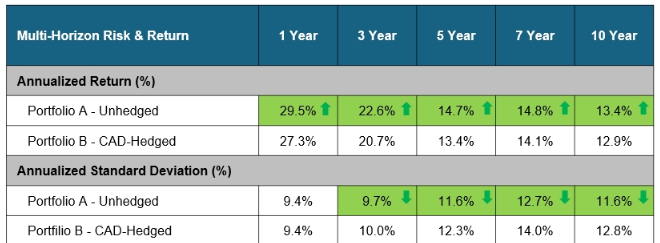
We believe maintaining unhedged foreign equity exposure remains the more suitable strategic stance, preserving returns and a further source of diversification in global equity portfolios.
Portfolio Update
Portfolio Update. The focus this week was on our fixed income holdings. For most of the past 10 plus years our fixed income portfolios could aptly be described as: preferred shares plus a handful of GIC’s. Over that period, our preferreds have provided high yields, tax efficiency, and generous gains but after their tremendous rally they now just offer ‘decent’ yields, tax efficiency and no further capital gains. Since they do come with more risk, this no longer justifies owning them in the proportion we had up to now and thus we are exploring other options within fixed income. In the ultra-low risk category, government bonds offer 3% to 4% yields while GIC’s offer 4% to 4.4% yields (and for shorter terms). High-quality corporate bonds offer less than GIC’s (without deposit insurance) so they offer little appeal. Lower quality corporate bonds are middling, offering 6% - 7% but with growing risks of default. Meanwhile, there is growing evidence that, much like the stock market, the case can be made that active management in niche markets has and will continue to produce outperformance in the fixed income space. As such we are increasingly exploring for niche, active management strategies that we feel could produce outperformance. With that said, we are likely heading into a prolonged period of decent yielding options from bread-and-butter fixed income so we must be careful not to chase higher returns in a fixed income market that is already looking pretty good.
Please note any changes apply to our PIM Portfolios Only, subject to restrictions. Please call to clarify if you have any questions.
Planning On
Business Owners Borrowing to Invest
As a business owner, you or your business may borrow money for various reasons including capital injection, purchasing capital assets and refinancing debt. Ideally, you want to ensure that these borrowed funds can provide a tax-advantage through interest deductibility. It is important to remember, though, that borrowing money to invest involves greater risk than using cash as it remains your responsibility to repay the loan or interest as per the terms of your agreement with the lender.
The Golden Rule: Direct Use
Here's the core principle: interest on borrowed money is deductible only if you can directly link that money to income-earning activities. That means business income or property income (dividends, interest, rent, royalties)—but not capital gains. The CRA is strict about this, so documentation matters. Business income includes any activity you carry on for profit or with a reasonable expectation of profit. In some cases, interest deductibility has been denied where there was no realistic prospect of dividends and no history of paying them.
Borrowing to Invest in Your Own Corporation
This is where it gets interesting. If you borrow to buy shares in your own company, the interest is generally deductible – provided there's a reasonable expectation of dividends. Court decisions consistently back this approach. The practical tip? If you're considering this strategy, establish a dividend payment pattern early (even nominal amounts work). It strengthens your position if the CRA ever questions the deduction.
Refinancing Keeps the Benefit
Good news: when you refinance deductible debt, the interest remains deductible on the new loan. The purpose doesn't change just because you've replaced the original loan.
Strategic Exceptions Exist
The CRA recognizes certain "exceptional circumstances"—like borrowing to make capital contributions that boost your corporation's income capacity, or corporations borrowing to fund shareholder redemptions while maintaining income-generating operations.
The Bottom Line
Leverage can certainly be a powerful wealth building tool, but the tax treatment is highly dependent on the specific facts. Ensure you do your research first and engage your professionals early in the process.
This information is not intended to provide legal, tax, or insurance advice. To ensure that your own circumstances have been properly considered and that action is taken based on the latest information available, you should obtain professional advice from a qualified lawyer or accountant, as applicable, before acting on any of the information.
Updates from the Team
Monthly Conference Calls
Please be advised that the September conference call is postponed to Friday, September 18th at 10 am. Call-in details will be sent out one week prior to the call. The October conference call will be cancelled. Please reach out to us if you have any questions.
RBC Annual Golf Tournament
On August 13th, I teed up with the others of my foursome at the 35th Annual Charity Golf Tournament hosted by the RBC Surrey Commercial Financial Services Team. This fundraising event was held to support the Guru Nanak Food Bank & BC Cancer Foundation. It was a good day for golfing for a good cause, with good company!

Charts of the Week
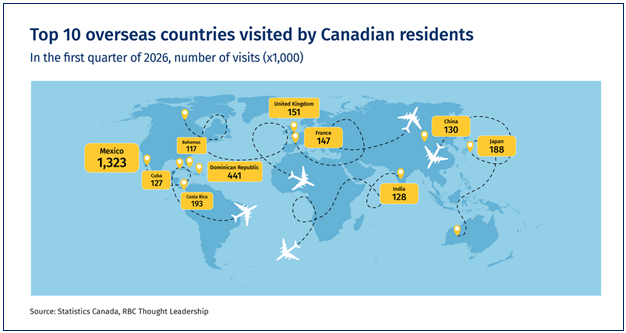
Feel free to share this newsletter with anyone who might benefit from it or find value in it. Thank you for reading our commentary. We welcome your feedback!
Return to homepage
This information is not investment advice and should be used only in conjunction with a discussion with your RBC Dominion Securities Inc. Investment Advisor. This will ensure that your own circumstances have been considered properly and that any action is taken based upon the latest available information. The strategies and advice in this report are provided for general guidance. Readers should consult their own Investment Advisor when planning to implement a strategy. Interest rates, market conditions, special offers, tax rulings, and other investment factors are subject to change. The information contained herein has been obtained from sources believed to be reliable at the time obtained but neither RBC Dominion Securities Inc. nor its employees, agents, or information suppliers can guarantee its accuracy or completeness. This report is not and under no circumstances is to be construed as an offer to sell or the solicitation of an offer to buy any securities. This report is furnished on the basis and understanding that neither RBC Dominion Securities Inc. nor its employees, agents, or information suppliers is to be under any responsibility or liability whatsoever in respect thereof. The inventories of RBC Dominion Securities Inc. may from time to time include securities mentioned herein. This publication is for information purposes only. Graphs and charts are used for illustrative purposes only and do not reflect future values or changes. Past performance is not indicative of future returns. This commentary is based on information that is believed to be accurate at the time of writing and is subject to change. All opinions and estimates contained in this report constitute RBC Dominion Securities Inc.'s judgment as of the date of this report, are subject to change without notice and are provided in good faith but without legal responsibility. Interest rates, market conditions and other investment factors are subject to change. Past performance may not be repeated. The information provided is intended only to illustrate certain historical returns and is not intended to reflect future values or returns. This publication is not intended as nor does it constitute tax or legal advice. Readers should consult their own lawyer, accountant or other professional advisor when planning to implement a strategy. Insurance products are offered through RBC Wealth Management Financial Services Inc.("RBC WMFS"), a subsidiary of RBC Dominion Securities Inc.* RBC WMFS is licensed as a financial services firm in the province of Quebec. When providing insurance products in all provinces except Quebec, Investment Advisors are acting as Insurance Representatives of RBC WMFS. In Quebec, Investment Advisors and Estate Planning Specialists are acting as Financial Security Advisors of RBC WMFS. RBC Dominion Securities Inc., RBC WMFS and Royal Bank of Canada are separate corporate entities which are affiliated. *Member-Canadian Investor Protection Fund. RBC Dominion Securities Inc. and RBC WMFS are member companies of RBC Wealth Management, a business segment of Royal Bank of Canada. â / ™ Trademark(s) of Royal Bank of Canada. Used under license. RBC Dominion Securities Inc. 2026 All rights reserved.