Nick Milau
August 6, 2026
Weekly Wrap
What Summer Doldrums?? Stocks carried on with their exuberant ways in the first week of August as Canadian and US markets were up 3% and 3.5%, respectively. Strong earnings reports were a big part of this move, particularly tech profits. Overall earnings are 31.4% above expectations, though that number is heavily influenced by exceptional one-time gains at two mega-cap companies. When those two companies are excluded, the surprise is a more reasonable 9.2%, which is still above both longer-term averages. In Canada, gold stocks were the biggest winner as gold prices recovered 7% of their lost ground from earlier this year. European markets were up 1.25% while the Emerging Markets are up over 2% as they benefitted from their tech-heavy mix of sectors. The Loonie rose 0.6% with solid Canadian economic data, including a huge jobs report this morning that saw a massive gain in both full and part time employment. Oil prices fell 7% on hopes of a deal between the US and Iran.
Market Insights
A new kind of stock market volatility emerges. The market has always been emotional (sometimes even irrational) which makes it prone to overreact to both good and bad news. In fact, we have become accustomed to this irrationality and for the sound of mind and stout of heart it has historically presented buying or selling opportunities to get in or out of the market…buy when the market oversells and sell when the market is overbought. And with many seasoned investors seeing the high valuations of today it is surprising that we have yet to see a sell-off in the market. Instead, a new type of volatility has emerged whereby investors, instead of selling stocks en masse, have been toggling between sectors in pursuit of higher returns. Throughout 2026, equity markets have been characterized by high cross-sector dispersion and single-stock volatility, even while broad market benchmarks (like the S&P 500) have stayed relatively calm and remain near historical highs. While headline index volatility (e.g., the VIX) has stayed moderate, underlying stock and sector volatility is elevated. Analysis of 2026 market data shows that individual stocks within the index have experienced roughly three times the volatility of the overall index itself. This is a result of rapid sector rotation as capital has been cycling rapidly between sectors, often shifting between mega-cap tech/semiconductors, traditional value, cyclicals, and defensive sectors. When one major sector pulls back, capital frequently rotates into another, muting the net impact on the broad index. The culprits for this new dynamic are likely a blend of AI powered trading strategies, excessive index investing (including traders buying in and out of sector ETF’s) as well as some rather opaque derivative and leveraged based strategies I’m not going to even bother trying to explain (I may not understand them anyway). While I remain concerned about the overall valuation of certain markets (the US) I do feel that this recent dynamic is a productive one…there is a good chance however that it too becomes as short-term focused as traders who historically would buy and sell the whole stock market.
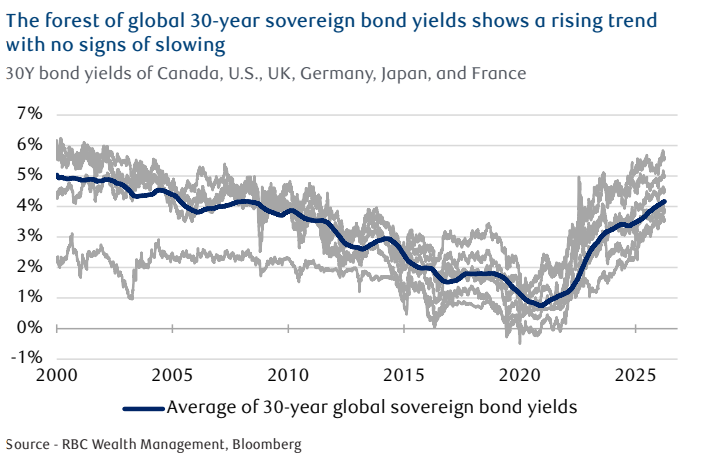
Higher government bond yields are being ignored and neglected. If you look at the chart below you might be able to see a trend. After two decades of declining, government bond yields have steadily, and pretty rapidly, risen. This has been a result of two things; higher inflation and higher real interest rates. When inflation rises lenders will raise their lending rates to compensate for the lost purchasing power upon repayment. But the higher real interest rates is a bit more mysterious. Notionally it is the extra interest rate a lender charges for the profit they wish to earn over and above expected inflation. This amount will ebb and flow with the supply and demand for capital and the supply and demand of those who will lend capital (and with so called risk appetite). Right now there is no shortage of capital (this I can assure you of). But lenders are beginning to be a lot more finicky. There has been a real shift in investor psyche over the last decade as investors would rather be equity investors then lenders. And why not…stocks have averaged 10% - 15% a year for the last decade and bonds have earned a meagre 1.5% a year so that will continue right?? Not likely. Such high recent returns from stocks will likely lead to underwhelming returns going forward and, conversely, such meagre recent returns for bonds have a pretty good chance or turning around for bond investors. Investment portfolios hold more equities today than they have in many years (in other words, there are fewer lenders and more stockholders). Even the mighty US treasury bond is having a hard time finding a lender; China is not too keen to lend to the US and even Japan is dumping US bonds to protect the Yen. Central banks still hold a lot of bonds but some have chosen to ‘diversify’ into other assets including gold (yikes) among other things. When there is a lack of interest in a particular investment theme it usually means there are opportunities for investors willing to fill the void. As for the broader economy, however, those who ignore what’s happening in the bond market are doing so at their own peril; higher interest rates will put a damper on future returns for ALL investors because it is a cost for governments and businesses that will eat into their margins. So even the exuberant equity investors of this generation had best take heed of what is happening in the bond market.
Portfolio Update
No major changes in the portfolio this week. Thanks to strong earnings reports, stock markets have moved up again to start this month, and due to the strong performance of our stocks, our equity weightings are creeping up in value relative to our fixed income. This makes me inclined to look to trim equity exposure but…the challenge I am faced with is what to sell. The stocks I am most inclined to trim are some of our bigger gainers but such profit taking would generate tax bills and we must take this into consideration. It is not an exact formula, but we are essentially comparing the potential for losing some of the gains on these stocks versus the tax bill for crystallizing the gain at current levels. As a long-term oriented investor with a business owner mindset, I am fine to hold onto stocks with big gains if I feel that the 10-year (or longer) time horizon remains attractive. In such instances I would be fine enduring a shorter-term dip in value. As always this comes down to an assessment of the competitive moat that these stocks have and, in most cases, that moat remains very much intact.
Please note any changes apply to our PIM Portfolios Only, subject to restrictions. Please call to clarify if you have any questions.
Planning On
Where are you getting advice….and is it good advice?
A 2025 survey conducted by TD and Gallup showed that 55% of Americans are using AI to get their financial advice. That is above the categories of “friends and families” which is next and then financial advisors.
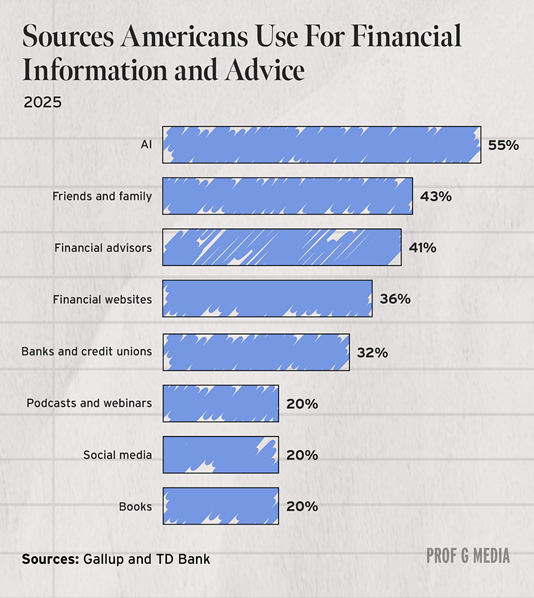
This feels high…while this is a survey of Americans…one would think that probably is a developed world phenomenon. And why not? It is quick and easy and AI sounds authoritative and confident which is what you want from anyone (or anything) giving you advice. It can be a useful tool for generic questions like asking about the features and benefits of a TFSA. It can, however, fail when it comes to personalized advice, unique to your situation and this is the most critical element of advice….is that it should be tailor-made to your circumstances without bias.
MIT Sloan researchers published a report in May of this year showing their findings after asking 1,000 people to write prompts about how to save and invest and then fed those responses into two of the more popular AI providers. They then used the advice to make financial decisions for made-up people across a full lifetime. They found that the advice was mostly correct but the way you asked for advice changed the advice given. Those with low financial literacy asked vague questions and ended up with $50,000 less wealth at age 60 than those with higher levels of literacy who knew what to ask and were more specific. And then come the bias….prompts generated by women resulted in $60,000 less wealth at age 60. Granted that some of the bias comes from the words used in the prompts and results in some of the disparity but they also found that when identical prompts were used and the only difference was gender, AI advised a lower equity percentage recommendation for the women. Racial differences also resulted in different advice.
A study by Investing Insiders in Britain asked 100 personal finance questions to AI on a variety of topics (retirement, housing, savings options) and they found AI tools were correct 56 per cent of the time, deceptive or misleading for 27 per cent, and incorrect for 17 per cent. Despite this finding, Americans only said that they found AI to give them incorrect advice 9% of the time. This means that some are getting advice without even realizing it is incorrect or misleading.
The MIT study also found that an alarming percentage had no trouble giving up their Social Security Number and bank account information as well.
Now humans are not infallible either and perhaps we can have our own biases but, unlike AI, we have a fiduciary responsibility to our clients and have no trouble not disclosing any personal and confidential information about you. While AI wants your data we strive to protect it at all costs.
To be fair, I asked Gemini this question “How good are you at providing financial advice?” and while it did share what it thought it excelled at it also stressed its limitations which included:
- No real time market data (with some further explanation)
- Not a licensed advisor: I can’t act as a fiduciary, execute trades or give direct legal/tax advice tailored to official regulatory standards. My output is strictly information.
In summary, it is not just advice that matters but the right advice.
This information is not intended to provide legal, tax, or insurance advice. To ensure that your own circumstances have been properly considered and that action is taken based on the latest information available, you should obtain professional advice from a qualified lawyer or accountant, as applicable, before acting on any of the information.
Charts of the Week
Feel free to share this newsletter with anyone who might benefit from it or find value in it. Thank you for reading our commentary. We welcome your feedback!
Return to homepage
This information is not investment advice and should be used only in conjunction with a discussion with your RBC Dominion Securities Inc. Investment Advisor. This will ensure that your own circumstances have been considered properly and that any action is taken based upon the latest available information. The strategies and advice in this report are provided for general guidance. Readers should consult their own Investment Advisor when planning to implement a strategy. Interest rates, market conditions, special offers, tax rulings, and other investment factors are subject to change. The information contained herein has been obtained from sources believed to be reliable at the time obtained but neither RBC Dominion Securities Inc. nor its employees, agents, or information suppliers can guarantee its accuracy or completeness. This report is not and under no circumstances is to be construed as an offer to sell or the solicitation of an offer to buy any securities. This report is furnished on the basis and understanding that neither RBC Dominion Securities Inc. nor its employees, agents, or information suppliers is to be under any responsibility or liability whatsoever in respect thereof. The inventories of RBC Dominion Securities Inc. may from time to time include securities mentioned herein. This publication is for information purposes only. Graphs and charts are used for illustrative purposes only and do not reflect future values or changes. Past performance is not indicative of future returns. This commentary is based on information that is believed to be accurate at the time of writing and is subject to change. All opinions and estimates contained in this report constitute RBC Dominion Securities Inc.'s judgment as of the date of this report, are subject to change without notice and are provided in good faith but without legal responsibility. Interest rates, market conditions and other investment factors are subject to change. Past performance may not be repeated. The information provided is intended only to illustrate certain historical returns and is not intended to reflect future values or returns. This publication is not intended as nor does it constitute tax or legal advice. Readers should consult their own lawyer, accountant or other professional advisor when planning to implement a strategy. Insurance products are offered through RBC Wealth Management Financial Services Inc.("RBC WMFS"), a subsidiary of RBC Dominion Securities Inc.* RBC WMFS is licensed as a financial services firm in the province of Quebec. When providing insurance products in all provinces except Quebec, Investment Advisors are acting as Insurance Representatives of RBC WMFS. In Quebec, Investment Advisors and Estate Planning Specialists are acting as Financial Security Advisors of RBC WMFS. RBC Dominion Securities Inc., RBC WMFS and Royal Bank of Canada are separate corporate entities which are affiliated. *Member-Canadian Investor Protection Fund. RBC Dominion Securities Inc. and RBC WMFS are member companies of RBC Wealth Management, a business segment of Royal Bank of Canada. â / ™ Trademark(s) of Royal Bank of Canada. Used under license. RBC Dominion Securities Inc. 2026 All rights reserved.