
Nick Milau
July 30, 2026
Weekly Wrap
Major market movements this week were largely driven by mixed big tech earnings, a Federal Reserve “hawkish” hold (see Market Insights for more on that) and new U.S. tariffs. Semiconductor and AI stocks faced a steep sell-off and high volatility (what else is new?) as they face increasing scrutiny over their heavy capital expenditure. The mixed messaging around the rate hold left many investors feeling uncertain about future inflation paths and rate timelines. Consensus seems to be a rate hike at some point while Trump still believes a cut is warranted. New 12.5% tariffs replace the 10% ones that have expired and the escalation of the U.S./Iran conflict has diminished the prospects of agreement soon and increased the price of oil. As of writing, the TSX is barely eking out a gain for the week at .02%, both the S&P 500 and Nasdaq are in the red by .35% and .17% respectively while the Dow is the “standout” at .20%, especially considering its 2.2% drop on Wednesday. The MSCI Emerging Markets Index is down just under 4% over the past 5 days pulling back from recent monthly highs amid localized tech sector volatility and profit-taking in Asia and Latin America. Gold held steady for the most part and is on track, despite today’s pullback, for its first monthly gain in 5 months, up over 2% for July.
Market Insights
Hyper Debt. While the corporate bond market remains open for AI-focused companies, investors are becoming increasingly selective, with demand dropping significantly from 5 times coverage in February to below 2 times by July—meaning issuers now need to offer wider interest rate spreads to attract buyers. Credit quality concerns are emerging as well; companies like Oracle are being downgraded due to aggressive AI spending plans that exceed previous expectations, and if these companies' earnings don't materialize as promised or competition intensifies (particularly from Chinese AI models), their financial health could deteriorate quickly. Additionally, mechanical limits are beginning to kick in, as major bond index ETFs have issuer concentration caps (typically 3%), and as the hyperscaler debt floods the market, these caps will trigger, reducing automatic investor demand for future deals. On a more positive note, the Canadian bond market has warmly welcomed record-breaking AI debt deals—Amazon's C$14 billion maple bond in June being a prime example—with pension funds and insurers particularly hungry for long-duration corporate debt to lock in higher yields, though this appetite may have limits. Google and Amazon now make up nearly 40% of the AA-rated Canadian corporate bond index and around 4% of the overall Canadian corporate bond index. The bottom line is that investor demand remains solid, but it's becoming more discerning and faces real structural constraints.
Federal Reserve Rate Decision. The Federal Reserve held interest rates steady on Wednesday, keeping its target rate between 3.5% and 3.75%, but the decision revealed significant internal disagreement within the policy committee. Three Fed officials—including the presidents of the Cleveland, Minneapolis, and Dallas Federal Reserve banks—preferred to raise rates by a quarter-point, while the remaining nine members, including Fed Chairman Kevin Warsh, voted to maintain the status quo. Markets reacted negatively to the announcement, with stock prices declining and the yield on 30-year Treasury bonds surging to its highest level since 2007, suggesting investor disappointment with the hold decision. Despite inflation having remained well above the Fed's 2% target for several years, Chairman Warsh reiterated the central bank's commitment to achieving that inflation goal. The takeaway is that while rates remain unchanged for now, growing dissent within the Fed signals ongoing debate about the appropriate path forward, and this uncertainty is likely to keep financial markets volatile in the near term. Warsh maintains his stated preference to avoid forward guidance and has indicated that he will only hold a press conference if the Fed has something useful to say. However, he is committed to them until the end of the year.
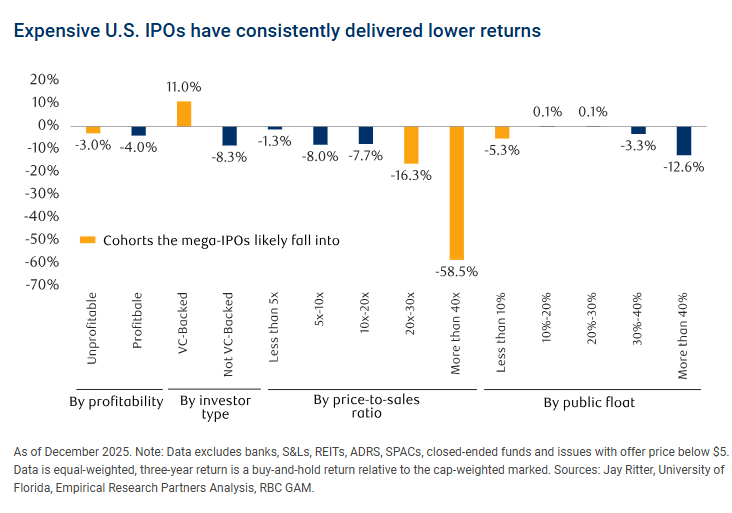
Mega IPOs at Elevated Valuations. Three major companies are entering or have entered the market at historically high valuations. SpaceX was priced at 96x price-to-sales, OpenAI may come in at 43x, and Anthropic a more modest 20x—substantially above the late-1990s tech bubble peak average of 32x. The companies justify these multiples with exceptional growth. All three rank in the top decile for revenue growth among U.S. large-cap firms, with Anthropic and OpenAI posting rates that exceed typical benchmarks. However, historical data indicates risk. IPOs priced above 40x price-to-sales have underperformed the market by 58.5 percentage points over three years (see chart below). Those priced between 20-30x underperformed by 16.3 percentage points. High-revenue tech IPOs ($1B+) with dual-class voting structures have performed better but still require sustained growth to generate competitive returns. The valuation-to-growth equation is critical. These companies are unprofitable. Any material deceleration in growth rates could trigger significant multiple compression and disappointing returns, despite their positions in high-growth industries. Key takeaway: SpaceX, OpenAI, and Anthropic must maintain exceptional growth trajectories to justify current prices.
Portfolio Update
There is no portfolio update this week.
Planning On
Property and lifestyle operational inflation
During our planning and projections meetings, we often have inquiries about the cost of healthcare as one’s age advances. This is a hard number to consider because so many factors determine the expense. Ageing in home is one thing with homecare and ageing in a care facility is another (the latter can actually be cheaper depending on the level of care). A blind spot that sometimes occurs when considering later-stage-of-life expenses is the outsourcing of activities and tasks that you are used to doing yourself. Whether it be just a lack of desire or energy or physical inability to do certain things, the cost of hiring someone can really add up. It can create a significant financial impact known as “property and lifestyle operational inflation”.
When physical mobility, strength, or stamina change, routine household chores transition from "sweat equity" to line items in a monthly budget. Some examples for consideration:
- Exterior & Property Maintenance
Outdoors: tasks that carry higher physical effort or fall risks are usually the first to be hired out:
- Lawn Care & Landscaping: Mowing, weeding, seasonal cleanup, and flowerbed upkeep.
- Safety & Hazard Mitigation: Clearing snow and ice from walkways, tree branch trimming, and cleaning high gutters to prevent water damage.
- Pressure Washing & Exterior Care: Cleaning decks, driveways, and siding to prevent mold and slip hazards.
- Interior Upkeep & Heavy Housekeeping
Inside the home, routine maintenance quickly requires paid assistance:
- Deep Cleaning & Chores: Scrubbing floors, washing windows, changing bed linens, and heavy laundry often require weekly or bi-weekly housekeeping services.
- Minor Technical Repairs: Tasks like changing high ceiling light fixtures, replacing HVAC filters, fixing door latches, or moving heavy furniture shift from quick weekend projects to paid handyman visits.
- Appliance & Plumbing Maintenance: Minor drips or appliance hiccups that a homeowner might have previously repaired require specialized tradespeople.
- Home Retrofits & Safety Adaptations
Maintaining a property for reduced mobility usually demands capital investments beyond standard wear-and-tear repairs:
- Accessibility Modifications: Converting a traditional bathroom into a curb-less walk-in shower with grab bars, widening door frames for walkers, or installing ramps.
- Multi-Level Solutions: Installing stair lifts or outdoor chair lifts.
- Smart Home Technology: Automated lighting, voice-controlled thermostats, smart locks, and monitored medical alert systems, all carrying upfront hardware costs and recurring monthly subscriptions.
- Transportation & Logistics
When driving becomes uncomfortable or unsafe, transportation costs shift dramatically:
- Outsourced Driving: Relying on rideshare platforms, medical transit services, or private drivers for appointments, errands, and social outings.
- Delivery Surcharges: Grocery delivery services, prescription delivery fees, and meal kit or hot meal programs add consistent service charges and tips over time.
- The Compounding Effect
What makes these expenses tricky is that no single fee feels overwhelming on its own—a $150/month lawn service here, a $200 bi-weekly cleaning crew there, $80 in delivery fees, and a $250 handyman callout. However, combined, outsourced household operations can easily add $500 to $1,500+ per month in non-medical costs alone.
As we meet if you would like us to include a dedicated "property services buffer" in retirement withdrawal strategies—or evaluating whether the predictable, bundled fees of a maintenance-free condo or senior living community might eventually compete favorably with the true operational cost of an older single-family home, please let us know.
This information is not intended to provide legal, tax, or insurance advice. To ensure that your own circumstances have been properly considered and that action is taken based on the latest information available, you should obtain professional advice from a qualified lawyer or accountant, as applicable, before acting on any of the information.
Charts of the Week
Feel free to share this newsletter with anyone who might benefit from it or find value in it. Thank you for reading our commentary. We welcome your feedback!
Return to homepage
This information is not investment advice and should be used only in conjunction with a discussion with your RBC Dominion Securities Inc. Investment Advisor. This will ensure that your own circumstances have been considered properly and that any action is taken based upon the latest available information. The strategies and advice in this report are provided for general guidance. Readers should consult their own Investment Advisor when planning to implement a strategy. Interest rates, market conditions, special offers, tax rulings, and other investment factors are subject to change. The information contained herein has been obtained from sources believed to be reliable at the time obtained but neither RBC Dominion Securities Inc. nor its employees, agents, or information suppliers can guarantee its accuracy or completeness. This report is not and under no circumstances is to be construed as an offer to sell or the solicitation of an offer to buy any securities. This report is furnished on the basis and understanding that neither RBC Dominion Securities Inc. nor its employees, agents, or information suppliers is to be under any responsibility or liability whatsoever in respect thereof. The inventories of RBC Dominion Securities Inc. may from time to time include securities mentioned herein. This publication is for information purposes only. Graphs and charts are used for illustrative purposes only and do not reflect future values or changes. Past performance is not indicative of future returns. This commentary is based on information that is believed to be accurate at the time of writing and is subject to change. All opinions and estimates contained in this report constitute RBC Dominion Securities Inc.'s judgment as of the date of this report, are subject to change without notice and are provided in good faith but without legal responsibility. Interest rates, market conditions and other investment factors are subject to change. Past performance may not be repeated. The information provided is intended only to illustrate certain historical returns and is not intended to reflect future values or returns. This publication is not intended as nor does it constitute tax or legal advice. Readers should consult their own lawyer, accountant or other professional advisor when planning to implement a strategy. Insurance products are offered through RBC Wealth Management Financial Services Inc.("RBC WMFS"), a subsidiary of RBC Dominion Securities Inc.* RBC WMFS is licensed as a financial services firm in the province of Quebec. When providing insurance products in all provinces except Quebec, Investment Advisors are acting as Insurance Representatives of RBC WMFS. In Quebec, Investment Advisors and Estate Planning Specialists are acting as Financial Security Advisors of RBC WMFS. RBC Dominion Securities Inc., RBC WMFS and Royal Bank of Canada are separate corporate entities which are affiliated. *Member-Canadian Investor Protection Fund. RBC Dominion Securities Inc. and RBC WMFS are member companies of RBC Wealth Management, a business segment of Royal Bank of Canada. â / ™ Trademark(s) of Royal Bank of Canada. Used under license. RBC Dominion Securities Inc. 2026 All rights reserved.