
Nick Milau
October 8, 2026
Weekly Wrap
Stocks were mixed this week, with Canadian stock markets flat. Weak job data this morning brought interest rates down a bit in Canada but we remain in much better shape with interest rate and inflation levels than the US. US stocks are up 1% but concerns are growing around where US interest rates are headed. The Loonie has dropped significantly over the last few weeks (around $0.70 now) and the main culprit is the spread between US and Canadian interest rates; US rates are jumping and ours are fairly steady. In fact, it’s the US Dollar that is rising more than the Loonie falling. The low Loonie puts us in good stead for trade deals by the way…if only Trump would quit being so obstinate! Speaking of whom, Trump did a lot of flip-flopping on Iran this week but, in a not so subtle political calculation, he now appears content to leave Iran alone until the midterms are over. International markets shed 1.5% this week amid the increased tensions on the Straight of Hormuz, despite the fact oil prices did not move much. Meanwhile the EU is also beginning to feel the pressure of rising bond yields as French bond yields are misbehaving much like those in the US; investors fear a lack of fiscal restraint combined with persistent inflation will not be fixed any time soon. The French are protesting in the streets about fiscal instability…mind you the French will use any reason to protest in the streets!
Market Insights
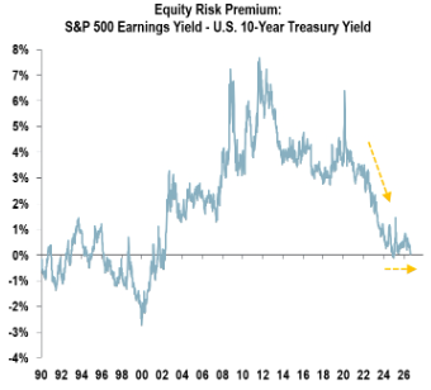
Short-Term Signals vs. Long-Term Signals. When using data, you have to be very careful with two things: what data you choose to analyze and exactly what questions you seek to answer. This is even more true in the time of AI when we have access to a plethora of data and the interpretation of such data right at our fingertips; bad data can lead to bad conclusions and/or overconfidence when used improperly. This week RBC produced a research piece that seeks to answer perhaps the most critical question investors want to know: is the outlook better for stocks or for bonds? The data that was used in this piece was strictly US (hence it does not directly apply to non-US markets) and the results told two different stories; the short-term one and the long-term one. The chart below encapsulates RBC’s research piece; RBC compared the earnings yield of the S&P 500 (which is the reciprocal of the Price-to-Earnings ratio…call it the E/P ratio if you will) with the 10-year US bond yield over time to see what signals they would glean for stock to bond allocation.
Source: Bloomberg
The result of this equation is called the Equity Risk Premium (ERP)…the Earnings Yield minus the 10-year bond yield. The theory is that when the ERP is high then stocks are comparatively attractive and vice versa. What is striking about this equation today is that US equity valuations are very high (AKA the earnings yield is very low at 5%) while interest rates have climbed to multi-decade highs with the 10-year at 5%; currently the ERP is about zero! So according to this theory, right now there should be a strong case to trim US stocks in favor of US bonds. And, by the way, with rates rising around the world a similar, though less convincing, argument can be made in other regions. So let’s dig into the data.
The short-term signal. RBC’s piece chose to focus on whether the ERP provided a good signal for the next 12 months and, like any search for a unicorn, it found no evidence of a relationship. So why would it be that such a logical data point provides no short-term signal? In the short term there are far too many variables that cannot be predicted, not least of which is investor sentiment. Generally, when stock valuations are high it is due to periods of high growth, excessive optimism, perhaps a newly hyped investment theme with a ‘this time it’s different’ kind of sentiment. Well…such heady times end at unpredictable times and in unpredictable ways. I’m not surprised the ERP is not a reliable short-term signal and, frankly, I have stopped searching for such market timing unicorns anyway.
The long-term signal. I then took ERP data to determine how US stocks did versus US bonds over the next 10 years. What I found was that there was a VERY strong indicator for the next 10 years: the lower the ERP the worse US stocks did versus US bonds and vice versa. The last time the ERP was zero (like today) US bonds outperformed stocks (from June 2002 to June 2012 the TLT bond ETF earned 8.93%/year, beating the S&P 500 which earned just 5.49%/year). Meanwhile, when the ERP was high, stocks significantly outperformed bonds over the next 10 years (Jan 2020 to Sept 2026 US stocks averaged 9.98% versus -5.0% for the TLT ETF). And during the multiple periods where there was a positive, normal ERP, stocks outperformed by a smaller amount (between 5-10%/year better).
The conclusion. The vast majority of the time the ERP is positive and, thus, the vast majority of the time, stocks outperform. As such, we generally hold a bias for stocks for long-term investors. But in rare instances where the ERP is zero, like now, we advocate for an increase in fixed income versus stocks.
Epilogue. OK, there are some nuances and exceptions that need to be pointed out. This data focused on the US markets only and the ERP remains positive in the vast majority of other markets. Hence, non-US stocks remain attractive. Further, if you pull out the US tech sector, which is responsible for the majority of the high US valuations, there are sectors and individual stocks whose ERP remains positive and thus a selective approach to US stocks is still worthwhile.
Portfolio Update
This morning we are selling our shares of UPS and replacing them with the Vanguard Intermediate-term Treasury ETF (VGIT)…US government bonds basically. UPS has been a significant disappointment, and the turnaround continues to look too far off for us to wait. With increasing numbers of shippers nibbling at their toes and some e-commerce companies creating their own internal delivery models (I see more Amazon trucks than brown UPS vans) their business model appears broken. Also, with the end of the year approaching the timing is good to trigger a loss now to help offset some of the capital gains we have realized in 2026. Meanwhile, with bond yields hitting very attractive levels in the US we could not pass up locking in a 5% yield with VGIT which holds a basket of 3-10 year US bonds that yield an average of about 5.1%/yr. The argument to shift out of US stocks into US bonds is about as compelling as I have seen it in my entire career (see above Market Insights) and the fact VGIT provides the benefits of diversification with similar, perhaps better, return potential versus stocks can’t be ignored.
Please note any changes apply to our Private Investment Management (PIM) portfolios only, subject to restrictions. Please call to clarify if you have any questions.
Planning On
Back in July I shared a link to RBC global asset management's MacroMemo. This an extremely well-researched offering by RBC Economics. I got into the MacroMemo back during COVID when I was an RBC Financial Planner. It was near the beginning of the pandemic, and the news was terrible to watch, and I didn’t know what was true and what wasn’t. Eric Lascelles, now Managing Director, Chief Economist and Head of Investment Strategy Research, got me through the tough times by just presenting me with the data. No viral videos, no guesses just the facts and it tremendously improved how I managed that health and personal crisis. I am still an avid reader as I appreciate his and his team’s take on the macro events that affect the world (not to mention that since his beard Eric and I bear a striking resemblance).
The reason I am sharing this particular post is largely the same as the last reason….AI. Nick and I were talking this week about how it is very hard for us to truly get a sense of what AI is doing (good or bad) so I am going to leave it to the experts again to parse through the noise to help us learn a little more about the life changing (or life ending depending on what you are listening to) technology.
I highlight the first two sections “The next AI iteration: consumer agents” and “AI safety risk – genuine concerns, but existential risks are low”, however, the topics also include digestible bites on the Fed and rising yields, macro themes from earnings commentary and Canada’s corporate tax cut. It is a long read from top to bottom but there are links to the sections that may interest you. Enjoy!
#MacroMemo - October 6 – November 4, 2026
This information is not intended to provide legal, tax, or insurance advice. To ensure that your own circumstances have been properly considered and that action is taken based on the latest information available, you should obtain professional advice from a qualified lawyer or accountant, as applicable, before acting on any of the information.
Updates from the Team
Move with Arthritis Research Challenge
The Milau team has been busy in September! Our team members stayed active in support of Arthritis Research Canada. From yoga, gym workouts, and hiking to dog walking, seawall strolling, and lunch break walks, we each found our own way to meet our 15-day exercise targets. 760 people took part in MOVE with Arthritis Research, and together they've raised over $136,000! The proceeds support arthritis research for people in BC and across Canada.

Charts of the Week
Feel free to share this newsletter with anyone who might benefit from it or find value in it. Thank you for reading our commentary. We welcome your feedback!
Return to homepage
This information is not investment advice and should be used only in conjunction with a discussion with your RBC Dominion Securities Inc. Investment Advisor. This will ensure that your own circumstances have been considered properly and that any action is taken based upon the latest available information. The strategies and advice in this report are provided for general guidance. Readers should consult their own Investment Advisor when planning to implement a strategy. Interest rates, market conditions, special offers, tax rulings, and other investment factors are subject to change. The information contained herein has been obtained from sources believed to be reliable at the time obtained but neither RBC Dominion Securities Inc. nor its employees, agents, or information suppliers can guarantee its accuracy or completeness. This report is not and under no circumstances is to be construed as an offer to sell or the solicitation of an offer to buy any securities. This report is furnished on the basis and understanding that neither RBC Dominion Securities Inc. nor its employees, agents, or information suppliers is to be under any responsibility or liability whatsoever in respect thereof. The inventories of RBC Dominion Securities Inc. may from time to time include securities mentioned herein. This publication is for information purposes only. Graphs and charts are used for illustrative purposes only and do not reflect future values or changes. Past performance is not indicative of future returns. This commentary is based on information that is believed to be accurate at the time of writing and is subject to change. All opinions and estimates contained in this report constitute RBC Dominion Securities Inc.'s judgment as of the date of this report, are subject to change without notice and are provided in good faith but without legal responsibility. Interest rates, market conditions and other investment factors are subject to change. Past performance may not be repeated. The information provided is intended only to illustrate certain historical returns and is not intended to reflect future values or returns. This publication is not intended as nor does it constitute tax or legal advice. Readers should consult their own lawyer, accountant or other professional advisor when planning to implement a strategy. Insurance products are offered through RBC Wealth Management Financial Services Inc.("RBC WMFS"), a subsidiary of RBC Dominion Securities Inc.* RBC WMFS is licensed as a financial services firm in the province of Quebec. When providing insurance products in all provinces except Quebec, Investment Advisors are acting as Insurance Representatives of RBC WMFS. In Quebec, Investment Advisors and Estate Planning Specialists are acting as Financial Security Advisors of RBC WMFS. RBC Dominion Securities Inc., RBC WMFS and Royal Bank of Canada are separate corporate entities which are affiliated. *Member-Canadian Investor Protection Fund. RBC Dominion Securities Inc. and RBC WMFS are member companies of RBC Wealth Management, a business segment of Royal Bank of Canada. â / ™ Trademark(s) of Royal Bank of Canada. Used under license. RBC Dominion Securities Inc. 2026 All rights reserved.