
Mike Morgan, CFP, CIM
Portfolio Manager & Wealth Advisor, Financial Planner
November 3, 2026
Background
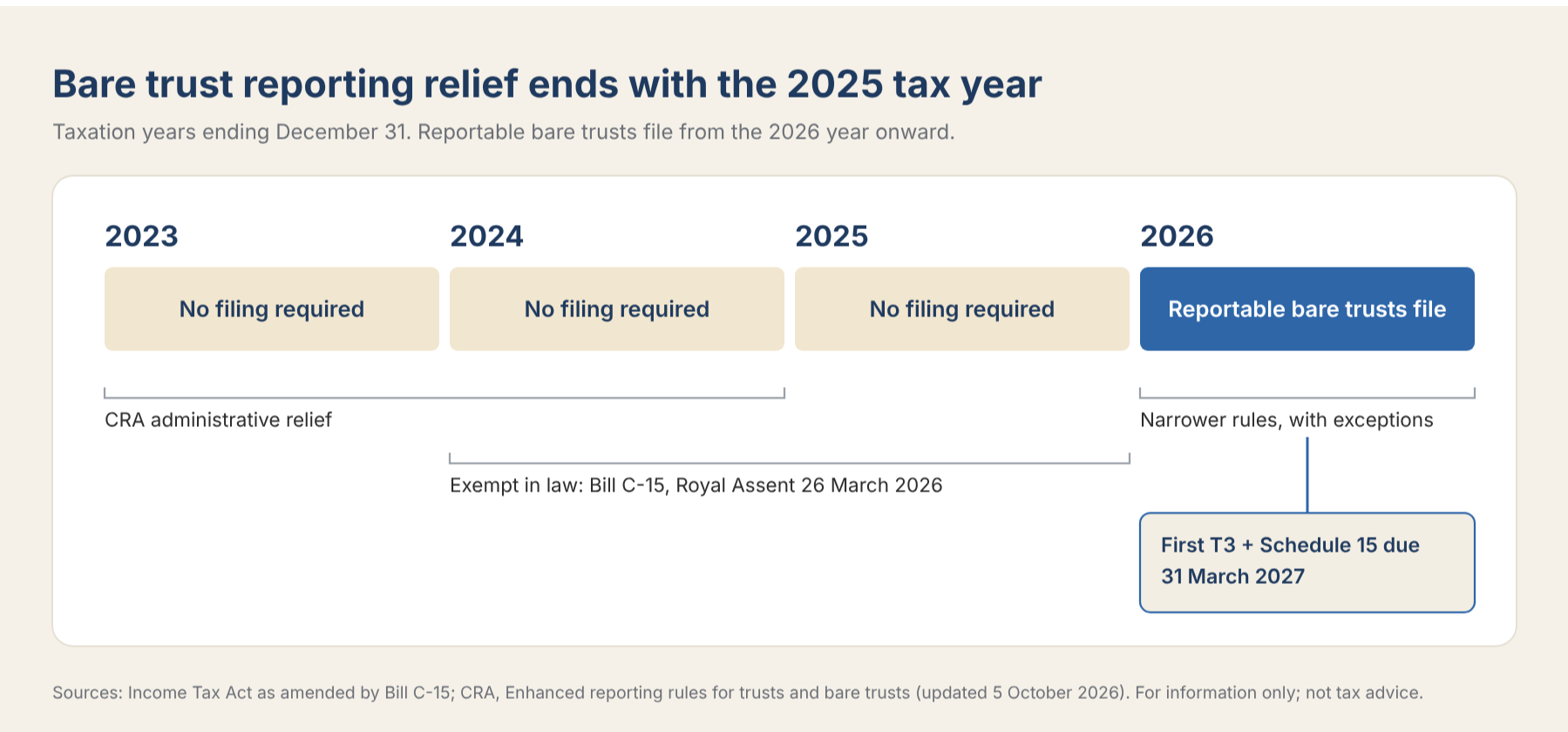
The Canada Revenue Agency (CRA) updated its guidance on the enhanced trust reporting rules on October 5, 2026. The substance was already in the legislation, but the update is a reminder of something a lot of families have stopped tracking: the relief that exempted bare trusts for the 2023, 2024 and 2025 tax years does not extend to 2026.
For trust taxation years ending on or after December 31, 2026—which, for almost everyone, means this December 31—certain bare trust arrangements are back inside the reporting rules. That leaves only the weeks between now and December 31, 2026, for reporting. And the arrangements this catches are rarely the ones people think of as trusts.
What changed, briefly
The enhanced trust reporting rules were introduced in the 2018 federal budget, and first applied to trusts with a taxation year ending after December 30, 2023. Most trusts have a December 31 year-end, so most have been complying since 2023.
Bare trusts were a different story. They were originally swept in, then given administrative relief by the CRA for 2023 and 2024. In August 2025, Canada’s Department of Finance released draft legislation replacing the old bare trust requirements with a narrower set of rules for taxation years ending after December 30, 2026. Those rules were enacted in Bill C-15, which received Royal Assent on March 26, 2026, and they confirm that bare trusts have nothing to file for 2024 and 2025.
So the sequence is: in scope, then out, and now back in—but in a more targeted form, with exceptions that didn’t previously exist. The arrangements that get caught now are a smaller group than the original 2023 rules would have captured. That is genuinely good news. It is also exactly why people who tuned out in 2024 may reach the wrong conclusion in 2026.
What is a bare trust?
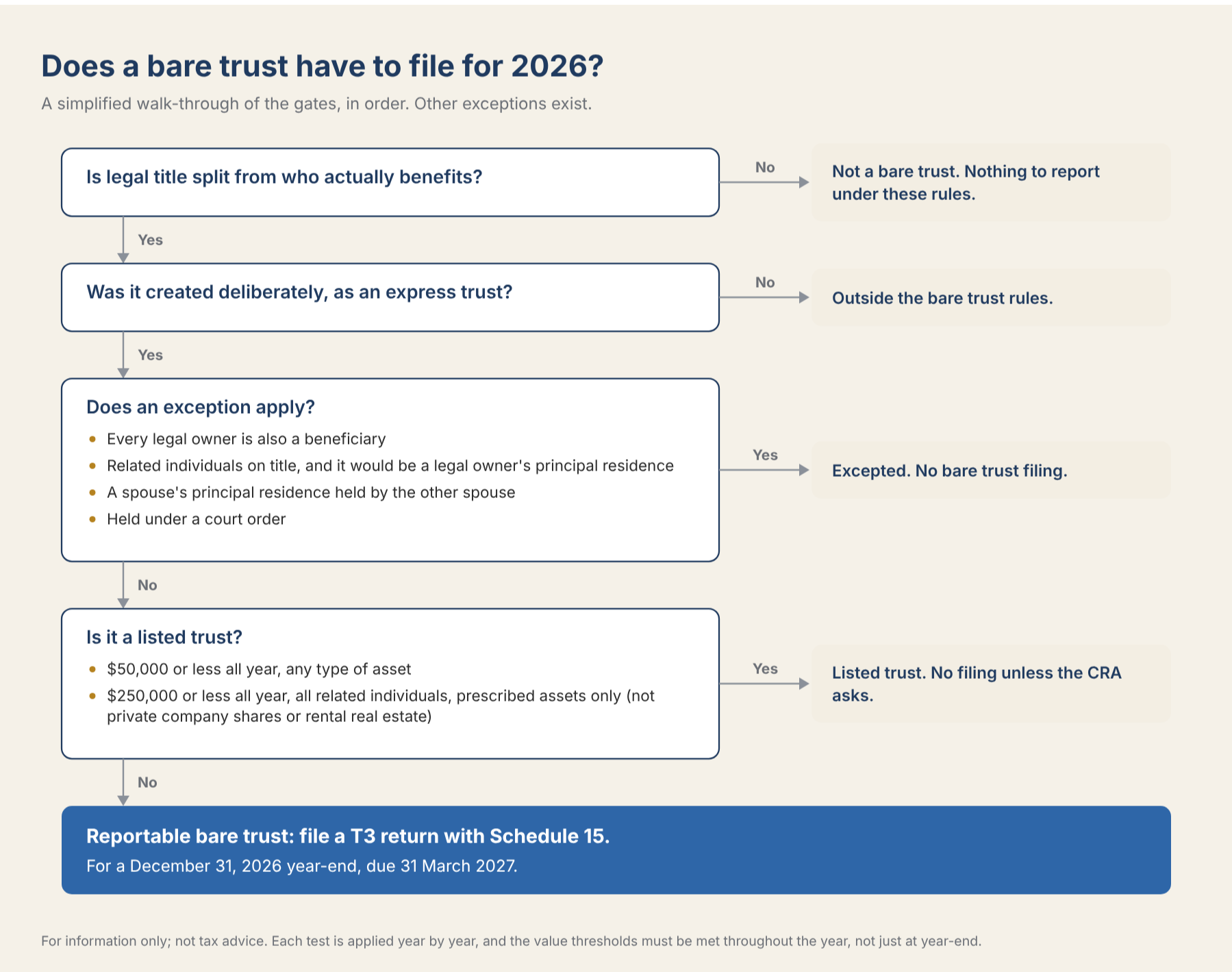
A bare trust doesn’t need a trust document. Nobody has to have called it a trust. It exists whenever one person holds legal title to property for the benefit of someone else, and the legal owner can reasonably be considered to be acting as that person’s agent.
Two conditions narrow it further. The arrangement has to be an express trust—deliberately created by someone, as opposed to a resulting or constructive trust imposed by a court. And it has to fall outside a specific list of exceptions.
In practice, the question to ask about any asset you own is simple: Is legal ownership on this different from who actually benefits from it? If the answer is yes, or if you’re unsure, keep reading.
Key exceptions
Four exceptions take common family arrangements out of the rules entirely:
- Everyone on title is also a beneficiary. A joint bank account between spouses, where both are legal owners and both are beneficial owners, is outside the rules.
- Related persons on title to a principal residence. Where the legal owners are related individuals and the property would be the principal residence of one or more of them for the year, the arrangement is excepted. “Related” is defined generously here: spouse or common-law partner, children, grandchildren, parents, siblings, nieces, nephews, aunts and uncles. This covers the very common case of a parent going on title so a child can qualify for a mortgage.
- A spouse’s principal residence held by the other spouse. Where one spouse is on title and the property is held for the use of the other and would be the legal owner’s principal residence, the arrangement is excepted. This covers spouses who jointly occupy a family home with only one name on title.
- Property held under a court order.
Separately, an arrangement that doesn’t fall under any of those four exceptions may still not be considered a listed trust. Other exclusions/exemptions include trusts where:
- The fair market value of the trust property doesn’t exceed $50,000 throughout the year, with no restriction on asset type.
- The total fair market value of trust assets doesn’t exceed $250,000 throughout the year where all trustees and beneficiaries are related individuals—but only where the trust’s assets are limited to prescribed types: cash, Guaranteed Investment Certificates (GICs), certain government and listed corporate debt, listed shares, mutual fund units, and similar. This list does not include private company shares, and it does not include real estate that isn’t personal-use property.
That last point is the one that often catches people. A rental property worth $300,000 cannot use the $250,000 threshold no matter how the numbers look, because real estate held for rent isn’t on the prescribed list at all.
Hypothetical example
The following is a hypothetical scenario created for illustration. It does not describe any actual client, and the figures are assumed.
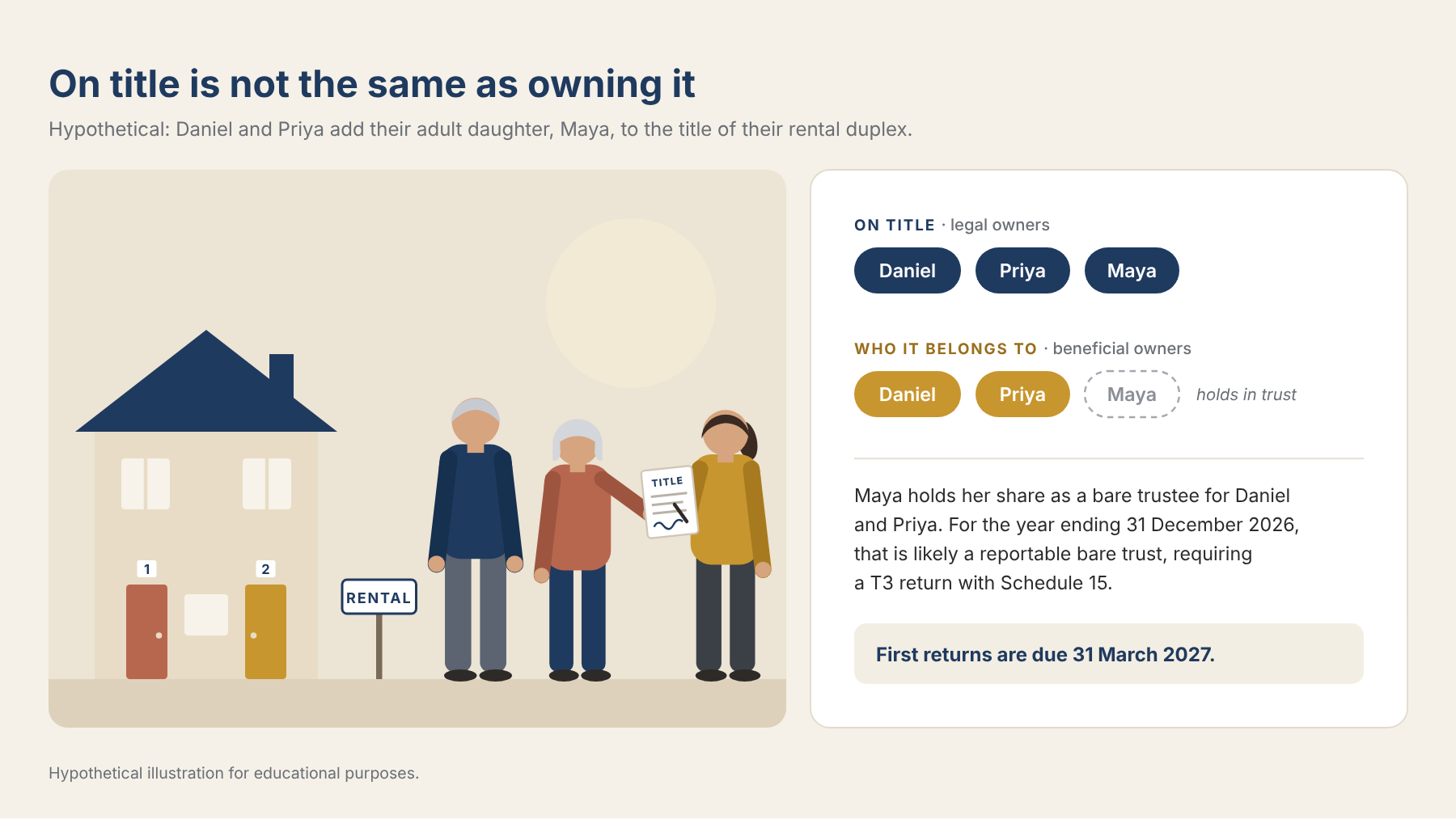
Daniel and Priya own a rental duplex in Scarborough with a current fair market value of $1.4 million. In 2023, on a well-meaning suggestion, they added their adult daughter, Maya, to the title. The goal was to simplify things for the estate later and avoid probate on that property.
Maya contributed nothing to the purchase. She receives none of the rent. Daniel and Priya report all of the rental income on their own returns and always have. Maya lives in her own condo across the city.
The conclusion is that this is likely a reportable bare trust for the year ending December 31, 2026, and a T3 return with Schedule 15 would be required, due March 31, 2027.
Now change only how the property is used. Suppose Maya lives there as her principal residence and none of it is rented out. The related-persons principal residence exception would likely apply, and the filing obligation would fall away. Same title, same family, same $1.4 million—different answer, because of who sleeps there.
That is the character of these rules. They turn on facts that have nothing to do with how the arrangement was documented.
Let’s test this scenario:
Test | Daniel and Priya |
Legal ownership split from beneficial ownership? | Yes—Maya is on title with no beneficial interest |
An express trust? | Yes—deliberately created by their own act |
Is every legal owner also a beneficiary? | No—Maya is a legal owner only |
Related persons on title to a principal residence | Related, yes—but the duplex is a rental, not anyone’s principal residence |
A listed trust? | No—$1.4 million exceeds $50,000, and rental real estate isn’t a prescribed asset for the $250,000 test |
What’s at stake
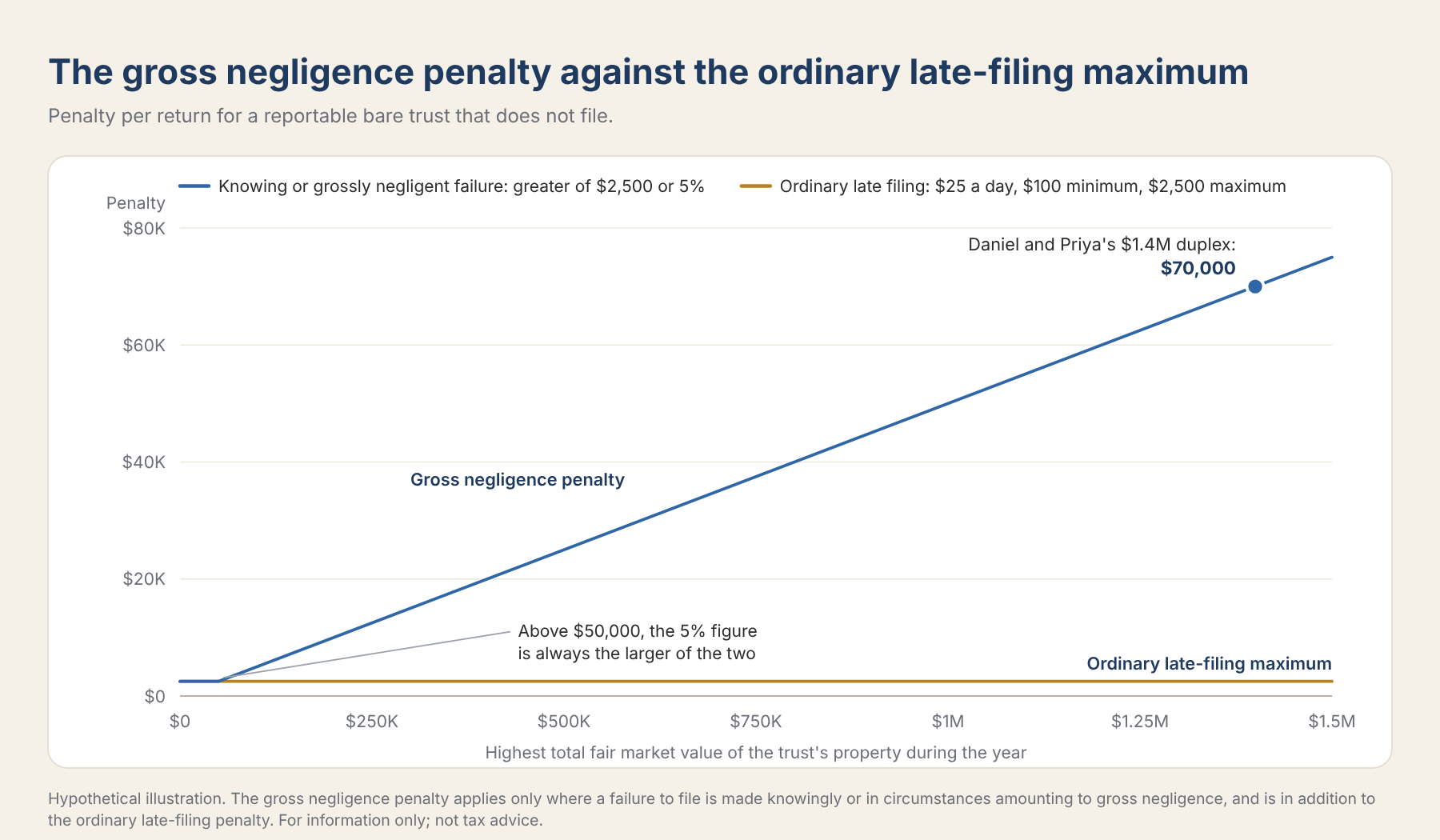
The ordinary penalty for filing late is $25 a day, with a $100 minimum and a $2,500 maximum per return, even when no tax is owing. Where a failure to file is made knowingly or in circumstances amounting to gross negligence, a further penalty applies: the greater of $2,500 or 5% of the highest total fair market value of the trust’s property during the year.
The $2,500 figure gets quoted a lot and ,in the gross negligence case, it’s misleading. Above $50,000 of property—which is also the point at which the listed trust exemption stops helping—the 5% calculation is always the larger of the two. On Daniel and Priya’s $1.4 million duplex, that would be $70,000.
The part that takes the most time
If a filing is required, Schedule 15 asks for the name, address, date of birth, jurisdiction of residence and taxpayer identification number of every person who, during the year, was a trustee, a beneficiary, or a settlor—plus, anyone who can influence trustee decisions about how income or capital gets distributed.
Two things make this harder than it sounds:
- First, “settlor” is defined more broadly than you’d expect. It includes anyone who loaned or transferred property to the trust, unless the transfer was for fair market value consideration or made under a legal obligation. For example, a parent who quietly funded part of a down payment years ago may be a settlor.
- Second, gathering this information takes longer than filling in the form. Dates of birth and Social Insurance Numbers (SINs) for adult children, in-laws and extended family are not things most people have on hand, and asking for them in March is an uncomfortable conversation to have in a hurry.
Separately, if a trust needs a CRA trust account number and doesn’t have one, there’s a $100 penalty where a trustee fails to provide a valid number to a financial institution and slips get issued without it. That penalty can be avoided if a number is applied for within 15 days of the institution’s request and provided within 15 days of receiving it.
What to do between now and December 31, 2026
Our team’s view is that this is a review worth doing deliberately rather than waiting for a tax preparer to surface it in the spring, for one key reason: The facts that determine the answer are facts you can still change this year. Who is on title, who occupies a property, and whether an arrangement needs to exist at all are live questions in October. They are settled history in March.
A practical list:
- Inventory every place where title and benefit diverge. Property, investment accounts, nominee corporations holding real estate, shares registered in one name but beneficially owned by another.
- Test each one against the exceptions rather than assuming the whole category is exempt. The 2023–2025 relief is the single most common source of error here.
- Check the asset-type restriction before relying on the $250,000 threshold. Private company shares and non-personal-use real estate do not qualify.
- Start collecting beneficiary information now if a filing looks likely.
- Ask whether the arrangement still earns its place. Some of these were set up to solve a problem that has since been solved another way, or that was never quite the problem people thought it was.
Remember, being exempt in 2025 tells you nothing about 2026. The test is applied year by year, and the rules changed in between.
Common questions
Does a bare trust need a written agreement to fall under CRA reporting rules?
No. The rules look at whether legal ownership and beneficial ownership are split and whether the legal owner is acting as an agent. Documentation is evidence, not a trigger.
We added our daughter to the title on our home so it passes outside the estate. Is this an exception?
If the property is the principal residence of one or more of the related legal owners for the year, the exception likely applies. The answer changes if nobody on title lives there.
Our family trust already files a T3. Does any of this change for us?
Family trusts that are express trusts have generally been inside the enhanced reporting rules since the 2023 year-end. The 2026 change is about bare trusts specifically. The updated rules did adjust the listed trust thresholds, so the exemption analysis is worth re-running.
If we’re exempt from Schedule 15, is there nothing to file?
Not necessarily. A T3 return may still be required under the ordinary rules—for example where the trust has tax payable, disposed of capital property, or allocated income to beneficiaries. Exemption from the beneficial ownership disclosure isn’t exemption from filing.
Is a joint account with my spouse a bare trust?
Generally not, where both of you are legal owners and both are beneficial owners. A joint account opened with an adult child for convenience, where the child has no beneficial interest, is a different question.
If you’re reviewing family arrangements before year-end, this is a conversation to have with your accountant and your advisor together rather than sequentially—the tax filing question and the “should this structure exist at all” question are the same conversation. Part of what our team does is make sure those conversations happen in the same room rather than six months apart.
Disclosures
This article is for informational purposes only and is not intended to provide legal, tax, accounting or investment advice. The scenario described is hypothetical and is used for illustration only; it does not describe any actual client or client experience, and all figures are assumed. Tax rules are complex, change over time, and apply differently to each person’s circumstances. You should obtain advice from a qualified tax and legal advisor regarding your own situation before acting on any of the information here.