
Mike Morgan, CFP, CIM
Portfolio Manager & Wealth Advisor, Financial Planner
October 12, 2026
Joanne has been paying herself a salary out of her own company since 1996. She is fifty now. The business had a good year, so she asked her accountant how much she could put away for retirement, and the answer came back $33,810.
She asked what that number would be for someone fifteen years younger earning the same salary. It is $33,810.
That is the part owners find hard to accept, and it is not an error. The RRSP limit is a flat dollar ceiling. Eighteen per cent of Joanne's $200,000 salary would be $36,000, but the annual limit stops her short of it. It does not rise because she has fifteen years left to fund a retirement instead of thirty. It does not rise because the company had a good year. A thirty-five-year-old earning exactly what she earns gets exactly the same room, and three decades to use it.
For most people that is fine. For an incorporated owner at fifty still trying to build a retirement out of a business, it is a ceiling in the wrong place. Everything above it goes into a corporate investment account and is taxed there every year.
An Individual Pension Plan is the structure that raises the ceiling. It is not right for everyone, and the way it is usually sold obscures what it actually does, so I want to be careful about both.
Joanne is a composite. The figures are hers and not a template — they come from an actuarial IPP illustration prepared in January 2026 for an owner of her age, salary and service history. Yours would depend on your own.
50% more retirement income
The video this article accompanies says an IPP can build about 50 per cent more retirement savings than an RRSP. Here is where that number comes from.
On the illustration for our owner, putting the maximum into her RRSP every year takes her to $4,309,660 at 65. The IPP, together with the small amount of RRSP room she keeps beside it, takes her to $6,388,170. That is 48 per cent more, or nearly half as much again. Carry both to 71 and the figures are $7,330,021 and $10,910,132, which is 49 per cent more.
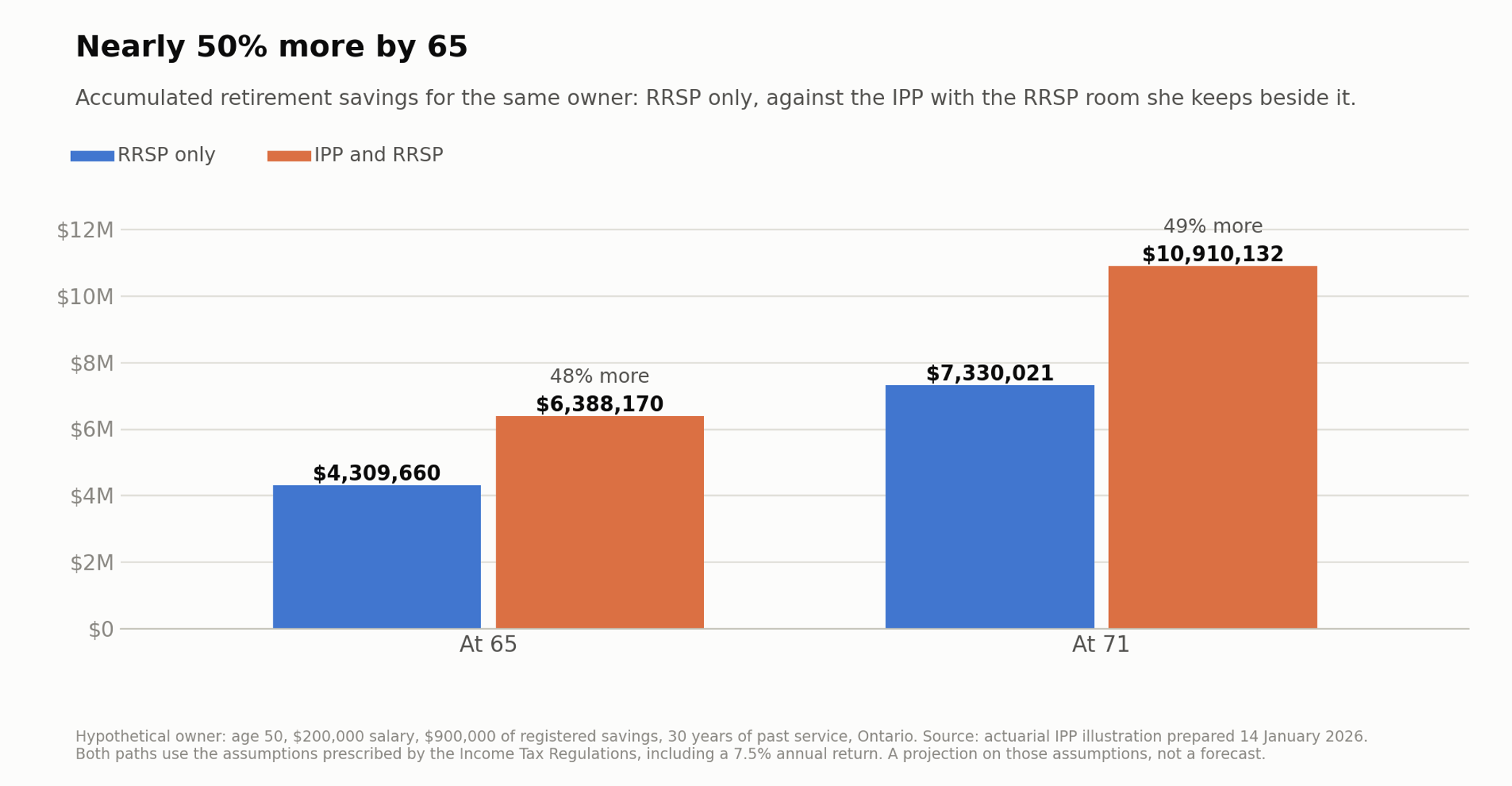
Figure 1. Accumulated retirement savings at 65 and 71: RRSP only against the IPP.
Both paths start from the same $900,000 of registered savings and both are run on the same assumptions. Those assumptions are not the actuary’s and they are not mine. An IPP is what the Income Tax Act calls a designated plan, and the Income Tax Regulations tell the actuary which assumptions to use when calculating the maximum the plan may be funded:
· a future investment interest rate of 7.5 per cent
· future inflation of 4 per cent
· future salary increases of 5.5 per cent
· a retirement age no earlier than 65
· post-retirement inflation adjustments no greater than CPI less 1 per cent
· life expectancy from the 1983 Group Annuity Mortality Table
Because the same 7.5 per cent is applied to both sides, the gap does not come from assuming a better return inside the IPP. It comes from more money going in: a larger contribution every year, and the corporation’s past-service contribution at the start. Your own returns will differ from 7.5 per cent in either structure, and the dollar figures will move with them. The extra room is what the IPP adds, and the rest of this article is about where that room comes from.
What the plan does
An IPP is a defined benefit pension plan that your corporation sponsors for you. Instead of contributing to an account and hoping, the plan promises a pension, and an actuary works out what the corporation has to put in to deliver it.
The pension is built one year at a time. For every year you work, you earn a piece of future retirement income equal to 2% of that year’s earnings, subject to CRA limits. So if Joanne earns $200,000, 2% of her salary would equal $4,000 of annual pension earned for that one year of service. That is an important distinction: it is not $4,000 being contributed to an investment account. It is $4,000 of annual retirement income, payable every year in retirement for the rest of her life.
There is, however, a limit to how much pension can be earned in any one year. CRA sets what is called the defined benefit limit, and for 2026 that amount is $3,932.22. Since 2% of Joanne’s $200,000 salary would otherwise produce a $4,000 benefit, she hits the ceiling. Her pension earned for that year is therefore $3,932.22 annually, or roughly $328 a month in retirement.
The same calculation happens again the following year, and every year after that. Each year of service adds another piece to the pension, and over time those pieces stack together to determine the total retirement income the plan is required to provide. The actuary then determines how much the corporation needs to contribute in order to fund that obligation.
This is where an IPP can become particularly meaningful for someone like Joanne. She has 30 years of past service behind her and another 15 years potentially ahead of her, which creates a substantial pension benefit to fund. It is not as simple as multiplying 30 years by today’s $3,932.22 limit, because each historical year is calculated using the pension limits that applied at the time, and those limits were considerably lower through the 1990s and 2000s.
The important point is that the pension itself is defined. Joanne is not simply accumulating an investment account and hoping it grows to a certain amount. The plan is designed around a specific retirement benefit, which also changes who carries the risk. With an RRSP, Joanne carries the investment risk; if markets disappoint, her retirement account is worth less. With an IPP, the corporation sponsors the pension promise, and if the assets are not sufficient to fund that promise, additional corporate contributions may be required.
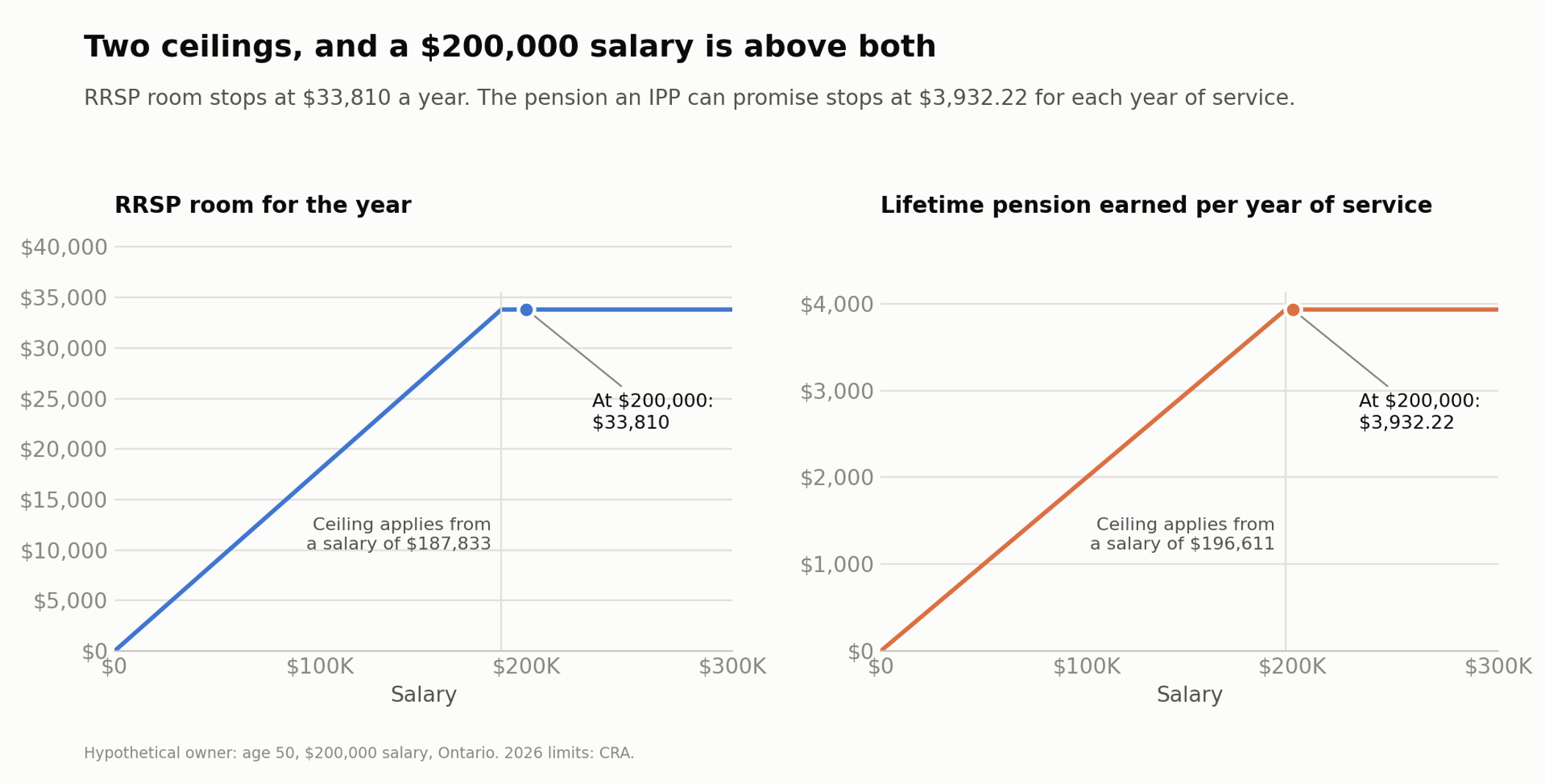
Figure 2. The RRSP limit and the defined benefit limit, 2026.
The salary question
To make the maximum current-year contribution to an IPP, your employment income has to be at least the year’s money purchase limit divided by eighteen per cent. For 2026 the money purchase limit is $35,390, so:
$35,390 ÷ 18% = $196,611
Our owner clears that by a few thousand dollars, so her plan can be funded to the largest pension the rules allow. Below that salary an IPP still works, and after about age forty it still permits a larger corporate contribution than an RRSP would.
One important condition sits underneath all of this: an IPP needs employment income. Dividends do not count as earned income for pension purposes, and they do not create RRSP room either. That matters because many business owners make the salary-versus-dividend decision one year at a time, usually based on what looks most tax-efficient in that particular year. The problem is that those decisions compound over time. If you have paid yourself only dividends for many years, there may be little or no employment income history on which to build an IPP. In Joanne’s case, she has received a salary every year since 1996, and that long history of pensionable earnings is a big part of what makes the opportunity so meaningful today.
Why the contribution is larger at fifty than at forty
This is one of the reasons an IPP becomes more attractive as a business owner gets older. The plan is working toward a defined pension at retirement, so the less time there is to fund that pension, the more money the corporation is generally allowed to contribute each year.
At younger ages, there is more time for contributions and investment growth to do the work. As you get closer to retirement, there are fewer years remaining, so the annual funding requirement increases. Around age 40, the amount that can be contributed to an IPP is generally similar to the RRSP maximum. After that, the IPP contribution begins to pull ahead, and the difference tends to become larger with age.
For Joanne at age 50, the illustration allows her corporation to contribute $44,702 to the IPP for her 2026 service, compared with $33,810 of RRSP room. That is roughly one-third more money going into a tax-deferred retirement plan in the first year alone. By age 64, the illustration shows an IPP contribution of $123,028, compared with $71,545 of RRSP room.
Those later numbers should not be read as a prediction of what Joanne will actually contribute 14 years from now. The illustration assumes her salary and the applicable pension limits increase by 5.5% annually. What matters is the relationship between the two lines: as Joanne gets older, the amount her corporation can contribute to the IPP grows considerably faster than the amount she could otherwise put into an RRSP.
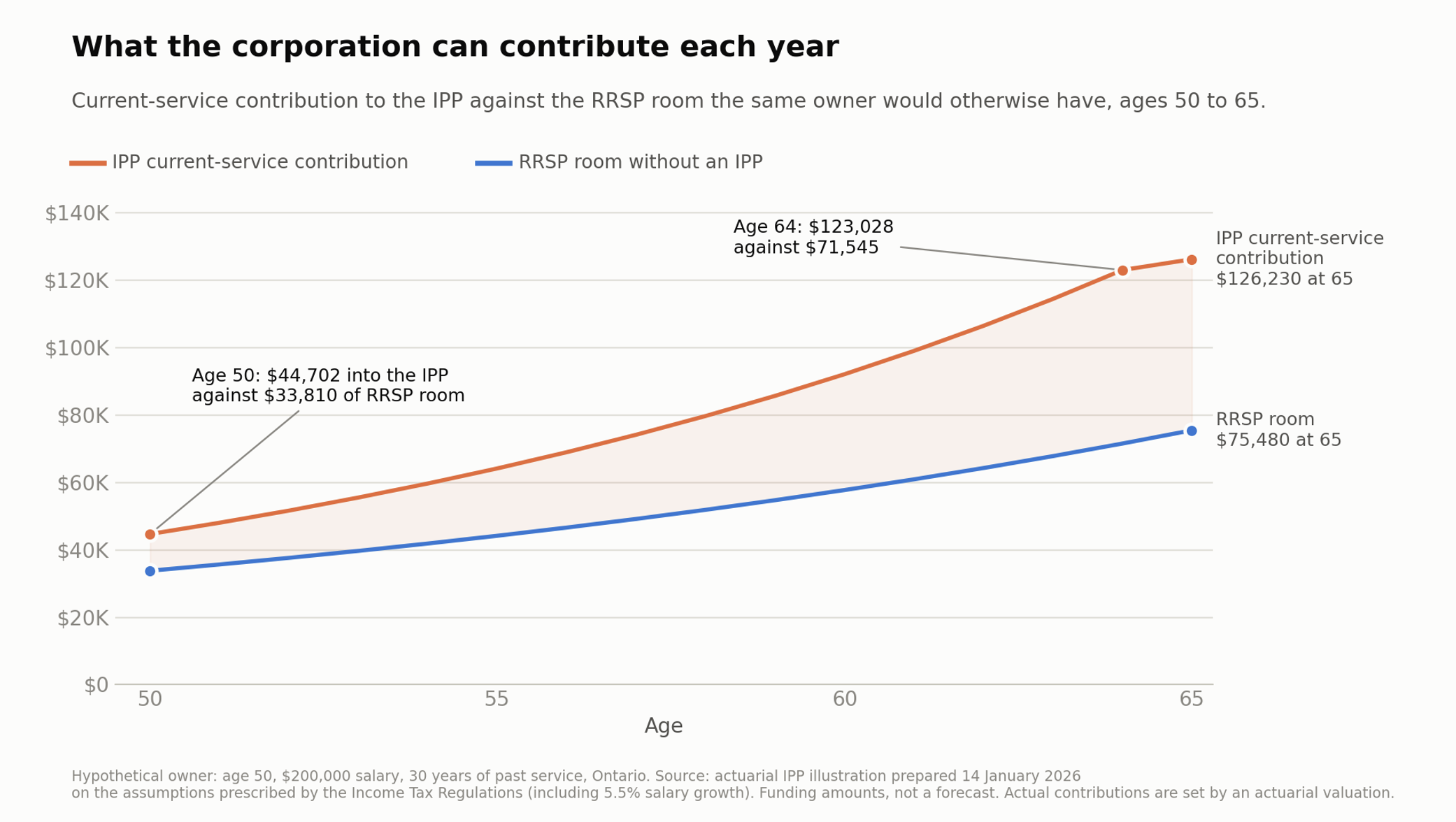
Figure 3. Annual contribution: IPP current service against RRSP room, ages 50 to 65.
One of the biggest advantages of establishing an IPP later in your career is that the plan may be able to recognize years you worked for the corporation before the IPP existed. In Joanne’s case, she has 30 years of eligible past service, from 1996 through 2025, and the actuary calculates that approximately $1,294,506 is required to fund the pension she has earned for those years.
That does not mean her corporation simply writes a cheque for $1.29 million. The tax rules require part of the past-service obligation to be funded by transferring money that Joanne has already accumulated in her RRSP. In this illustration, approx. $ is transferred from her RRSP into the IPP. The money remains inside a tax-deferred retirement plan; it is simply moving from one registered plan to another. Her corporation then contributes the remaining $402,676, which is deductible to the corporation.
There is a trade-off going forward. Once Joanne participates in the IPP, the pension benefit she earns each year creates a pension adjustment, which reduces the amount of new RRSP room she receives. This is the same for anyone participating in a corporate pension plan.
What it costs you
I will not pretend this is a free upgrade, because the constraints are real and they are the reason I talk a good number of owners out of it.
The funding is mandatory. This is a pension promise, not a savings target. If the plan runs a shortfall, whether from poor returns or from expenses charged inside the plan, the corporation may have to top it up, and the obligation does not pause because the business had a difficult year.
The money stops being the corporation’s. Once contributed it belongs to the plan and can only be used for retirement purposes. It cannot come back to fund payroll or an acquisition.
It is administered, and administration costs money. An actuarial valuation is required every four years, or every three where pension benefits legislation applies, plus a trustee, plus annual filings. The illustration budgets $1,750 a year for the actuarial firm’s fees.
The investments are constrained. An IPP can hold what an RRSP can hold, but no more than ten per cent of the plan’s market value may sit in the securities of any one corporation, with exceptions for mutual funds, pooled funds and government bonds. You can’t hold 30% of the portfolio in one stock!
It may have to be wound up if you sell the company. A buyer is unlikely to want to sponsor your pension.
Against that, three things are worth putting on the other side of the ledger. Pension legislation generally provides creditor protection for the assets. Payments from the plan in retirement are eligible for pension income splitting and the federal pension income tax credit at any age, which an RRSP’s income is not until 65. And the plan’s investment management fees are deductible to the corporation when it pays them directly, which RRSP fees are not.
The two moments an IPP does something an RRSP cannot
This is the part that tends not to make it into the sales material, and it is the part I find most interesting, because it has nothing to do with retirement savings as such.
Moving passive assets out of the operating company. A corporation’s access to the small business deduction is affected once it earns more than $50,000 of passive income in a year. Funding an IPP moves capital out of the corporation into a separate tax entity, which reduces the passive assets sitting inside it. The same movement can help with qualifying for the lifetime capital gains exemption on a share sale, because excess passive assets are exactly what disqualifies shares. That is the housekeeping I describe as purification in the article on selling a business tax-efficiently. For our owner, the $402,676 past-service contribution is capital that leaves the company in the first year.
A final funding opportunity at retirement. Another potential significant benefit can arise when retirement happens around the same time as the sale of the business. Once Joanne retires and begins drawing her pension, the actuary may be able to calculate an additional corporate contribution to fully fund benefits that were not built into the plan while she was working. These can include things like early retirement benefits, a temporary bridge pension, full inflation protection and improved survivor benefits. This additional contribution is commonly referred to as terminal funding.
The numbers can be substantial. In Joanne’s illustration, the corporation could contribute an additional $670,196 if she retires at 65, or approximately $1.33 million if she retires at 60. The earlier retirement produces the larger amount because the plan has to fund a richer pension over a longer retirement period.
This becomes particularly interesting if Joanne is also selling the assets of her business around the same time. An asset sale can create a large amount of taxable income inside the corporation. A properly structured terminal-funding contribution is deductible to the corporation, so making that contribution in the same period may help offset some of the income created by the sale, while moving more corporate money into the pension plan for Joanne’s retirement.
Ideal candidates
In my experience the people for whom this is worth modelling look like this: incorporated, over forty and usually over fifty, drawing consistent T4 employment income and not dividends only, with stable corporate cash flow, a company that will keep existing for a while, and a tolerance for administration. They also have an accountant, an actuary and an advisor who will sit in the same conversation and not in three separate ones.
If that is close to you, the question to take to your accountant is not “should I set up an IPP”. It is narrower and more useful:
1. What is my actual T4 employment income, and what would it need to be?
2. How many years of eligible past service does the corporation have for me?
3. What would the actuary’s current-service contribution be at my age and salary, against the $33,810 an RRSP allows at the 2026 limit?
4. What happens to the plan if I sell the business, and when?
5. Can the corporation carry a mandatory funding obligation through a bad year?
The fourth and fifth are the ones that decide it. The first three only tell you the size of the opportunity.
Summary
An IPP is a good structure for a specific person: an incorporated owner in the second half of their career, paying themselves properly, with more capital than registered room and a business that will be around to sponsor the plan. For that person it does something nothing else does, and the two sale-related uses above can be worth more than the retirement saving.
If this sounds like it may fit your situation, call or email me. We can look at your age, T4 income, years of service and corporate cash flow and determine whether an IPP is actually worth considering for you.