
Mike Morgan, CFP, CIM
Portfolio Manager & Wealth Advisor, Financial Planner
November 18, 2026
On November 5, 2026 the federal budget proposed a new capital gains exemption of up to $15 million. For context, the lifetime capital gains exemption most business owners know about is $1,275,000 for 2026. The new one is almost twelve times larger.
I have had a version of the same conversation several times in the week since. An owner reads the headline, does the arithmetic on their own company, and arrives wondering whether their exit just got dramatically cheaper.
For most of them, the honest answer is no. Not because of a technicality buried in the fine print, but because of the first condition in the measure. It is worth understanding properly, because the gap between what this looks like and what it does is wide.
Before I go further: this is a proposal. It was announced in the budget, there is no draft legislation as at the date of this article, and several of its rules have been explicitly deferred. Nothing here is a recommendation to do anything.
What was actually announced
The measure is called the Canada Growth Incentive. It would exempt up to $15 million of capital gains, and that $15 million applies separately to each qualifying individual, for each business. A qualifying individual is a person — not a trust — who is at least 18 when the share is acquired and resident in Canada for the year of the claim.
The exemption attaches to a qualifying share. That is where it gets interesting.
The condition that decides most cases
A qualifying share has to be issued on or after November 5, 2026, and it has to be issued solely for cash, or in exchange for employment services provided to the company.
Read that twice, because it is the whole article.
If you own the common shares of a company you incorporated in 2009, those shares were issued in 2009. They are not qualifying shares, and nothing in the proposal as announced changes that. There is no grandfathering. There is no transitional rule. The exemption reaches growth on shares issued after budget day, not the value you have spent fifteen years building.
Property is also not acceptable consideration. So the route of contributing an existing business into a corporation in exchange for shares does not obviously get you there either.
There is a provision for "continuity rules," and I have seen it misread. The budget says those rules would accommodate certain share-for-share exchanges and other reorganizations that occur after qualifying shares have been issued. They protect a qualifying share through a later reorganization. They do not convert an old share into a qualifying one.
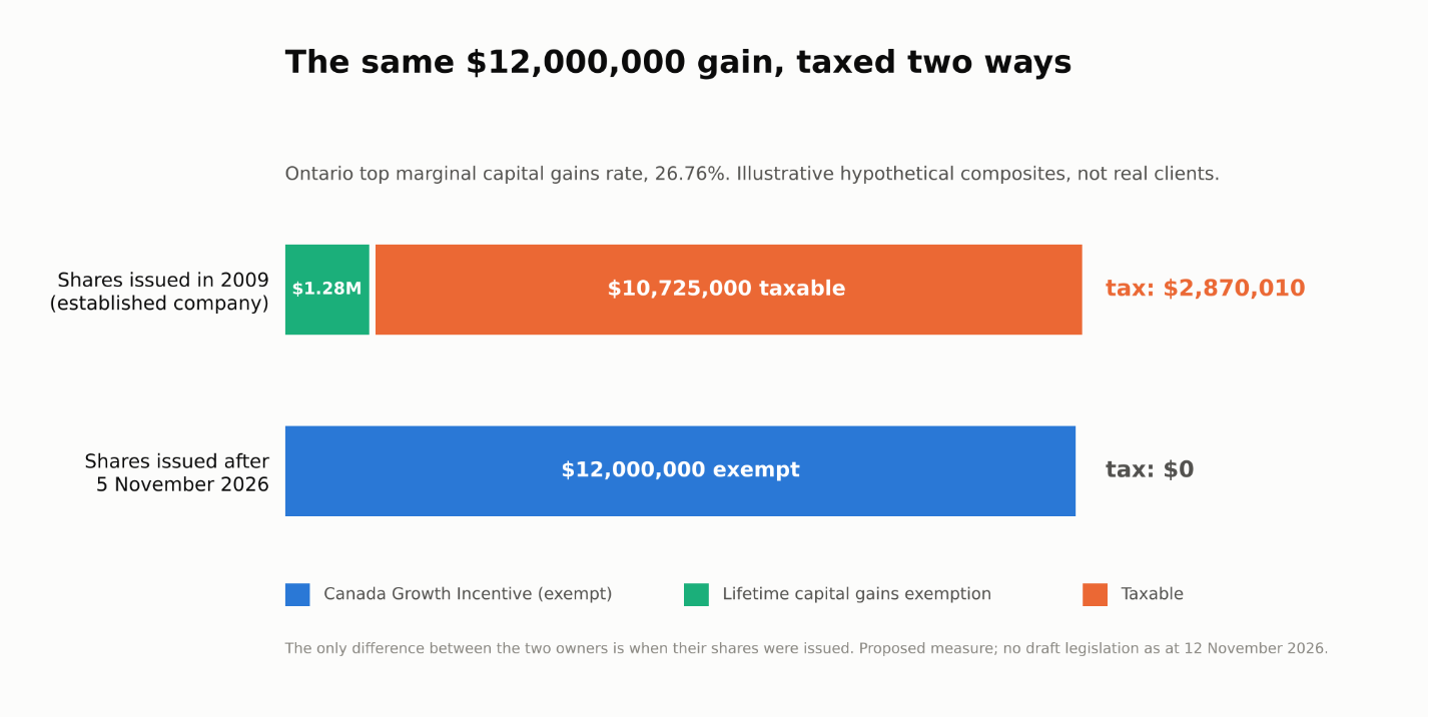
An example
Take two owners with identical companies and identical $12,000,000 gains. One holds shares issued in 2009. Assuming his shares meet the qualified small business corporation tests, he shelters $1,275,000 under the lifetime capital gains exemption and pays tax on $10,725,000. At Ontario's top marginal capital gains rate of 26.76%, that is $2,870,010.
The other holds qualifying shares issued after budget day. The whole $12,000,000 falls within the $15 million limit.
These are illustrative hypothetical composites, not real clients, and they ignore alternative minimum tax, which I come back to below.
What it looks like when it does work
Here is a hypothetical. Priya incorporates a manufacturing company in Ontario in March 2027 and subscribes for her common shares with $100,000 of cash. The company is a Canadian-controlled private corporation. Its assets are used in the business, it operates in Canada, and the group's carrying value is nowhere near the $100 million ceiling.
In 2033 she sells for $16,100,000. Her capital gain is $16,000,000. The exemption covers $15,000,000 of it, leaving $1,000,000 taxable.
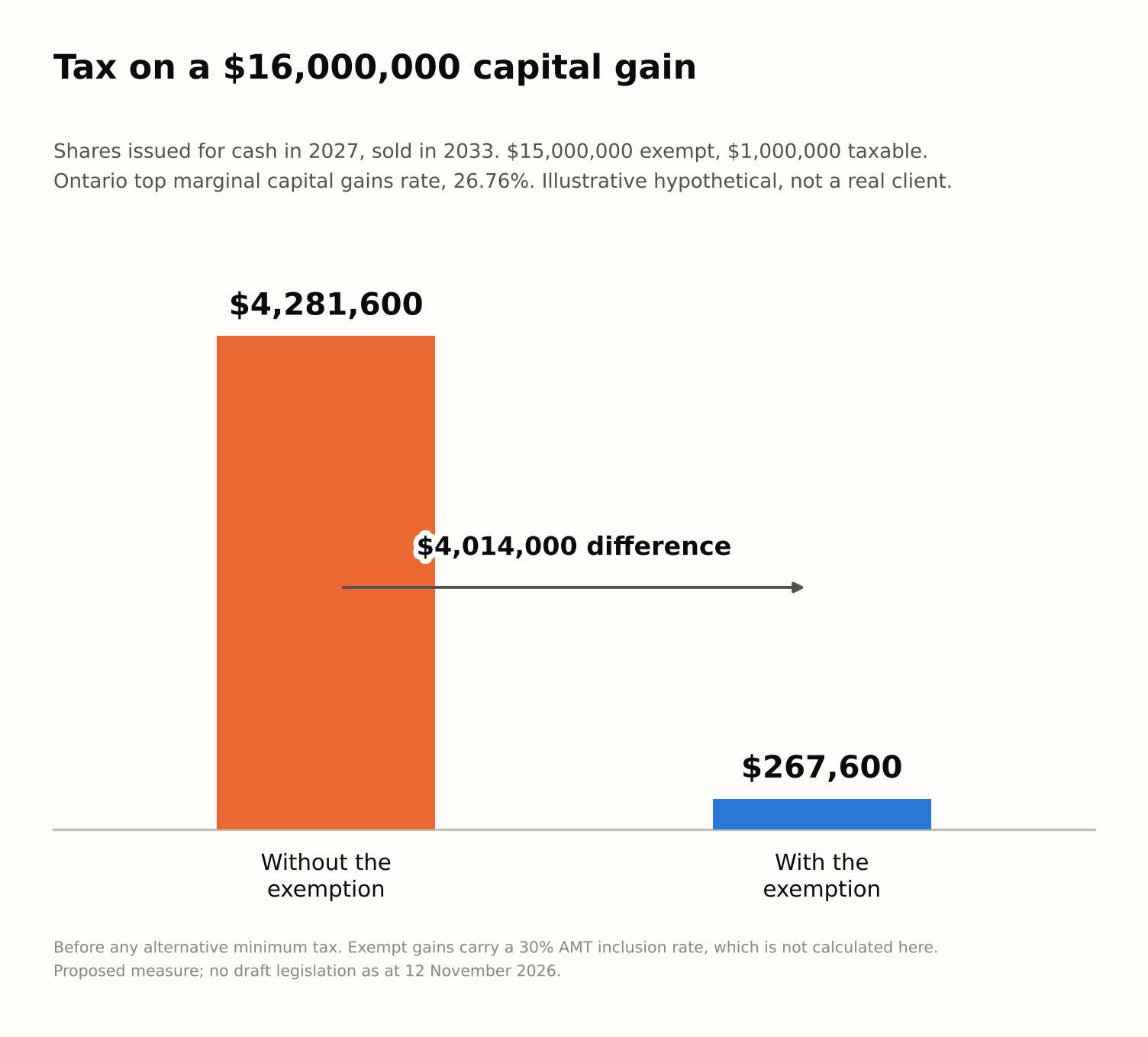
At 26.76%, tax on $1,000,000 is $267,600. Without the exemption, tax on the full $16,000,000 would be $4,281,600. The difference is $4,014,000.
That is a serious number, and it is why the measure is worth understanding even if it does not apply to your current company. It applies to the next one.
One caution on that arithmetic. Gains exempted under this measure carry a 30% inclusion rate for alternative minimum tax purposes, the same treatment as lifetime capital gains exemption gains. I have not calculated AMT in this example, and in a year with a gain this size it is not a rounding error. That is a conversation for your accountant with your actual numbers in front of them.
What has to be true, and when
There are three separate asset tests at three different moments, and they are easy to run together.
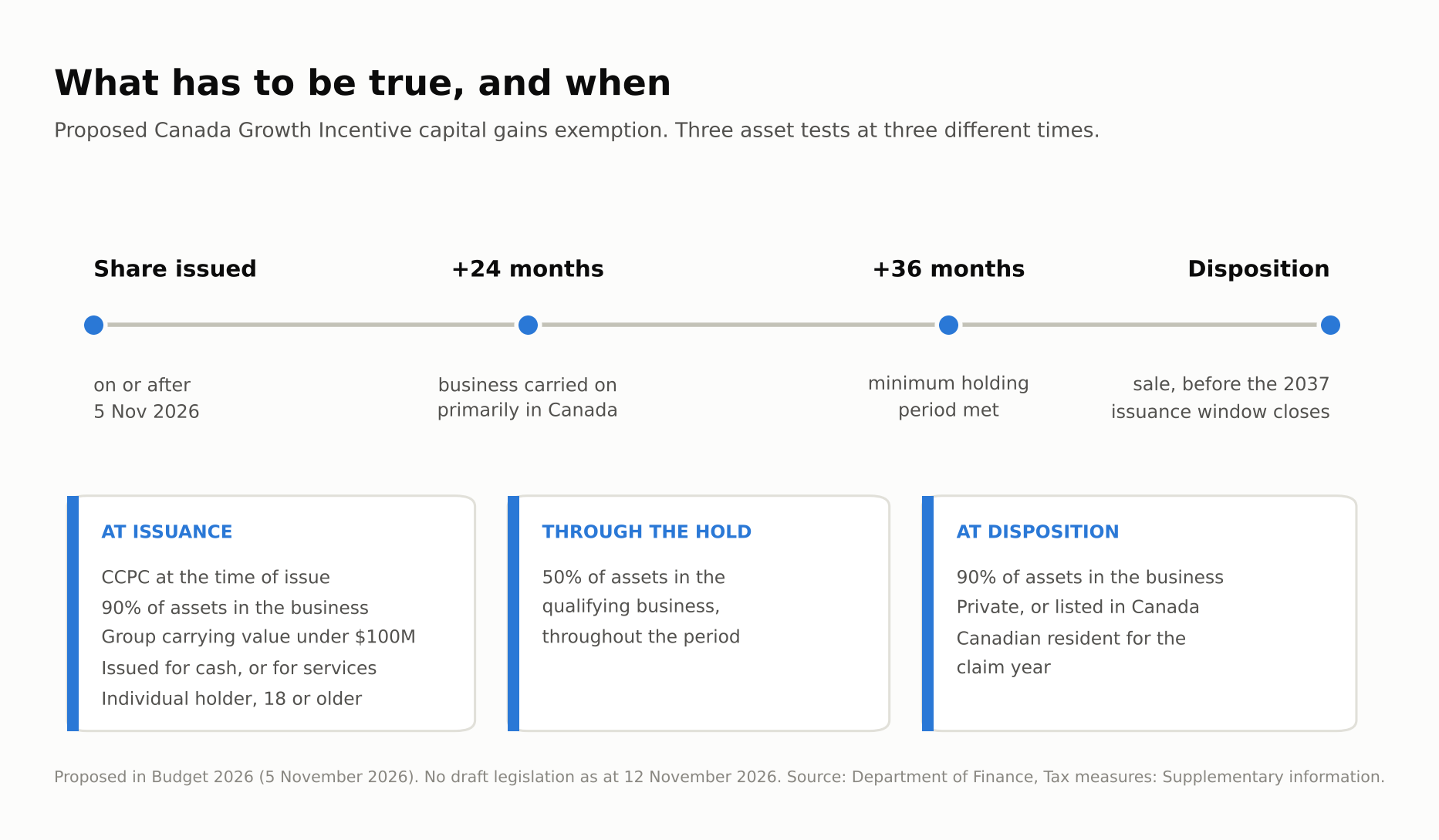
At issuance, the company has to be a Canadian-controlled private corporation, substantially all of its asset value has to sit in the qualifying business, and the combined carrying value of the company and its related corporations has to be $100 million or less. That ceiling is measured on carrying value, not fair market value, and only immediately before and after the share is issued — a company that grows well past $100 million afterwards is not disqualified by having done so.
Through the holding period, at least half the company's asset value has to stay in the qualifying business. For the 24 months after issuance, the business has to be carried on primarily in Canada.
The share has to be held for at least 36 consecutive months before it is sold. There is no partial relief for a shorter hold — it is a cliff, not a slope.
At disposition, substantially all of the asset value has to be in the qualifying business again, and the company has to be Canadian-resident and either private or listed on a Canadian exchange. Notably, it does not have to still be Canadian-controlled at that point. A sale to a foreign buyer, or a sale after a Canadian listing, is contemplated.
Who is excluded
The proposal defines a qualifying business as an active business other than a long list of things. Out: consulting services, and the professional practices of accountants, lawyers, notaries, physicians, other health care practitioners, engineers and architects. Out: any business whose principal asset is the reputation or skill of its employees. Out: agriculture, fishing, forestry, mining, financial, insurance, utilities, real estate, food and accommodation, arts, recreation and entertainment. Out: any business operating under a licensing or franchising agreement.
That is a lot of successful Canadian businesses. If you run a professional corporation, this measure is not for you, and no amount of structuring changes a carve-out written that plainly.
Trusts are also excluded as holders. A family trust cannot claim it, and the exemption cannot be multiplied by running shares through one.
The collision with the lifetime capital gains exemption
Claiming the Canada Growth Incentive on a company's shares would limit your ability to claim the lifetime capital gains exemption on shares of that same company. It works in the other direction too.
What the proposal does not say is by how much. It does not state whether the reduction is dollar for dollar, proportionate, or something else.
I want to be straightforward about that, because I have seen worked examples circulating that stack the two exemptions and produce a combined figure. There is no basis for that arithmetic yet. Anyone publishing a precise combined number is guessing.
The one sale where both survive
There is an exception, and it is the most interesting part of the measure for owners thinking about succession.
On a sale to an employee ownership trust or a worker cooperative, the budget says a qualifying individual could generally claim both the employee ownership trust capital gains exemption and the Canada Growth Incentive on the same sale, with the use of one having no impact on the limit available under the other. The word "generally" is the budget's, not mine.
This has produced a figure in circulation — roughly $25 million of combined exemption. The arithmetic is evidently $15 million plus the $10 million employee ownership trust exemption, and it needs two qualifications before anyone relies on it.
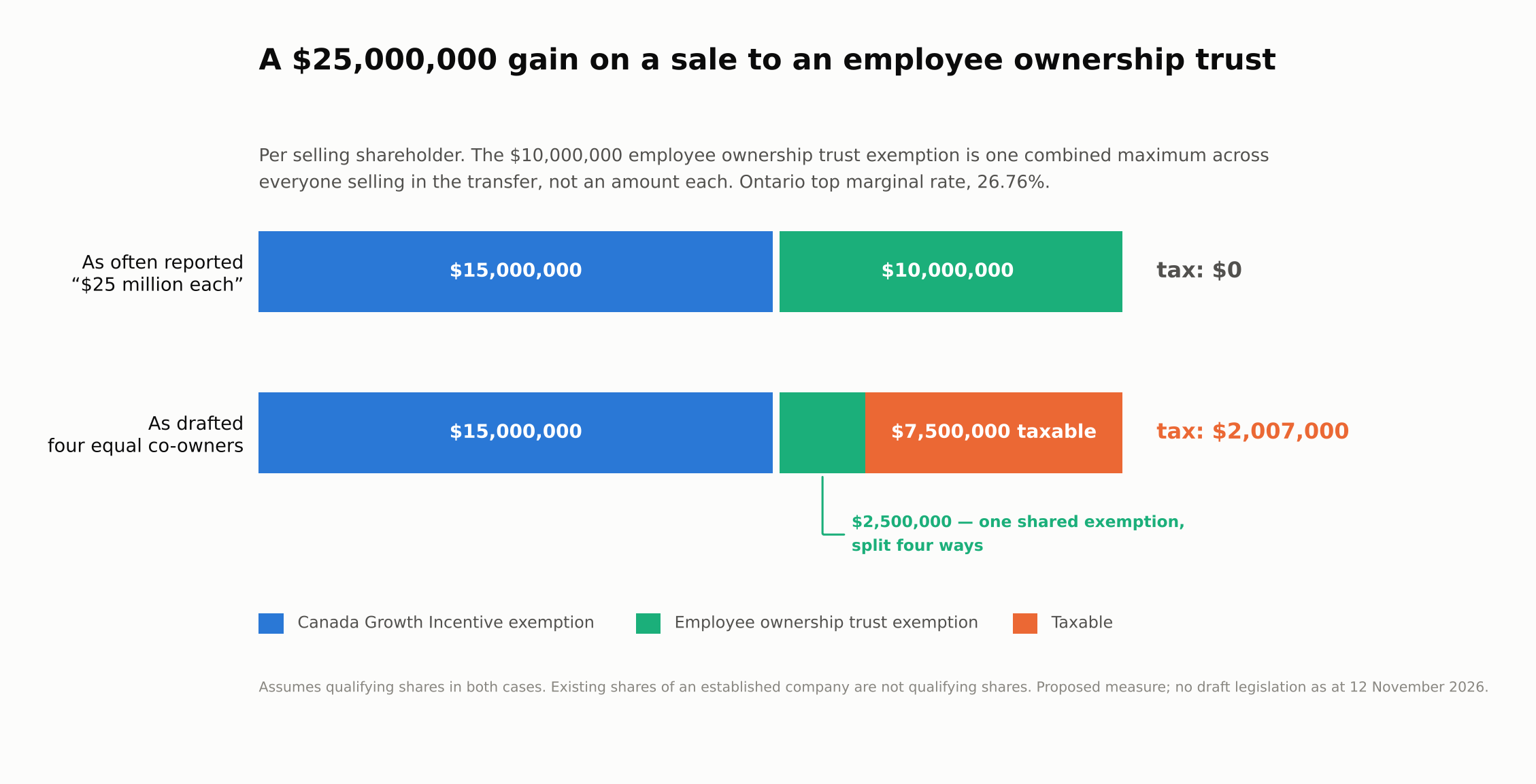
First, the $10 million employee ownership trust exemption is not per shareholder. It is one combined maximum across everyone selling in the qualifying transfer. If four of you own the company equally and each has a $25,000,000 gain, each of you has your own $15 million under the growth incentive, but you are sharing a single $10 million — $2,500,000 each if you split it evenly. That leaves $7,500,000 taxable each, and $2,007,000 of tax each at Ontario's top rate. Read it as $25 million each and you are out by roughly two million dollars a person.
Second, and more fundamental: the shares still have to be qualifying shares. For a company somebody founded in 2009, they are not. The $25 million stack is real in principle and largely theoretical for established owners today.
So where does this leave an established owner
Four places, and I would describe all of them as questions to raise rather than steps to take.
If you are starting something new, or buying into something new, the share you subscribe for with cash from here on could be a qualifying share. That is the clean case, and it is worth being deliberate about how those shares are issued.
If you are bringing in a senior hire, shares issued in exchange for employment services can qualify. That is a genuinely new tool for recruiting and retaining people at that level.
If your company has room to grow and you are prepared to put new money in, newly issued shares subscribed for cash could carry future growth inside the exemption. The value already sitting in your existing shares stays where it is.
And if you have a family trust holding shares, there is a question worth asking your accountant and your lawyer about whether future growth can be directed onto new shares issued to an individual. I am raising it as a question because that is what it is. The trust cannot claim the exemption itself, the rules on multiplying the limit through multiple corporations have been explicitly deferred to a later date, and there is no draft legislation.
What I would not do is make an irreversible structural decision on the strength of a budget announcement. The integrity rules are not written yet, and they are the rules most likely to catch clever planning done early.
What I am watching
Draft legislation, which will settle the share-for-share question and the extent of the lifetime capital gains exemption limitation. The integrity rules on multiple corporations. And whether the provinces follow.
Until then, the useful thing an owner can do is know which category they are in. If you run an excluded business, this is not your measure. If you hold shares issued years ago, it is not your measure on that company. And if you are about to start or capitalize something new, it very much is, and the mechanics of how those shares get issued now matter in a way they did not three weeks ago.
Frequently asked questions
Is the Canada Growth Incentive law?
No. It was proposed in the federal budget of November 5, 2026. There is no draft legislation as at the date of this article, and several of its rules have been deferred for later release.
Does it apply to shares I already own?
As proposed, no. A qualifying share must be issued on or after November 5, 2026, for cash or in exchange for employment services. No grandfathering has been announced.
How much is the exemption?
Up to $15 million, applying separately to each qualifying individual in respect of each business.
Can I claim it and the lifetime capital gains exemption on the same company?
Claiming one would limit the other. The proposal does not say by how much. The exception is a sale to an employee ownership trust or worker cooperative, where the budget indicates both could generally be claimed without affecting each other's limit.
Does my professional corporation qualify?
No. The professional practices of accountants, lawyers, notaries, physicians, other health care practitioners, engineers and architects are expressly excluded, as are consulting businesses.
How long do I have to hold the shares?
At least 36 consecutive months immediately before the sale. There is no partial relief for a shorter holding period.
This article is for informational purposes only and is not intended to provide specific tax, legal or investment advice. The Canada Growth Incentive described here is a proposal announced in the federal budget of November 5, 2026. It is not law, no draft legislation has been released as at the date of this article, and the measure may be changed or may not be enacted. Figures and conditions are drawn from the Department of Finance's Tax measures: Supplementary information published with that budget.
All examples are illustrative hypotheticals and do not describe real clients. Tax calculations assume Ontario's top combined marginal capital gains rate of 26.76% for 2026 and a 50% capital gains inclusion rate. Your result will differ based on your province, your income, your adjusted cost base and your circumstances. Examples do not account for alternative minimum tax, which applies a 30% inclusion rate to gains exempted under this measure.
Please consult your own tax and legal advisors before acting on any of the matters discussed.