Why Private Markets Can Improve a Portfolio — and What You Give Up to Own Them
Most portfolios I review are built from two things: stocks and bonds that trade on public exchanges. The largest pension funds, endowments and family offices stopped investing that way a long time ago. A meaningful share of their capital sits in companies, loans, buildings and infrastructure that never appear on a stock ticker.
Most portfolios I review are built from two things: stocks and bonds that trade on public exchanges. The largest pension funds, endowments and family offices stopped investing that way a long time ago. A meaningful share of their capital sits in companies, loans, buildings and infrastructure that never appear on a stock ticker.

Mike Morgan, CFP, CIM
Portfolio Manager & Wealth Advisor, Financial Planner
October 19, 2026
For years that was out of reach for individuals. It no longer is. I use private market investments in client portfolios, and RBC's own long-term targets now set aside 20 per cent of a balanced portfolio for alternatives. I use them for two reasons: they can improve the return potential of a portfolio relative to the risk being taken, and they diversify a portfolio in ways that public stocks and bonds cannot. They also come with one cost that matters more than all the others, which is that you cannot get your money back quickly. This article covers both sides.
What private markets are
A private market investment is ownership of, or a loan to, a business or asset that does not trade on a public exchange. There are three broad groups. Private equity is ownership in private companies, from growing businesses to large established ones bought out and improved by a specialist manager. Some of today’s strongest private companies will become tomorrow’s public-market leaders, giving private investors the opportunity to participate in their growth long before most investors can buy the stock. Private credit is lending done directly to companies, outside the banks and the public bond market. Real assets are the physical things an economy runs on: infrastructure, real estate and natural resources such as farmland and timberland.
Each does a different job. Private equity is there for growth. Private credit and real estate are there largely for income. Infrastructure sits between the two and brings some protection against inflation.
The first reason: more return for the risk you take
Investors in private markets give up the ability to sell whenever they like, and they expect to be paid for it. That extra return is called the illiquidity premium. Private managers also work in less efficient corners of the market and, in private equity, usually control the companies they own, so they can change management, strategy and financing in ways a public shareholder cannot.
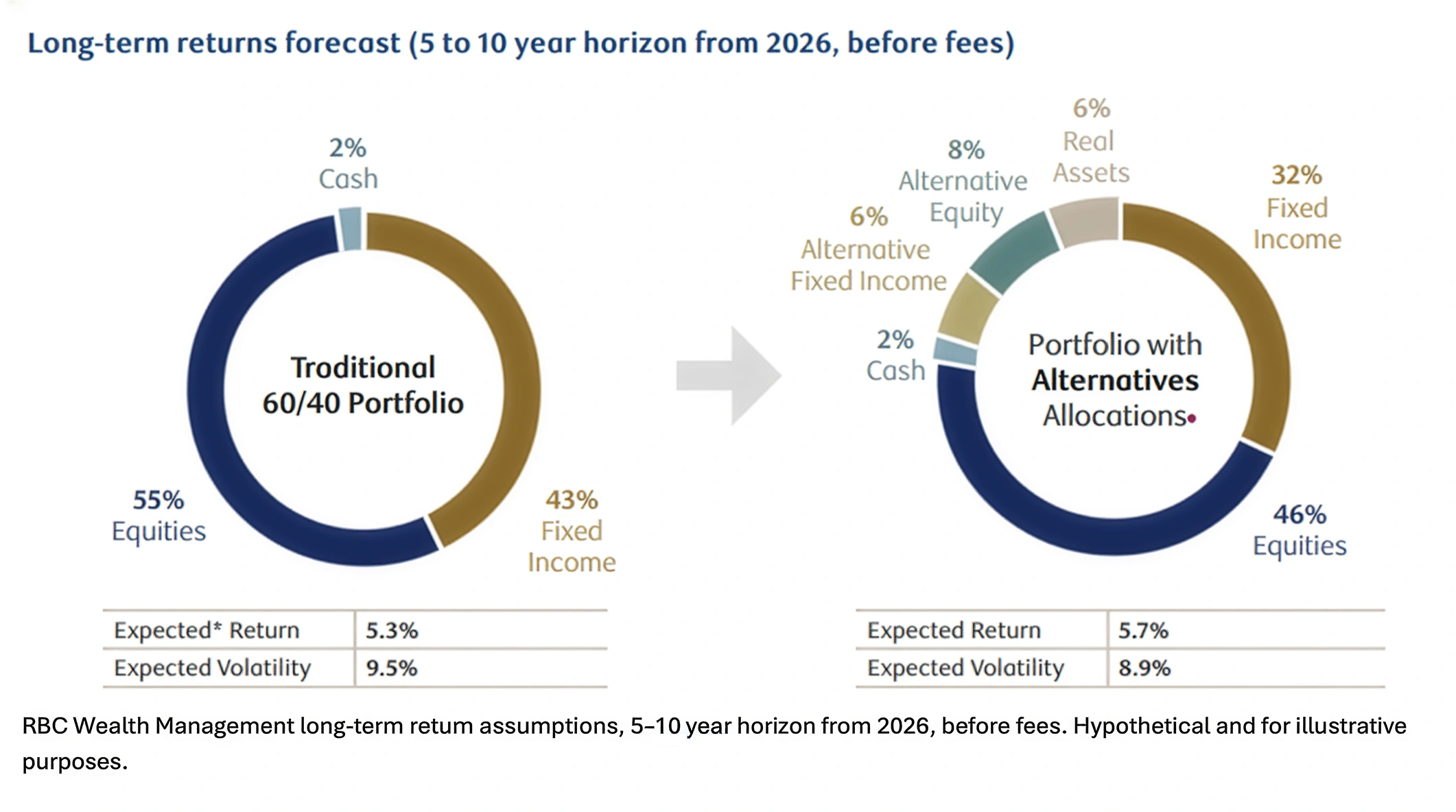
RBC Wealth Management's long-term forecast shows what that can mean for a whole portfolio. Over a five-to-ten-year horizon from 2026, a traditional balanced portfolio of stocks and bonds is forecast to return 5.3 per cent a year with volatility of 9.5 per cent. Move 20 per cent of that portfolio into alternatives and the forecast return rises to 5.7 per cent while volatility falls to 8.9 per cent. That is a higher return with a smoother ride, or about 15 per cent more return for each unit of volatility.
The premium does not show up every year. From 2023 to 2025, private equity lagged both public stock markets and private credit, which is unusual. RBC's Canadian Investment Committee expects private equity to reclaim its premium from here, because private businesses are now valued more attractively against public ones after that stretch. Private markets reward patience, and they are the wrong place for money that needs a good result in short order.
This is the active value-creation argument for private markets. A private-equity manager can buy a business, improve margins, expand distribution, make acquisitions, change leadership or reposition the company before selling it years later. A private-credit manager can negotiate a loan directly, including its yield, covenants and collateral. Infrastructure and real-estate managers can improve assets and capture contractual, regulated or rental income. The return is not supposed to come only from the market becoming more expensive.
The second reason: diversification beyond stocks and bonds
The traditional balanced portfolio is built around the idea that stocks provide growth while bonds provide stability. For a long time, that worked particularly well because bonds often held up, or even rose, when stocks fell.
That relationship has become less dependable. The clearest recent example was 2022. Inflation surged, central banks raised interest rates aggressively and, in Canada, the Bank of Canada increased its policy rate seven times by a total of 400 basis points. Stocks fell, but bonds fell with them. The part of the portfolio investors expected to cushion the decline was declining too. When both major pieces of a portfolio are reacting to the same forces at the same time, the portfolio is less diversified than it may appear.
And it was not just a one-year event. Using monthly data for the five years ending February 2026, AQR calculated the correlation between the S&P 500 and U.S. Treasuries at +0.53. That does not mean bonds no longer belong in a portfolio. They still play an important role in providing income, liquidity and generally lower risk than equities. It simply means the diversification benefit between stocks and bonds may not always be as reliable as investors became accustomed to.
That is where private markets can add something different. They broaden both what you can own and the ways your portfolio can make money. Private equity gives investors access to companies outside the public markets. Private credit earns interest directly from borrowers. Real estate collects rent. Infrastructure may generate revenue through long-term contracts, regulated rates or usage fees.
The important distinction is that those returns are driven by different things. They are not insulated from the economy or from public markets, but they do not all depend on stock prices rising or bond yields falling.
That is how I think about diversification: not simply owning more investments, but owning investments that can make money for different reasons.
There is one important qualification. Private assets are usually valued monthly or quarterly rather than second by second on an exchange, and those valuations often involve estimates. Some of the smoother returns you see on a statement therefore come from the way private assets are priced, not simply because the underlying investments are less volatile.
What you actually own in private markets
"Private markets" can sound abstract. The investments themselves are not. They include businesses, sports properties and infrastructure that people encounter every day - as well as some of the most important companies shaping the next decade.
Take Blackstone Private Equity Strategies Fund (BXPE). Its published portfolio includes OpenAI, Anthropic and CoreWeave - companies at the centre of the artificial-intelligence build-out - alongside businesses such as Jersey Mike's and Nobu. That is a useful illustration of the opportunity-set argument: investors can gain exposure to important businesses before they reach the public markets, or through investments and structures that are not ordinarily available in a traditional public-market portfolio.
CVC makes the idea even more tangible through sports. It has invested in the commercial business of the Women's Tennis Association and has partnerships across major sports properties including LaLiga and France's Ligue 1. CVC also built the Gujarat Titans after winning the rights to a new Indian Premier League cricket franchise in 2021. The team won the IPL in its first season. The interesting investment lesson is not the trophy. It is the business model: a large share of franchise revenue comes from centrally negotiated media and sponsorship rights, creating an economic engine very different from a public stock index.
KKR Infrastructure provides the physical-world version of the same story. Through businesses such as CyrusOne and Vantage Towers, KKR invests in the data centres and telecom towers underneath cloud computing, AI and mobile communications. CyrusOne operates more than 60 data centres across the U.S., Europe and Asia. Vantage Towers owns and operates more than 85,000 telecom towers across ten countries. These are assets most people use indirectly every day without ever seeing them on a brokerage statement.
These are narrow examples, not the investment thesis, nor are they recommendations to invest in any of these businesses or funds. I do not believe someone should own private markets because a particular company may eventually have a high-profile IPO or because professional sport makes a good story. The point is that the investable economy is much larger than the list of securities trading on an exchange.
What it costs you: the risks
Illiquidity is the main one. Many evergreen (open-ended) private-market funds have an initial lock-up or charge for redeeming early. After that, liquidity is often available only monthly or quarterly, and redemptions may be capped. If requests exceed the fund’s limit, investors may receive only part of what they ask for and have to wait for the balance. That is not theoretical. Several large private-credit vehicles have seen redemption requests exceed their quarterly limits in 2026. The cap can protect investors who remain by reducing the risk that a manager is forced to sell good assets cheaply, but it reinforces the central point: this has to be money you will not need for years.
Valuations are estimates. Without a public market price, the manager or an independent valuer estimates what each asset is worth. Statement values can lag reality, in both directions.
Leverage. Private equity buyouts carry more debt than a typical public company, and many credit funds borrow to raise their returns. Debt magnifies losses as well as gains.
Credit losses. Private credit is still credit. Borrowers can weaken, loans can be marked down and defaults do happen. That has been especially visible in parts of the software market in 2026, where concerns about leverage and AI disruption have put pressure on some borrowers. A lender’s results ultimately depend on underwriting discipline, loan structure and what can be recovered when things go wrong.
Fees and manager selection. Fees are higher than in public funds, and the gap between the best and worst managers is far wider than it is in public markets. Choosing the manager matters more here than almost anywhere else in a portfolio, which is why the due diligence RBC does before a fund reaches the shelf carries so much weight.
Eligibility and protection. Many private-market funds are offered under exemptions from the public prospectus requirements and are available only to investors who meet specific eligibility criteria, often including accredited-investor requirements. They also operate under a different disclosure and regulatory framework than conventional prospectus-qualified mutual funds, another reason investors need to understand exactly what they are buying.
How I build a pension-style portfolio
I build what I call pension-style portfolios. I do not mean trying to copy the Canada Pension Plan, OMERS or Ontario Teachers’ line for line. I mean borrowing the way large institutions think about capital: start with what the money needs to do, protect the liquidity that will be needed in the near and medium term, and invest the genuinely long-term portion of the portfolio across a broader opportunity set.
Public equities and bonds still play an important role. They just do not have to do all of the work. Private equity can provide another source of long-term growth. Private credit can add income. Infrastructure and real estate can introduce cash flows tied to physical assets, contracts, rents and long-term economic activity. The objective is to build a portfolio with several different engines of return rather than relying primarily on public stock and bond markets.
That is very different from simply saying, “Put 20% in alternatives.” The percentage comes second. The first question is what role the investment is supposed to play. What source of return am I trying to add? What risk am I trying to diversify? What existing exposure is it complementing or replacing? And, just as importantly, how much of the portfolio can reasonably become less liquid?
That last question matters because illiquidity is not automatically a disadvantage. For money that genuinely will not be needed for years, giving up some liquidity can open access to investments and potential sources of return that are difficult to reach in public markets. But the trade-off only makes sense after enough liquidity has been set aside for spending, emergencies, major purchases and other foreseeable needs.
At the end of 2025, plans such as OMERS, CPP Investments and Ontario Teachers’ had substantial allocations to private equity, credit, infrastructure and real estate — in some cases representing more than half of their portfolios. Their circumstances are very different from those of an individual investor. They have long-dated liabilities, ongoing contributions and the ability to hold assets through market cycles. The lesson is not to copy their percentages. It is to borrow the discipline behind them.
I apply the same thinking to individual portfolios, but not the same allocations. We first protect the capital that may be needed in the near and medium term. For suitable investors, part of the remaining long-term capital can then be allocated to private markets, with the goal of adding meaningful exposure to different sources of growth, income and diversification without giving up more flexibility than the family can comfortably afford.
That is what I mean by building a pension-style portfolio. It is not about owning alternatives because institutions own them, or reaching an arbitrary percentage. It is about deciding which sources of return belong in the portfolio, what each investment is there to accomplish, and whether the investor is being adequately compensated for giving up some liquidity to access them.
If you want to understand whether private markets have a role in your portfolio, and how much illiquidity you can reasonably afford, I’m happy to work through that with you.
Mike Morgan, CFP, CIM is a Portfolio Manager and Wealth Advisor with Morgan Wealth Management of RBC Dominion Securities Inc. This article is for information purposes only and is not investment advice, an offer to sell or a solicitation to buy any security. The funds named are examples of strategies available through RBC Dominion Securities; they are offered only to investors who qualify, by offering memorandum, and may not be suitable for you. Investments in alternative funds are speculative and involve significant risk of loss of all or a substantial amount of your investment. Alternative funds may engage in leverage and other speculative practices, can be highly illiquid, are not required to provide periodic pricing or valuation information, and are not subject to the same regulatory requirements as prospectus-offered mutual funds. The forecast returns and volatility shown are hypothetical, are before fees, were generated by RBC Wealth Management, and are not a guarantee of future results. Strategic allocation targets are a guide and are not suitable for all investors. Past performance does not guarantee future results. Asset allocation and diversification do not assure a profit or protect against loss.