
Sunil Bhardwaj
Lead Strategist
July 2, 2026
Imagine walking away from an expensive purchase only to buy it months later after the price had gone up. In most situations that would be a mistake. But in investing, a higher price doesn’t always mean something is more expensive.
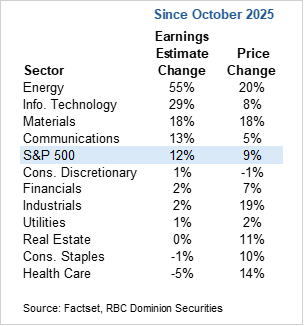
The recent rally in the stock market is one such example. Despite the S&P 500 Index being 9% higher than it was eight months ago, expected 2026 earnings have risen 12% over the same period. Because earnings have grown faster than prices, the market’s price-to-earnings (P/E) ratio has actually declined, meaning investors are paying less per dollar of earnings today than they were last fall.
Highest Earnings Growth: Tech and Energy
Admittedly, the earnings growth has been concentrated in technology and energy stocks – the latter boosted by oil prices. Energy is a small component of the US index but earnings estimates for that group have soared 55% thanks to elevated commodity prices.
A much more influential sector is the technology group, which comprises 37% of the S&P 500 Index. Over the past eight months, that group has risen 8%. The estimated 2026 earnings for that group, however, have jumped an impressive 29%. So despite some hand-wringing about the sustainability of tech stocks’ strength, we maintain a healthy allocation to the group as underlying business growth continue to outpace the share prices.
Stocks Track Earnings Over The Long Run
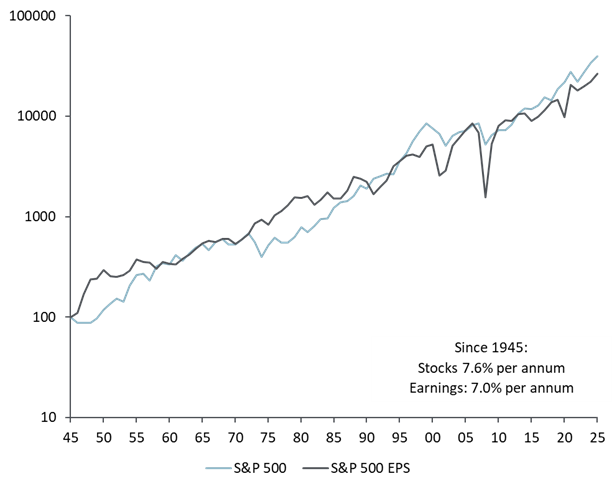
Despite concerns about the US-Iran war and higher oil prices, many investors have been puzzled by the strength of the stock market. But stocks have risen on the back of unexpectedly strong earnings growth, which gives us confidence in their sustainability. Short-term divergences can happen. In the long term, stock prices follow earnings growth.
Share Prices Have Risen with Earnings Over the Long Term
|
Taking Some Profits in Canadian Banks
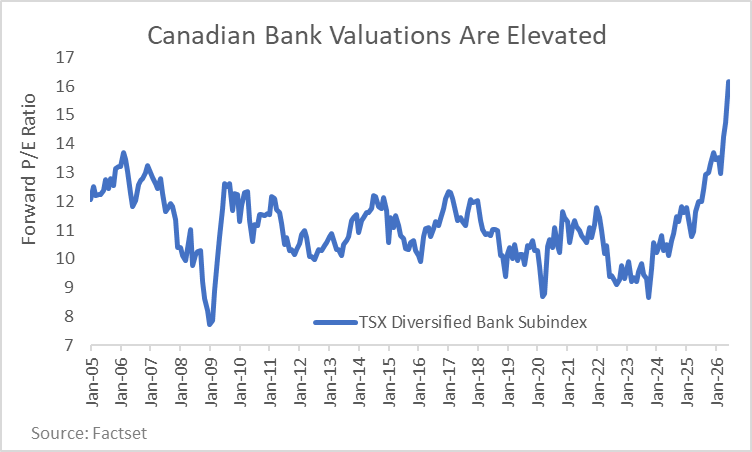
It is worth discussing the Canadian banks, because they present a different picture. The group has surged 42% since the end of October but, unlike the broader US market, their expected 2026 earnings have only risen 8%, causing P/E ratios to expand to all-time highs.
There are several reasons to believe that banks will continue to grow earnings over the next few years. Capital markets earnings remain strong thanks to rising equity markets, merger and acquisition activity and steady corporate debt issuance. Loan losses remain muted, despite a tepid Canadian economy. A recent regulatory change will allow the banks to deploy more capital, which should help boost their loan growth. Down the road, AI cost-cutting could bolster margins further.
Some of these positive drivers are tied to the ebbs and flows of market cycles, however. That is why we recently harvested some profits as a matter of risk management – protecting capital while maintaining a strong core position in these stable institutions.
Conclusion
There are several potential sources of stock market volatility in the coming months, including the unresolved re-opening of the Strait of Hormuz, a US central bank that is considering raising interest rates, and US mid-term elections in November – the last of which has historically caused some investor angst. But as we have mentioned several times in the past, the 12-month period after the US midterm elections has historically generated the best returns for equities. The S&P 500 has gained an average of 15% in the year after the last 19 mid-term elections since 1950 – with zero down years.
If earnings keep surprising to the upside, the odds are in our favour of that streak continuing.
If you have any questions, please do not hesitate to contact us.