AI-AI-Uh-O A Month-Long AI Disruption Serial – Part IV: The Dire Straits of Hormuz
Over the past 7-years, okay, it’s been 4-weeks, but with war (apologies, we are not supposed to call it this), umm, lots of bombs dropping in the Middle East, the completion of our Serial on Artificial Intelligence has felt like an endeavor we started in 2019. That said – the timing could not be better, as straits have become particularly newsy in the past couple of weeks and the conclusion of our piece happens to fall on the 40thanniversary of the launching of the last major world tour of an absolute late 70’s and early to mid-80’s icon – Dire Straits.
Over the past 7-years, okay, it’s been 4-weeks, but with war (apologies, we are not supposed to call it this), umm, lots of bombs dropping in the Middle East, the completion of our Serial on Artificial Intelligence has felt like an endeavor we started in 2019. That said – the timing could not be better, as straits have become particularly newsy in the past couple of weeks and the conclusion of our piece happens to fall on the 40thanniversary of the launching of the last major world tour of an absolute late 70’s and early to mid-80’s icon – Dire Straits.
Barasch - Wellwood Wealth Partners
March 23, 2026
Over the past 7-years, okay, it’s been 4-weeks, but with war (apologies, we are not supposed to call it this), umm, lots of bombs dropping in the Middle East, the completion of our Serial on Artificial Intelligence has felt like an endeavor we started in 2019. That said – the timing could not be better, as straits have become particularly newsy in the past couple of weeks and the conclusion of our piece happens to fall on the 40thanniversary of the launching of the last major world tour of an absolute late 70’s and early to mid-80’s icon – Dire Straits.
For those not familiar with these British rock Gods, Dire Straits hit the scene in the late 1970’s with their first single – Sultans of Swing – and generally found their early niche as a natural progression of Pink Floyd – complex (and long) musical arrangements as opposed to radio-ready music. For the most part, Straits’ early success was more for the musically snobbish than for the masses with a joke at the time going something like this – “Dire Straits had a female roadie, ensuring that their concerts would be coed.”
This all changed in 1985 when Dire Straits went from niche to mega rock icons. For this, the band owes a bit of thanks to one Gordon Matthew Thomas Sumner, who is better known by his rock handle – “Sting”. You see – for Dire Straits first single off their fifth studio album – Brothers in Arms – Straits frontman Mark Knopfler needed a hook, and he went to former Police frontman Sting for that hook on the song “Money for Nothing”. Sting, who had recently left The Police to go solo, utilized the chorus from the Police Song “Don’t Stand So Close to Me” to construct the hook “I Want My MTV”, which was a shoutout to the then exploding music video platform. Given that The Police were two years removed from being the biggest band in the world and Sting himself was in the midst of a monstrous debut solo album (The Dream of the Blue Turtles), attaching his name to a new single was a savvy hook to help Dire Straits trend more mainstream.
“Money for Nothing” would go on to be a worldwide monster hit (it would become the first video ever shown on the UK version of MTV), Brothers in Arms would become the first compact disc to ever sell one-million copies (Brothers would go on to sell 30 million copies over the next 40-years) and Dire Straits would for a couple of years become the most popular band in the world.
Speaking of “straits”, let’s wrap up our serial on AI. In case you missed it, here are links to the first three parts of our series:
In Part I of our serial, we looked at the history of disruptive new technologies from the Industrial Revolution to the Internet Age.
In Part II, we looked at how for the first time, a new technology (AI) is coming for cognitive, white-collar work as opposed to past technologies, which tended to target repetitive tasks. We then looked at the J-curve and the tendency for new technologies to have negative near-term economic benefits before generating a long-term productivity surge.
In Part III, we explored how AI is likely to widen the income gap, historic government responses to disruption and the current lack of any response and the very real impact on the software sector over the past half-year.
In our final part of the serial, we will explore how this is likely to play out from here.
Let’s break this down into three phases:
Phase 1: Efficiency gains and the early signs of job losses (c. 2023 to 2028)
In the near term, AI is most likely to erode specific tasks within jobs rather than eliminate jobs. A junior lawyer still has a job - but now produces 10x the document review throughput; a financial analyst still has a job - but the research process that took two days now takes two hours. Phase 1 begins to show productivity gains and headcount efficiency, not mass unemployment.
The visible effect has been a slowdown in hiring, particularly at entry level, as firms discover they can serve the same workload with a smaller team. This is already observable in junior analyst hiring on Wall Street, paralegal hiring at large law firms, and entry-level consultant hiring. In similar fashion to the introduction of the Internet, the productivity gain arrives before the job creation. Let’s look at a chart and then comment:
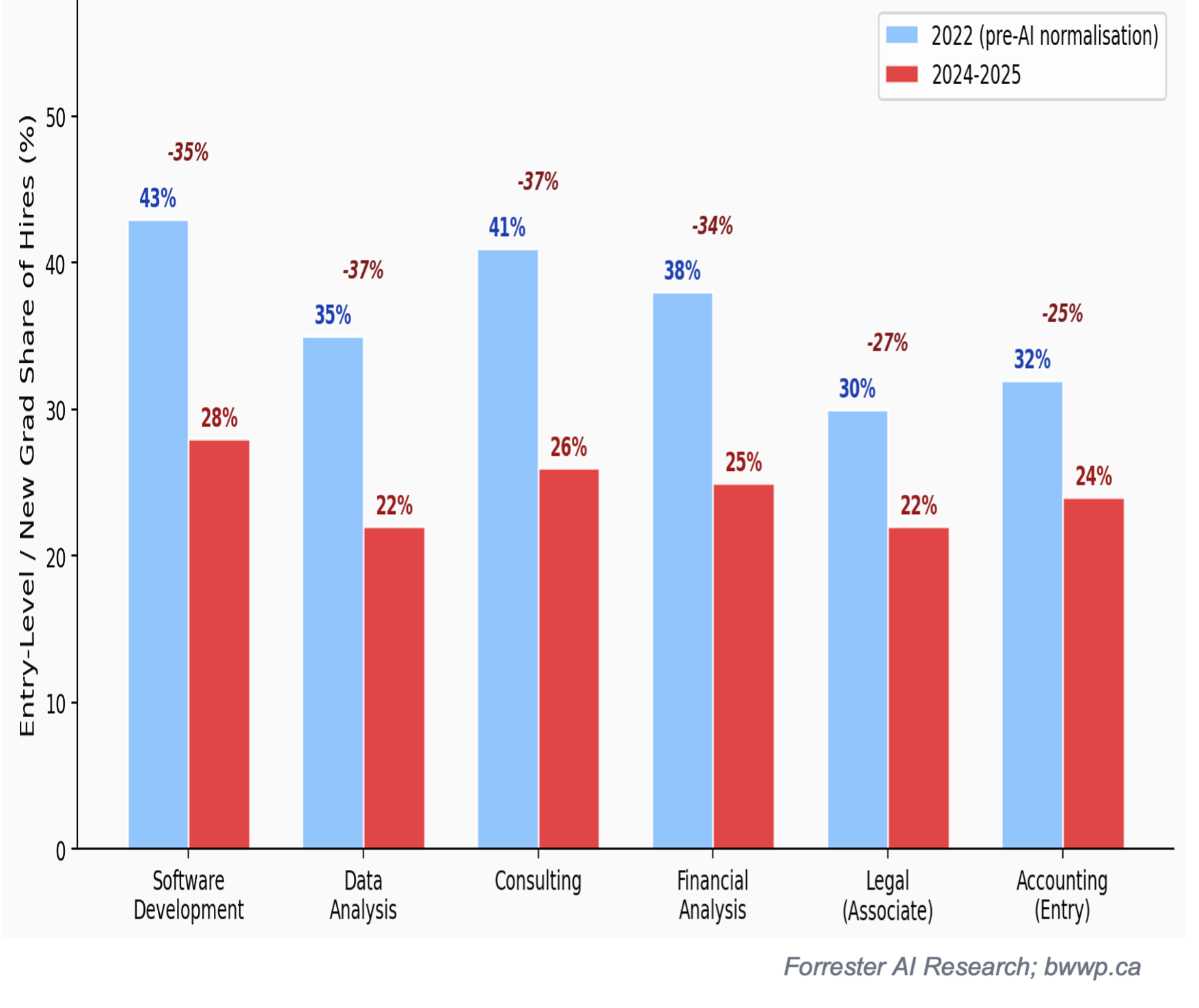
As you can see from the chart above, it’s not so much a loss of jobs (yet), but a significant slowdown in the pace of hiring of entry-level workers – those most likely to be tasks with roles that AI can now do more efficiently and as one attorney client recently told me, “at a much higher quality.”
Phase 2: Productivity surges (c. 2028 to 2035)
This is the phase when AI's productivity payoff begins appearing in macroeconomic data. Labor productivity growth could re-accelerate toward the 3% range last seen during the Internet boom. Let’s revisit a chart from Serial Part II:
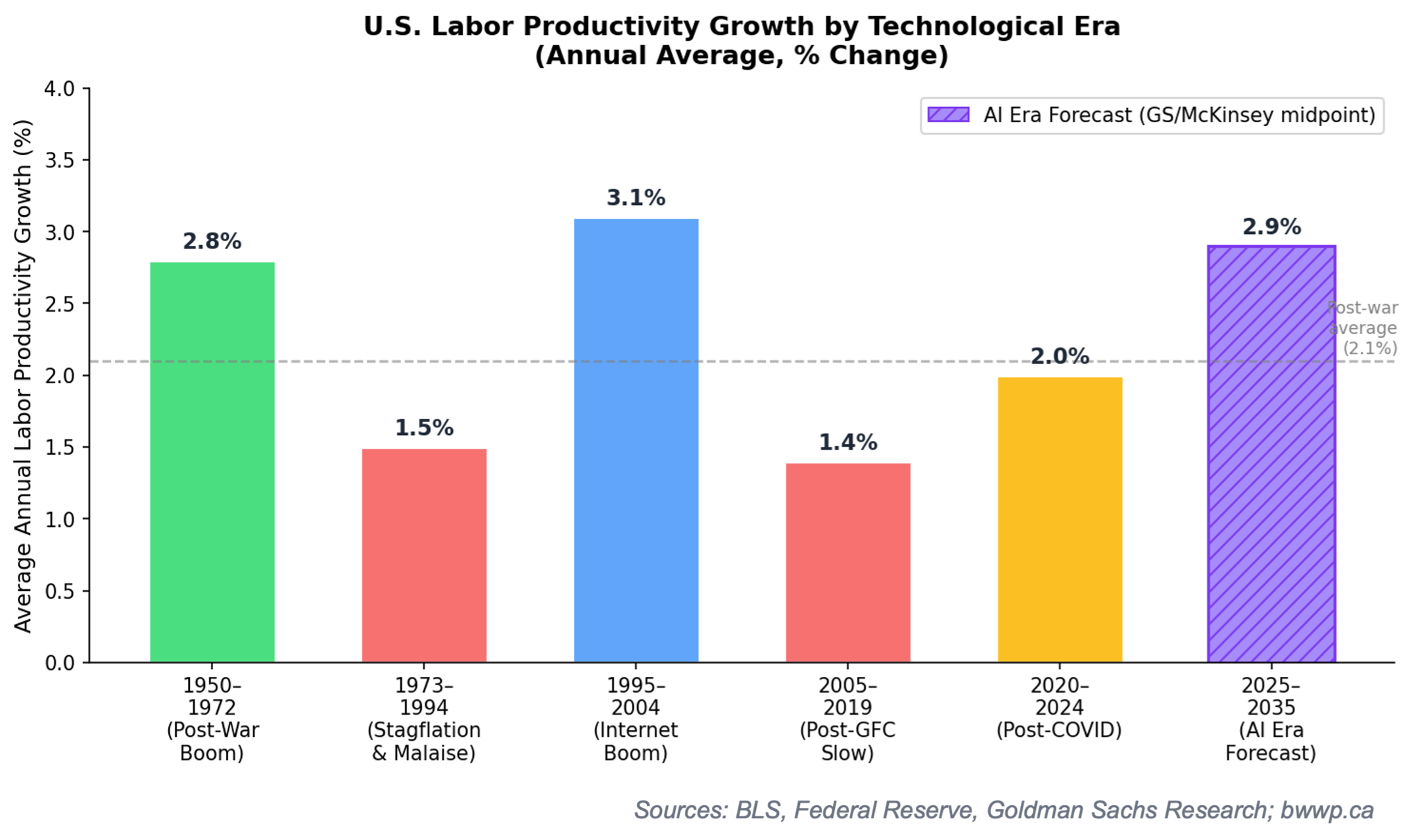
But this aggregate gain will mask a dramatic skills divide: workers who can use AI to amplify their output will command an increasing premium, while those whose roles are most fully automatable will face genuine displacement pressure. If you have kids or grandkids and they are not learning how to use AI in a constructive way (making videos of Stephen Hawking chair-racing Max Verstappen does not count), we would strongly urge you to push them to get started.
This mirrors the pattern we highlighted with ATMs way back in Serial Part 1: bank tellers who survived automation were the ones who became relationship bankers — people whose interpersonal and judgment skills were not replaceable. The white-collar equivalent is the lawyer who uses AI to review contracts 10x faster and then applies judgment to strategy and client relationships, versus the lawyer whose entire value proposition was careful reading — which AI now does much more efficiently.
Phase 3: New Professions and the Policy Reckoning (c. 2030 to beyond)
The most important and least predictable phase involves the emergence of entirely new categories of work. It is also likely the phase in which we will see how the government’s lack of input (Serial Part III) in how the AI Age unfolded begins to rear its ugly head – had proper rules and regulations been put in place during Phase 1, it is likely that some of the messier parts of phase 3 could have been avoided. The lesson from every prior technological wave is - the most significant job creation comes from domains that did not exist before the technology arrived.
For AI, nascent new roles are already visible: prompt engineers, AI trainers, model evaluators, AI ethics and compliance officers, human-AI workflow designers. But these are probably not the largest new categories - those likely involve applications of AI capabilities in directions not yet obvious, creating demand for entirely new kinds of human expertise just as the Internet created demand for UX designers, growth hackers, and podcast producers.
How this plays out politically will depend on how broadly shared AI’s productivity gains prove to be. If the gains are captured primarily by capital and the most AI-literate professionals, the political consequences could be severe - and the demand for more aggressive policy intervention correspondingly intense.
Part IX: Final Thoughts
History has taught us an important lesson about new technology: disruption in the short-term can be severe, transitions can be messy and prolonged in some cases, but that the long run economic benefits are significant.
AI is likely to follow this pattern, but the distribution of disruption is going to be different than prior technology waves. Blue-collar and lower-wage workers, who were the primary victims of automation for two centuries, face less immediate risk from AI than highly-educated professionals. The college-educated white-collar worker - the net beneficiary of every automation wave since industrialization - is now in an unfamiliar position: at the center of the disruption rather than watching it from a minimum safe distance.
This does not mean their careers are doomed. It means the skills that protected them in prior eras - credentials, analytical ability, information synthesis - now need to be augmented by things that AI cannot replicate - judgment in conditions of genuine uncertainty, human relationship, ethical accountability, and what we would call “creative capacity.”