Paul Chapman
Senior Portfolio Manager & Wealth Advisor
July 30, 2026
“When I want to read something I can tune everything else out. I will say this: I know no wise person who doesn’t read a lot. I suspect that you can read on the computer and get a lot of benefit out of it, but I doubt that it will work as well as reading printed material. I think people who multi-task pay a huge price. They think they are extra productive, and I think when you multi task so much you don’t have time to think deeply about anything. You are giving the world an advantage you shouldn’t. Practically everyone is drifting into that mistake. Concentrate hard on something that’s important. I did not succeed in life by intelligence. I did because I have a long attention span.” – Charlie Munger
Note that the contents of this memo are all my thoughts, and not the views of RBC Dominion Securities. As well, no part of this content was AI-assisted or created.
YOU CAN LISTEN TO THE ABBREIVATED PODCAST VERSION OF THIS NOTE HERE
Friends & Partners,
Things seem to remain interesting as we come thru the middle of summer – in world events, weather events, and market events. I have been around a lot this summer, seeing clients and portfolio managers across Canada and the US. One thing is for certain – many are feeling uncertain.
At a high level, I see many who may not fully realize or appreciate that everything in their lives is correlated. For example, if and when we get into a recession, there is not a lot you can do to protect yourself against that. Chances are that you will feel the effects of that in your job or business, and in that event, you can bet that stocks pull back, and likely materially. So, you have to be diversified in your life. That is the purpose of what we do. Concentration is what builds wealth – diversification is how you protect it. If you lose your job, or your income or business takes a serious step back, you don’t want your investment capital and portfolio to be getting hammered at the same time. Financial stress is avoidable, it’s all about how you structure your financial affairs.
There has been, and remains, a significant amount of speculative behaviour, ‘chasing’ and FOMO – many investors are chasing returns, and the next shiny object. Discipline and diversification are paramount, however. We have a law of large numbers in finance that is not a prediction, a wish, or a theory – it is a law. And many investors will learn the hard way how hard it is to compound at the numbers that we have seen in selected names and strategies.
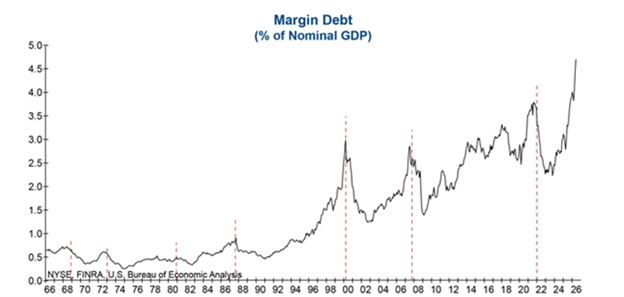
Stocks feel like such a sure bet too many. So much so that investors are more comfortable using leverage to enhance returns than ever before. With this latest jump, the 3-month rate of change for Margin Debt came in at 23%. This lofty level has only been reached two other times in history: two months before the peak of the Tech Bubble and four months ahead of the peak in 2007 that led to the Great Financial Crisis.
Source: Investech
The market has obviously been driven by (and remains concentrated in) the AI trade. I have harped on the risks of being too concentrated there in my last few memos – it pays to work with someone who is knowledgeable in that sector as the leadership is shifting under the surface. We may still be early innings here in some respects. But the air will come out of this trade at some point high level. One thing is for sure – DO NOT OWN LEVERED ETFS. I expand on that in one of the subsections below.
The ‘AI trade’ took a breather in July, for these main reasons:
- The cost of the AI infrastructure/data center buildout has been a concern for a while, but those concerns are getting validated by several events. Some of the big tech companies are spending the bulk of their free cash flow on the infra buildout. This is a problem if investors begin to think it is not temporary.
- This all costs money. And now these companies are coming to market with significant equity and debt raises. The amount of AI-exposed investment is flooding the market and while there’s a lot of money out there, concerns are growing about how much of a broad appetite there is amongst investors who need to stay diversified.
- There’s too much inflation (in AI components). The cost of AI-related components has gone parabolic, and this has now created a feedback loop amongst the hyperscalers/AI companies. There are legitimate capacity concerns regarding advanced semiconductor chips, memory, cloud space and other critical components to data center construction and to secure the needed components, the richest companies in the world (the major tech companies) have started a “spending war” with each other to secure components.
- Competition. Another Chinese cheap AI model spoils the party. This time it was Moonshot, a Chinese AI company/LLM that is nearly as effective as the advanced models from OpenAI and Anthropic, but it costs much less to utilize. The basic fear here is that AI and LLMs become, mostly, commodities and consumers go to “good enough” cheaper alternatives, which makes the very expensive latest models unprofitable. The Chinese did this with steel 40 years ago (flood the market with product below the cost of production), they may do it again.
- Capacity. What if we don’t need all these data centers, after all? While that’s not expected (in fact, quite the opposite) there are numerous reasons this could happen. First, the populous adopts cheaper, Chinese-alternative AI models, reducing domestic demand. Second, AI itself becomes more efficient, reducing the need for the expected number of data centers. Third, Al is not as widely adopted as expected. Finally, while those are all demand related, another potential limiting factor in data centers is political, namely that communities push back against data centers in their communities (we’re seeing this already). If that happens, then the earnings destruction would be ugly.
Taken together, this all suggests that the AI trade is entering a new phase. The easy momentum gains are probably behind us, but that does not mean the broader AI story is over. Instead, leadership is becoming far more selective, rewarding investors who can distinguish between crowded positioning and genuine opportunities.
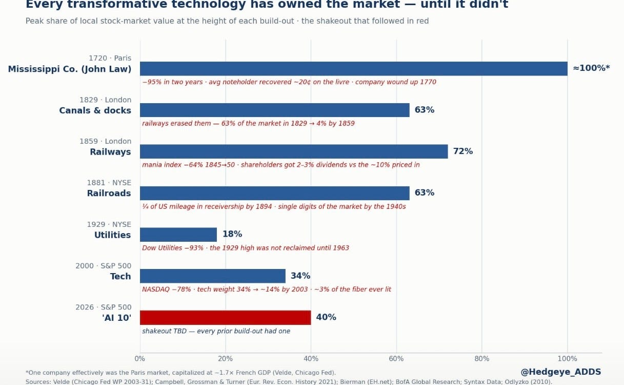
We are living through an extraordinary market environment. The level of concentration in many equity benchmarks has increased significantly. Around 50% of the S&P 500 is an AI themed trade, we haven’t seen this level of concentration since the mid-1960s.
This is not an argument against investing in companies driving the artificial intelligence era. Many are extraordinary businesses with durable prospects. The point is that, at today’s weights and valuations, the benchmarks — and the passive strategies following them — increasingly assume one set of outcomes will dominate.
History shows that the leaders of one era are rarely the leaders of the next. Good active portfolio managers can use research and judgment to adapt as market leadership evolves, while passive investors may be taking unintended risks.
There remains a solid outlook for the economy, inflation, rates, earnings and the market in the medium and long term, and I remain generally constructive on that front. You can dig into that in the final subsection below. The environment, however, demands solid and active management, and as Liam Neeson would say, ‘a particular set of skills’.
Other Interesting Things To Highlight
I am proud to support My Friend’s House, and their upcoming event on Oct 1 at Osler Ski Club. Join us for an inspiring and interactive evening where creativity and community come together. HeArt of Red: Live Painting Experience celebrates artistic expression while raising vital funds for My Friend’s House in support of women and children facing gender-based violence and abuse in South Georgian Bay. Throughout the evening, guests will witness the powerful process of art unfolding in real time. Ten talented artists will take part in two live painting rounds, each lasting 30 minutes. As the artists bring their canvases to life, attendees are invited to be part of the experience by casting their votes during each round. Artwork created during the evening will be available through a silent auction, while the finalist’s pieces will be showcased in an exciting live auction at the end of the night. More than an art event, HeArt of Red: Live Painting Experience is a chance to come together in support of a shared vision - a community where everyone can live free from gender-based violence and abuse and feel safe, respected, and supported. Purchase tickets HERE

I hope you’re enjoying summer so far, despite the smokey days… We are enjoying some time with the family, and the kids are active throughout all seasons which has been fun.

It Pays To Be Cautious
One risk to highlight: don’t buy leveraged ETFs. These are ETFs that leverage the returns of something – like an underlying index, or stock. The problem for most is they do not understand the inherent mechanics of these, and the return profile is often very poor (i.e. they do not produce the return you would expect, it’s usually much worse). I can send info on that to anyone that wants to dig in, but otherwise just trust me on this and don’t touch them. The other issue is that they introduce some systemic risks to markets because they’ve become so popular.
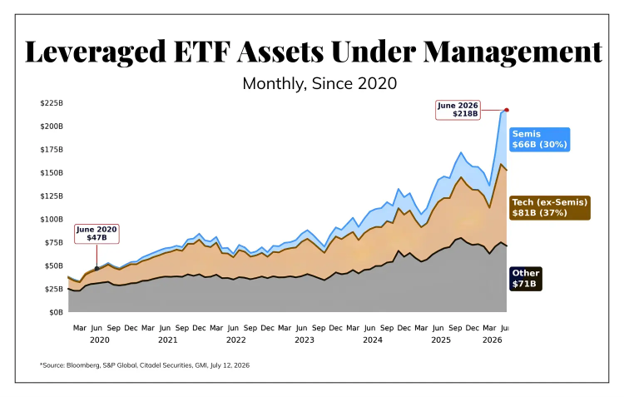
Some sizes of these leveraged ETFs have become downright frightening. For example, here is the SOXL — the 3x Semiconductor Bull ETF:
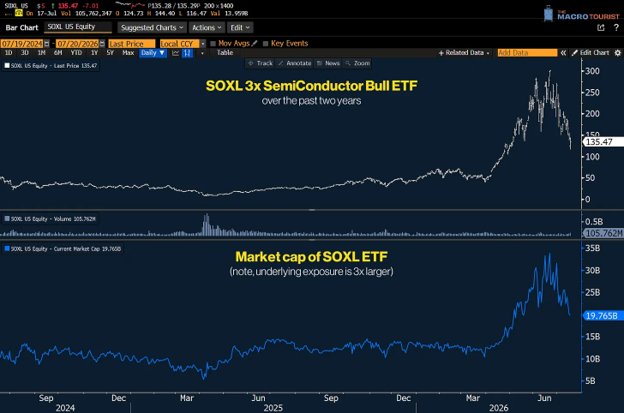
These ETFs are exaggerating moves both upward and downward due to their hedging activity. If we get a real bout of volatility in markets, these things could blow up, easily. The effects will cascade within some of these ETFs and related stocks (think ‘growthy’ exposure here). This puts some systemic risks into the system.
More reasons to remain cautious include that many are ploughing money into US stocks.
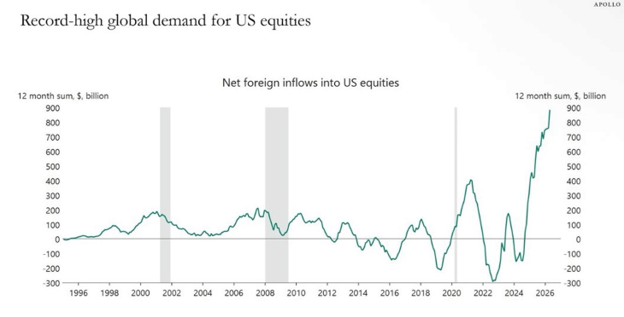
Source: RevCap
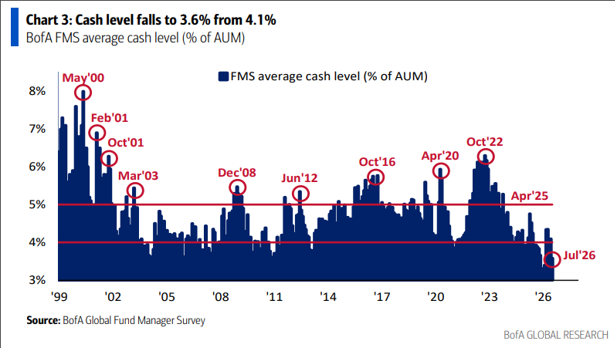
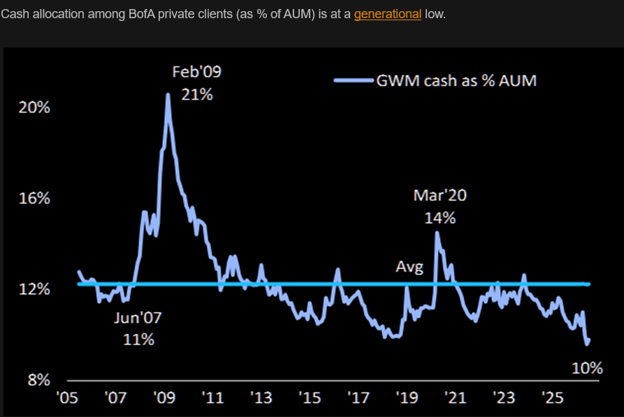
And folks are deploying all their cash, not exactly keeping it for a rainy day here:
Here’s another one, showing that options traders have been their most bullish on stocks since December 2020, after the total put/call ratio plunged to 0.61:
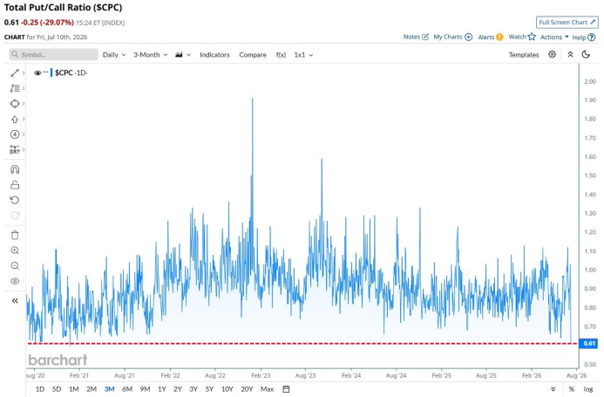
Company management is selling more of their own stock than usual too. US executives are selling shares at the second-fastest pace in more than 20 years, a red flag to some investors because it suggests people with the most corporate knowledge are wary about market here.
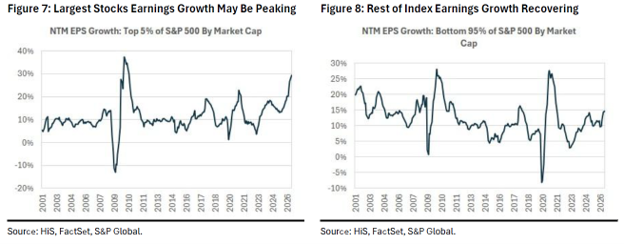
But earnings have been rocking, unlike the tech bubble where it was just margin expansion. But what if earnings are in a bubble? If that were the case, the CAPE ratio would show that we’re in the biggest bubble in history:
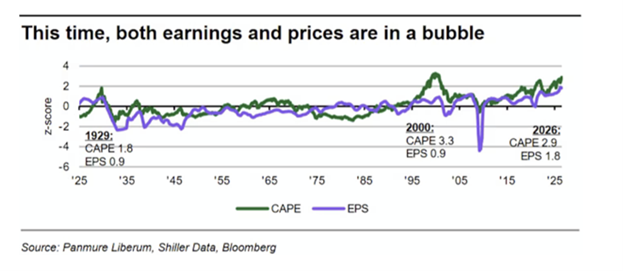
Something is broken in price discovery when companies with negative earnings keep outperforming companies with positive earnings. This will change at some point:
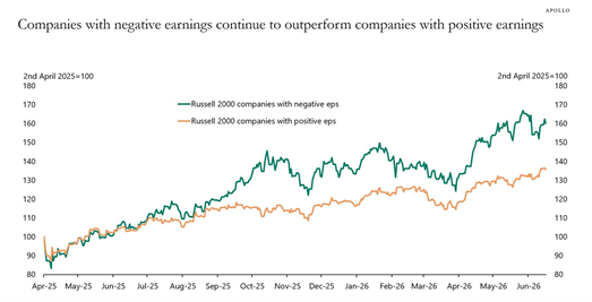
Source: Apollo
There Are A Number Of Positives To Note
The market has been ‘broadening out’ finally, which is healthy – meaning, the gains are being made outside of AI-themed/growthy names. This is breadth, which remains healthy, as revenue growth is broadening into earnings gains beyond the S&P 500. S&P 400 and S&P 600 forward earnings are climbing to new record highs along with the S&P 500 forward earnings:
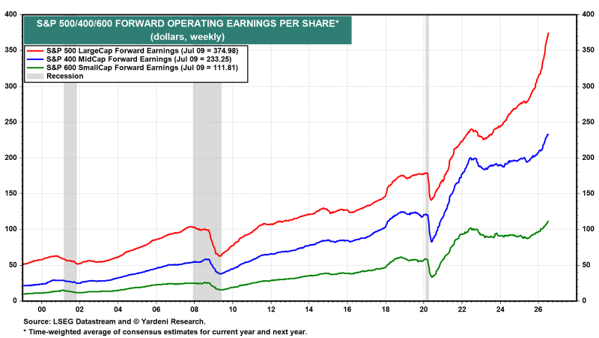
The economy remains resilient. One of the longest cycles in history, which isn’t a bad thing:
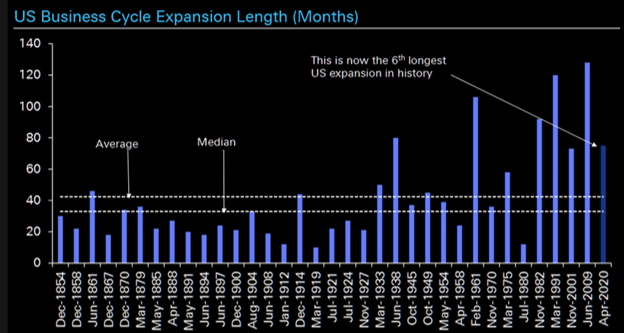
Source: NBER
The current bull market is now just over three and a half years old. Humilis strategist and founder Brian Belski notes that this is important because over the past 50 years all bull markets that were able to celebrate a third anniversary wound up lasting at least five years in length with an average bull market duration of nearly eight years. So, if history is any sort of guide, there is likely at least a few years and maybe more left in this current bull market. The average cumulative average gain for the first five years of those prior five bull markets was 135%, suggesting that even at current levels there is still room for stocks to gain through 2027.
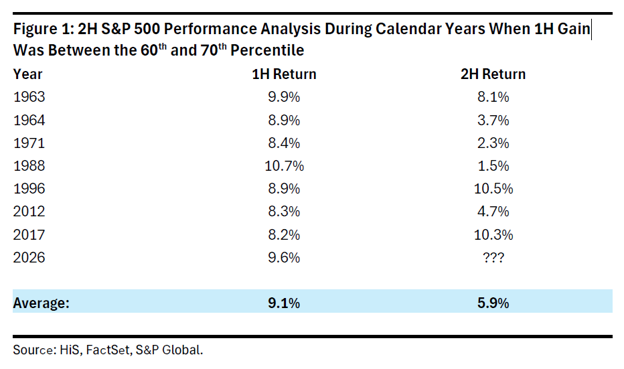
As well, strong 1H Gains typically translate to further second half gains. Of course, during strong markets, some investors are still worried that stocks are way overvalued and are due for a significant correction in the coming months. Belski shows that 1H starts to calendar years of this magnitude typically lead to further gains during the 2H. For instance, in the 7 calendar years where the S&P 500 1H gains were in the 60th to 70th percentiles of all years since 1950, the average 2H return for those years was 5.9%. More important, in none of those years did the S&P 500 register a 2H loss with gains ranging from 1.5% to 10.5%. This could take the S&P500 to the 7,500 to 8,000 range.
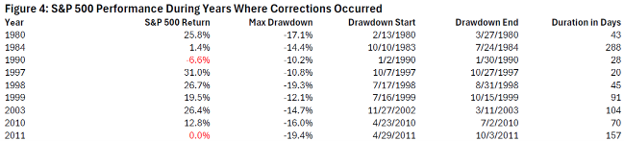
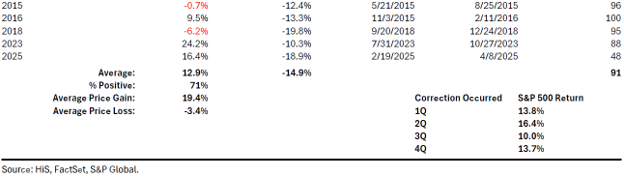
If we get a correction, which is inevitable at some point, the year can often finish off very strong. As the chart below shows, there have been 14 calendar years where the S&P 500 experienced a max drawdown between 10-20% (e.g., the commonly accepted definition of a correction) at some point during the year. The average return of those years was 12.9% with gains occurring 71% of the time. In addition, the average for price gains was 19.4% while the average for price losses was 3.4%. Furthermore, it also did not seem to matter at what point during the year corrections occurred as average gains were fairly strong regardless of the quarter where the correction concluded. However, calendar year gains appeared to be slightly better when corrections concluded during the first half of the year.
Finally, the earnings bubble story may not be the case across the board by any means: