Paul Chapman
Senior Portfolio Manager & Wealth Advisor
June 29, 2026
“A bull market is like sex. It feels best just before it ends.” – Warren Buffett (who famously quoted the late money manager Barton Biggs)
“Bull markets are born on pessimism, grow on skepticism, mature on optimism and die of euphoria.” – Sir John Templeton
Note that the contents of this memo are all my thoughts, and not the views of RBC Dominion Securities. As well, no part of this content was AI-assisted or created.
[YOU CAN LISTEN TO THE ABBREIVATED PODCAST VERSION OF THIS NOTE HERE]
Friends & Partners,
Happy Canada Day! We are blessed to live in one of the best countries in the world, and it’s worth celebrating today with friends and family.
In speaking with a client this past week, we were discussing all of the risks and potential pitfalls that the markets continue to contend with. He noted that my Partner Memo often sounded like I was bearish – I noted to him that I aim to write the note in a similar way to how I position portfolios: cautiously optimistic (at this point in time anyway). I am paid to worry for you, and manage accordingly – by identifying, navigating and minimizing the risks. So, naturally, I will look for the potential potholes along the way and navigate accordingly. But, at the same time, we need to continue to move forward, so I will always highlight what could go right as well and manage accordingly.
Speaking of risks and uncertainties out there, markets largely removed one major source of uncertainty recently (the U.S. and Iran ceasefire agreement, and while there will continue to be disputes, the reality is neither side wants to materially escalate). The positive coming from this is that the Strait of Hormuz as a leverage point for Iran will be greatly diminished in the coming years as the number and speed of pipelines being built across the desert to avoid the Strait will be significant, and this infrastructure will ensure the Strait is not as big a supply choke point in the future. Oil has come back to earth – but expect increased oil demand moving forward as many countries will want to hold larger inventories moving forward given that the world has become more volatile and they will want more diversified supply chains and higher oil inventories (and other commodities too).
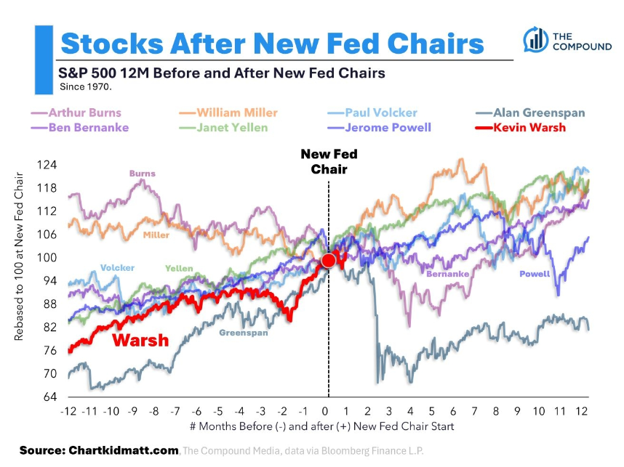
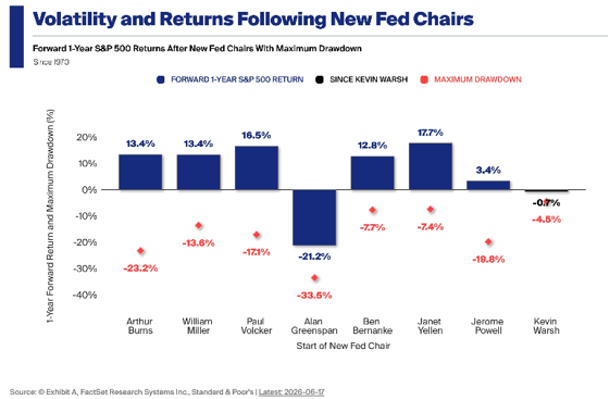
The market also gained a new uncertainty in the last few weeks as the new head of the US Fed (Kevin Warsh) came out much more aggressive (i.e. ‘hawkish’ in finance speak) than most were expecting. In short, Warsh threatened to dramatically alter the way the Fed conducts monetary policy and that is a new uncertainty that markets have to come to terms with. Warsh is making some big changes, the biggest of which is that it has eliminated forward guidance – the Fed will no longer project what it’s going to do. This is going to create some volatility in rate expectations, so the market will digest these changes for a bit.
But, like the Iran War, that is not enough at this point to offset the still-powerful tailwinds supporting this market – AI infrastructure-driven earnings growth and solid economic growth.
It may seem a bit confusing that the whole Iran situation didn’t pressure markets more or for a longer time, but the reality is that when earnings growth and economic growth are above average (and they are), a macroeconomic influence has to be a major negative to offset those positives.
But until AI-driven earnings growth begins to waiver or growth data begins to flash stagnation or recession warnings, then the less-clear Fed outlook may be a headwind, but not a showstopper.
Back to my point about looking for the risks to the outlook – it is entirely possible that, in the coming months, we find out the US Fed is embarking on a major rate-hike campaign or doing something else (like more balance sheet reduction?) to reduce inflation. That would take the wind out of the market’s sails without question.
And the AI ‘bubble’ question is the big one of the day, and some recent volatility in the markets has been caused by this concern as markets are getting worried that all this AI buildout is simply costing too much money amidst uncertain customer demand.
Let’s put into perspective the sheer size of the AI investment cycle: global AI capex will exceed $1 trillion this year. That is twice what the total fiber-optic network buildout was for the entire internet over five years from 1996 to 2000, and in a single year! To put it another way, it is roughly 10x the annual pace of the largest infrastructure investment cycle of the prior generation, or the combined defense spending of China, Russia, the UK, France, Germany, and Japan combined. Also, note that another $1 trillion will be spent over the next 5 years on utilities to provide the electricity to power it. So, it is critical to remain grounded in some realistic cost-benefit analysis of the future earnings from that investment. Charts that go up and to the right too quickly (parabolic) on euphoria always end the same way… We all know that this pace of spending and capex is unsustainable over the long-term, so those who don’t maintain discipline will get hurt.
In terms of pure market behaviour, this feels A LOT like the tech boom cycle of the early 2000’s to me. But like in that cycle, technology will certainly change the world, though we don’t know the timing of the investment cycle until after the dust settles, and who will come out as the winners and losers.
The surging costs of everything AI-related, in an environment of still-paltry AI-linked revenues, is resulting in 1) the destruction of free cash flow amidst some of the largest, previously most profitable tech companies in the world and 2) forcing these behemoth tech companies to issue stock and debt to have the capital to continue to pay exorbitant prices to build out data centers that hopefully one day will produce tons of revenue.
JP Morgan estimates that $1.5 trillion stock issuance will have to come to the market over the next two years as companies move to IPOs and secondary stock sales to raise capital. This is a level of net equity issuance that we have not seen in the market since the late 1990’s…
Think about it this way: SpaceX, Anthropic and OpenAI don’t want to go public. They have to go public to be able to secure the capital to keep spending. Between SpaceX, Anthropic and OpenAI, we will see the three largest IPOs ever by a mile.
But it’s going to take one of the major AI players to essentially ‘blink’ on the spending before investors will believe the economics of the AI buildout are turning bad. If that happens, it’s a major negative not just for the markets, but also for the economy.
The picture below is simple but impactful - the real argument isn’t whether AI is a bubble, it’s whether AI is a bubble yet.
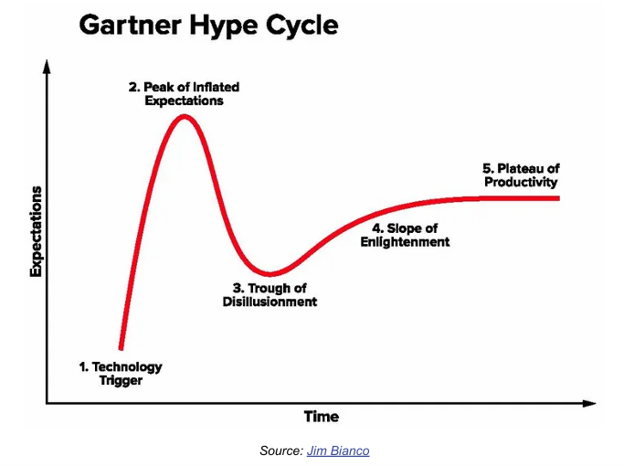
However, to say the AI trade is “ending” due to sluggish price action in ‘Magnificent 7’ names and other high valuation tech sector names in 2026 is a hard argument to make at this point. The idea that the AI investment cycle is maturing to a stage that is increasingly sensitive to traditional equity market fundamentals would be much more accurate, underscored by Micron’s 16% gain in the day post-earnings on measurable earnings metrics and strong guidance. Going forward, this means that digging into AI stock balance sheets, earnings and revenue trends, and order logs will be much more important than simply investing in a company promising growth from AI, or a blind index. Active management is back.
Overall, we obviously have to remain vigilant – as I have noted many times in the past, the quote from Howard Marks noting that ‘you can’t predict, but you can prepare’ is as relevant today as ever. The outlooks from RBC (here), RBC GAM (here) and KKR (here) are all good reads for those of you that want to dig into things more, and I would agree with KKR’s conclusion that the general risk-reward asymmetry favors staying long quality exposures (high-ROE, stable earnings, low-leverage), and adding selected alternative exposures like nominal GDP-linked assets (energy/power infrastructure, etc) makes sense.
At the end of the day, this is all about risk. The potential pitfalls are ample, mitigating risk is key. Many investors may think they can hide out in certain ‘defensive’ stocks, which may be true to a point, but I can tell you that in a bear market, all stocks (and many other asset classes) correlate to 1 and all go down together. Diversification in the portfolio construct is key for us, aiming for ‘defensive growth’ with a core focus on the preservation of our client’s capital remains the focus, and is prudent now more than ever.
Other Interesting Things To Highlight
I am blessed with one of the best teams in the business (as our clients and partners know!), and it continues to grow. Salmana Dogar joins us as a Client Experience Associate from the banking side at RBC. Salmana graduated from Western University with a Bachelor of Arts in Political Science. Following graduation, she joined RBC Royal Bank as a Client Advisor, where she developed a strong foundation in client service and relationship management. In her current role, Salmana supports the operational needs of the team, including account opening, processing fund transfers, and contributing to team projects that help ensure an efficient and seamless client experience. She is committed to delivering exceptional service and supporting both clients and advisors.

I am so proud of our daughter Rae (‘Bean’) for all of her accomplishments – in sport, academics and the community. And it’s quite the balance – my kids miss a lot of school for snowboarding in the winter months! She graduated grade 8 with Honours, and received the French Award, Caring and Sharing Award, and Athlete of the year Award. Proud dad moments every day.
|
|


How An AI Bust Could Play Out – Just Like The Year 2000?
One of the biggest surprises of the AI stock rally is the fact that the biggest beneficiaries (semiconductor and memory companies like Nvidia, Micron, etc) are trading at such low forward multiples, despite massive multi-year rallies and extreme profit growth. And the explanation is because the market doesn’t think it’s sustainable.
Despite these companies having stock price explosions, these stocks trade at borderline ‘cheap’ forward multiples: 21x for NVDA, 10x for MU, 24x for AVGO, and 14x for SNDK. For context, the S&P500 is trading at ~21.5x forward earnings, so these companies that are growing earnings hand over fist are mostly trading at a lower multiple than the S&P 500! This is odd to say the least.
Frankly, this makes little sense. Companies seeing earnings growth like this should be trading at much higher multiples and the fact that isn’t happening is one of the biggest differences between the AI boom and the dot-com boom (companies routinely traded with forward P/Es above 100 in the late-1990s).
The reason these stocks trade with such reasonable forward multiples is becoming clear: investors are starting to think the earnings growth isn’t sustainable the profit explosion in the AI infrastructure sectors (semiconductors, memory, networking, data storage) is coming directly from increased spending (capital expenditures) from the largest tech companies and private AI companies (MSFT, AMZN, ORCL, GOOGL, META, OpenAI, Anthropic, etc.).
The hyperscalers’ spending on AI infrastructure is creating an earnings windfall for the AI infrastructure names. But the sheer pace of spending (trillions forecasted over the next several years) is making analysts and investors nervous because it may not be sustainable and Oracle confirmed that worry two weeks ago in its earnings results.
Using simple math, it appears that ORCL will have a ~100% sales/capex ratio in 2027. To keep things simple, that means ORCL will spend all of its revenue on capex, the vast majority of which will go into AI infrastructure. That means that ORCL will almost certainly have negative free cash flow and that is only sustainable for so long, even for a company like them.
The fear is that AI isn’t adopted as quickly or as profitably as expected and the hyperscalers and AI companies dramatically cut capex spending. That, in turn, hurts the earnings of the AI darlings (semiconductors, memory, networking, etc.) because their “stuff” isn’t needed and the entire earnings of the S&P 500 decline.
Think of it this way: GOOGL (to use one as an example) cancels building 10 data centers because it’s going to cost too much money and the return isn’t there. That will result in massive order cancellations at NVDA, MU, AVGO, SNDK, etc., because no one needs the chips, networking, memory, or processor power.
Now, to be fair, this fear has been around for several months, and it isn’t appearing yet. However, it’s not without precedent because this is exactly how the dot-com bubble burst.
Massive spending to build out fiber across the country to connect homes to the internet boosted the internet infrastructure names throughout the late 1990s. That, combined with pulled-forward demand due to the Y2K required computer upgrades to create enormous earnings growth for tech companies and the S&P 500. Even though it was real, it wasn’t sustainable.
While people connected to the internet, their connection wasn’t nearly as profitable as quickly as everyone assumed. Because of that, the buildout stopped. Earnings for the S&P 500 declined over the early 2000s and that, combined with the recession (which was in part driven by 9/11), led to the multi-year bear market in the early 2000s. It took 4 years for the S&P 500 earnings to regain the previous high.
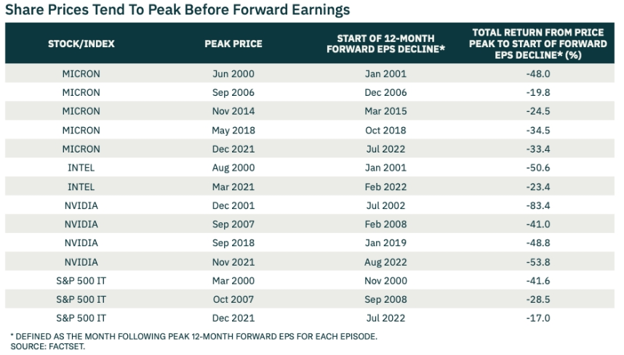
In terms of timing, all we can point to is history, which suggests that the stock price tends to drop well before the slowdown data comes through in earnings reports. Based on the previous cycles, by the time the estimate cuts arrived, IT stocks had already fallen an average of nearly 30%.
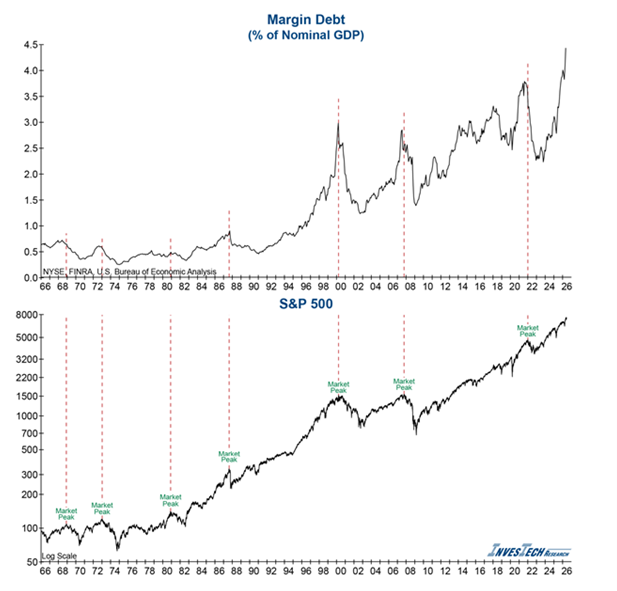
Adding in the investor behaviour is feeling similar to the late 90’s as enthusiasm abounds in some regards. Enthusiasm is readily apparent in the amount of investor leverage now employed in the markets as margin debt as a percentage of nominal GDP shot up 9% in May, reaching a new all-time high:
There Are Multiple Tailwinds Today Too
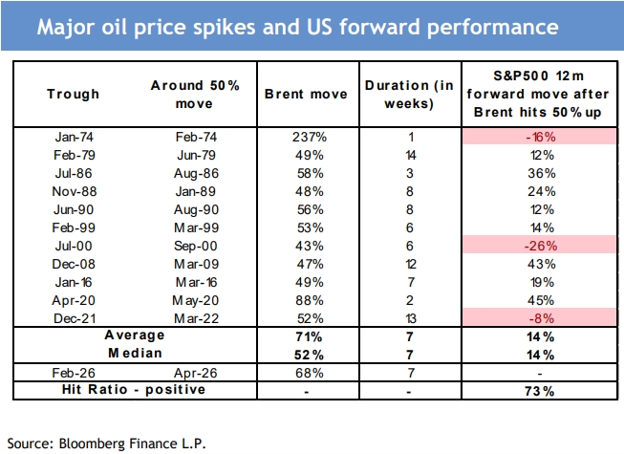
Now that oil prices are coming back to earth, that has typically portended solid stock returns in the following months:
I noted there is uncertainty with a new Fed Chair in the US who is shaking things up. Markets typically do OK following new Fed Chairs taking the helm:
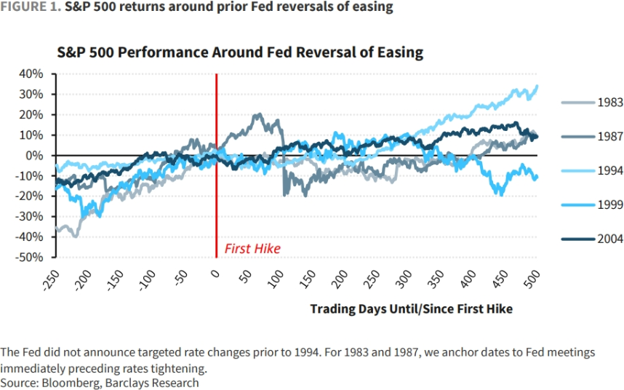
There is also little evidence of market headwinds leading into Federal Reserve “reversal of easing” scenarios, if history is any guide. Markets are now pricing the resumption of Fed hikes sometime this year, following the latest inflation prints. The Fed has "reversed easing" (i.e. cutting cycle, followed by a period of holding rates steady, followed by the resumption of hikes) five notable times in the last several decades. In most cases, the impending reversal was not a major headwind for S&P 500 returns over the 6 months leading to the event. However, equity market performance following the first hike was typically quite muted, averaging low-single-digit downside with a downside hit rate fluctuating between 3–4 instances out of 5, between 2 weeks and 3 months out.
There is worry that given the blowout earnings in Q1, some are concerned about the prospects of peak EPS growth and how it may impact market performance in the months ahead. But there has been some great analysis on this risk from strategist Brian Belski.
Even though it does appear that Q1 will represent the high-water market for year-over-year quarterly S&P 500 EPS growth, it is important to point out that EPS growth is still expected to maintain healthy growth rates throughout 2027. Belski notes that this dynamic is misunderstood among many investors and market watchers.
He notes that “first, year-over-year quarterly EPS growth is still expected to maintain historically elevated levels of growth throughout 2027 (see chart below). Second, our work shows that the stock market has held up just fine during calendar years where year-over-year quarterly EPS growth peaked. As shown below, we identified five years since 2002 where this growth rate peaked and found that the S&P 500 had an average price return of 10.8%. Yes, this is much lower than the years when this growth rate troughed, where the S&P averaged an 18.9% price return, but it is still slightly higher than the average for all calendar years since 2002.”
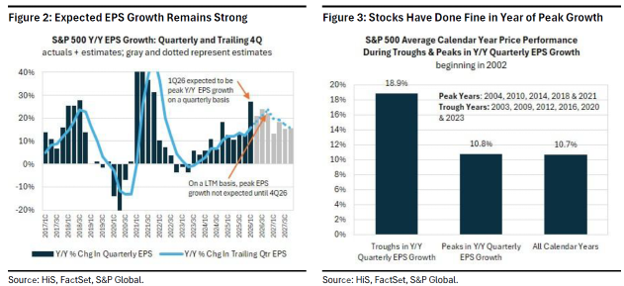
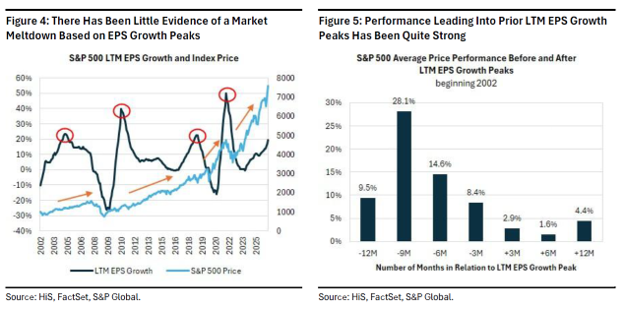
He goes on to note that trailing 1-year EPS growth is a better indication of market performance, and a better way to measure profit cycles. He notes that the LTM EPS growth is not expected to peak until 4Q26 (i.e., early 2027 reporting period), and this is important because his analysis suggests that market returns have remained quite strong leading into the prior peaks for LTM EPS growth. For instance, even if LTM EPS growth peaks sooner than currently is expected, we found that the S&P 500 has delivered average gains of 9.5%, 28.1%, 14.6% and 8.4% in the 12, 9, 6 and 3 months leading into the prior peaks.
Finally, we have to talk about valuations. Do they matter? Of course. You don’t want to overpay for anything in life. However, do they serve as a timing tool? That is, should you sell all your stocks because stocks, en masse, are expensive? No.
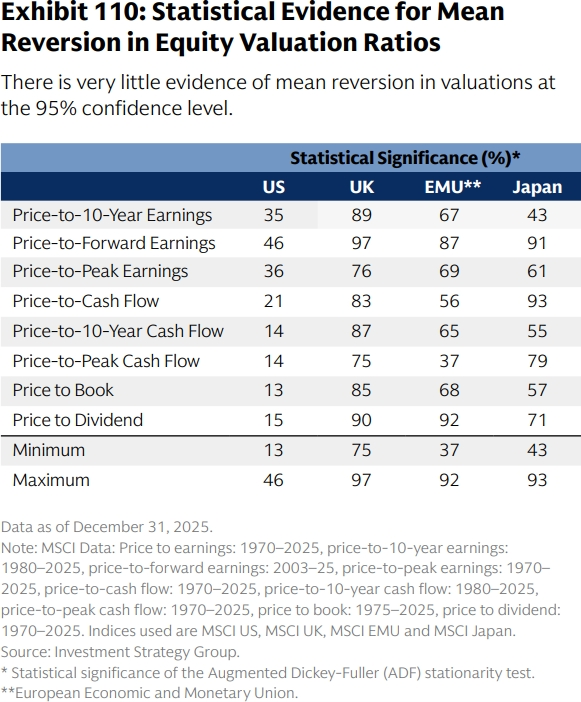
There is no statistical evidence that equity valuations revert to any long-term mean over any specific horizon: Extending the analysist across eight widely used valuations metrics in the U.S., the U.K., the eurozone and Japan, only the U.K.’s forward PE ratios exhibit statistically significant mean reversion; all other metrics showed no such relationship. Equity valuations are a bounded time series: there is some upper bound since valuations cannot reach infinity, and there is a lower bound since valuations cannot go below zero. However, having upper and lower bounds does not imply valuations are stationary and revert to the same long-term mean.