Paul Chapman
Senior Portfolio Manager & Wealth Advisor
September 29, 2026
“Americans can be counted upon to do the right thing after exhausting all other possibilities” – quote attributed to Winston Churchill (but according to research by the Quote Investigator, no historical evidence or written record ties this phrase to the British leader. Some researchers link early variations of this sentiment to Israeli diplomat Abba Eban, rather than Churchill)
Note that the contents of this memo are all my thoughts, and not the views of RBC Dominion Securities. As well, no part of this content was AI-assisted or created.
YOU CAN LISTEN TO THE ABBREIVATED PODCAST VERSION OF THIS NOTE HERE
Friends & Partners,
Well, as expected, with the onset of fall, we often see an onset of volatility, and we are sure living through some of that these days. And these days, it’s pretty much all about interest rates running higher. That and the narrative that AI is going to kill us all.
On the AI front, those who know me well know that I’ve been fascinated with the risks that AI poses for over a decade. This is an issue to be taken seriously. But, like everything, there should be a balance of views, and steps taken to assess and manage the risk. This means an oversight body without question.
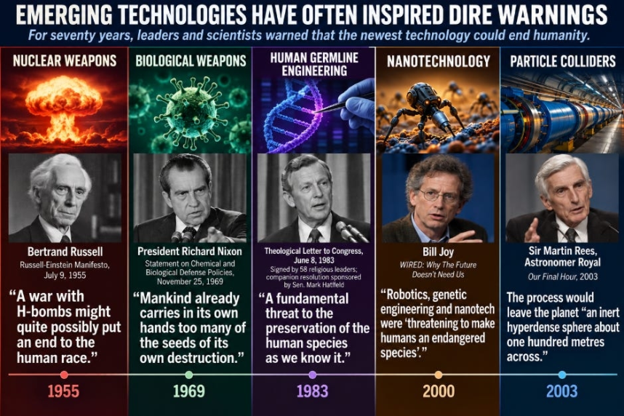
While there has been plenty of fear in the media about AI, that has been the case with every large-scale technological adoption; it is human nature to fear what is not fully understood. So far, AI hasn’t been destroying jobs, but rather the opposite. “Experts” have often warned of risk from new technologies: from nuclear weapons to nanotechnology, technology catastrophists have long warned of immense risk from emerging technologies. While many such warnings proved overwrought or wildly premature, others catalyzed support for constructive safeguards that averted bad outcomes (hint hint with AI):
But history has been fairly consistent here in terms of the economy and markets when adopting and integrating new technologies – look at the tech boom that started in the 1990’s. Back then, many pointed to the lack of productivity at the time: computers were everywhere, except that the productivity numbers stunk. Then, productivity growth doubled from 1995 to 2005. This cycle may be different but may rhyme. Multiple views can be right and wrong at the same time but beware of markets getting overhyped – if you lived through the 90’s and early 2000’s, you know how that movie played out.
The stock market has seemingly defied gravity recently given that higher rates, and many of the factors driving that, are often headwinds for stocks. The markets are definitely lacking something called ‘breadth’ – the S&P 500 is not far from an all-time high, when 60% of the names in the index are down 20% or more (bear market!), with 60% below their 100-day moving average, even as the S&P sits very near an all-time high! This is nearly the worst breadth we have ever seen. 430 companies in the S&P 500, put together, are currently down 22% on average – while the total market is near an all-time high. Does this matter? I’m not sure, but we’ve only seen this a couple of times, in 1973 and 1999. But that doesn’t mean that signals anything actionable or that history repeats necessarily. But I digress.
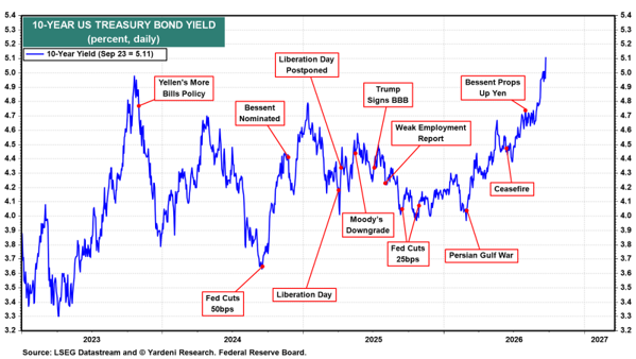
Bond yields have risen for many reasons this year (see chart below). The war in the Middle East and the war between Russia and Ukraine have pushed up crude oil and refined petroleum product prices. Rising interest rates in Japan are forcing hedge funds to unwind their ‘carry trades’ (this is where they borrow money in Japanese yen to invest in higher yielding US bonds, so now they are paying back their yen loans by selling the US government bonds that they purchased with the proceeds). There is a big surge in the supply of AI-related corporate bonds, and the widening US federal budget deficit has also been cited as explanations for the bear market in bonds. BUT the main reason that bond yields rose sharply is that the US economy is booming.
Bond yields moving higher on strong economic data is not a bad thing since that stronger economic activity is helping earnings growth. With two earnings seasons complete and two to go for 2026, earnings look to be rising an astonishing +36%. That kind of earnings growth buys the market a lot of resilience. And with Q3 earnings season starting in a few weeks, it is likely that another good one is coming.
So, the increasing strength in the US economy is the most important explanation for the rise in bond yields. In combination with the inflationary impact of the wars, the central banks have been forced to pivot from thinking about more rate cuts at the beginning of this year to rate hikes. This drives up rates further.
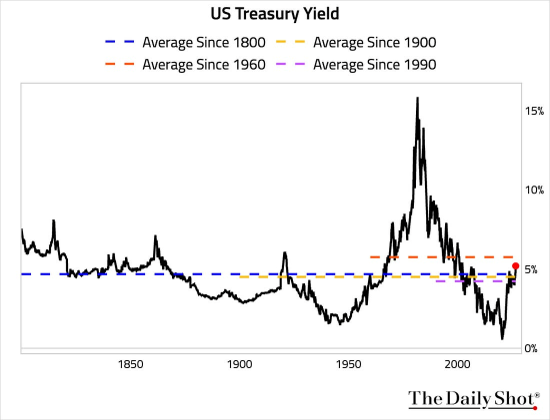
If we zoom out to the long term, rates aren’t getting as crazy as some would have you think… More like a return to normal.
Back to stocks, they’ve held in there quite well given these usual headwinds. But stocks aren’t quite as resilient as you may think – it’s mostly tech/growth names pulling it higher once again. This stock market is getting more and more leveraged to one sector (AI). Meta’s Muse (personal AI agent) is generating another round of AI bullishness for three main reasons: 1) personal AI agents (that act as a useful personal assistant) could dramatically accelerate AI adoption, which could boost revenues for AI/tech companies and reduce ‘return on investment (ROI)’ concerns about AI, 2) personal agents like Muse require a lot of computing power and network capacity. If these becomes widespread, then it's only going to dramatically increase demand for AI infrastructure and make the AI boom even bigger, 3) based on the initial success of Muse, we can expect copycats from OpenAI, Google, Anthropic, Microsoft and that could speed numbers 1 and 2 (meaning more personal AI agents could increase adoption and put even more demand on AI infrastructure). This would all mean even more earnings growth for the tech sector, and since earnings growth is the number one driver of this bull market, adding more fuel to that fire would help further support stocks despite headwinds.
Yes, yields are surging, oil is higher, and there's no real progress on Iran or Russia/Ukraine (so far). But that hasn’t mattered (yet) to stocks because economic growth is very strong and accelerating (as we have seen from virtually all economic data recently) and earnings growth has continued upward pressure. For all the focus on geopolitics, the reality is that if economic growth is strong and earnings are growing above trend, they trump everything else.
But here’s the catch. If we get another bout of "AI anxiety" like we saw in Jan/Feb or July, the "rest of the market" will likely not be able to hold up now like it did then, because for the rest of the market, conditions are worsening (i.e., higher yields, compressed margins).
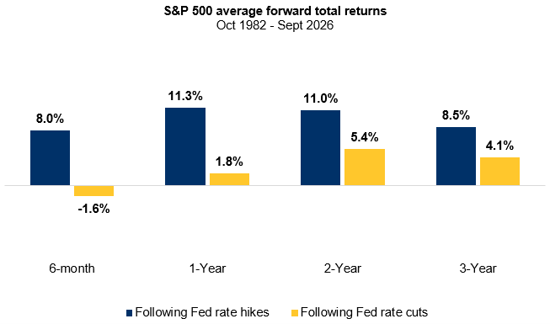
Looking at past performance, as central banks raise rates, stocks often don’t do too badly.
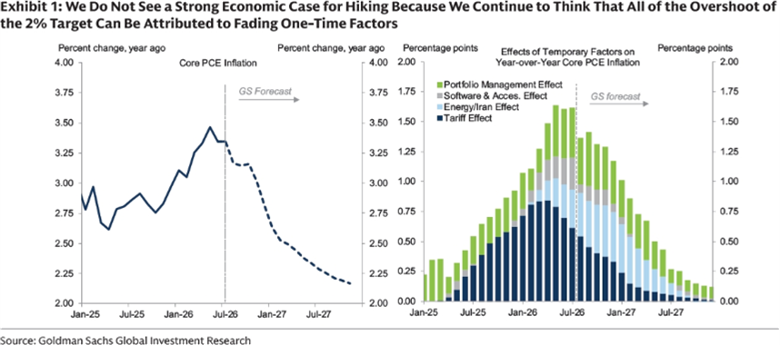
Finally, there’s a ton of uncertainty around inflation – is it here to stay? These is some very good analysis from Goldman Sachs showing that much of it is one-time in nature, and that much of the U.S. inflation overshoot could be attributed to one-time factors whose impact is likely to fade.
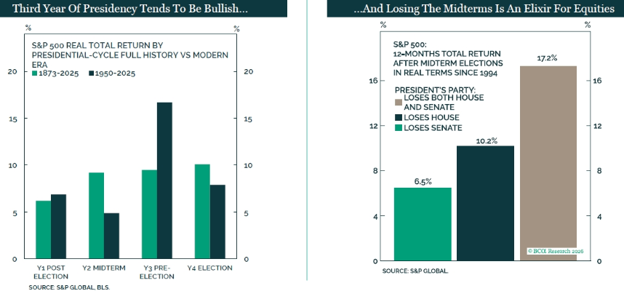
It goes without saying that there is considerable uncertainty out there. We are positioned accordingly – defensive, but never out of the market. Midterms in the US are around the corner, that will come with fireworks. Stocks have hit some speed bumps, but also remember that U.S. large-cap equities have historically performed very well in the third year of the Presidential Cycle, especially when the president loses both the House and Senate:
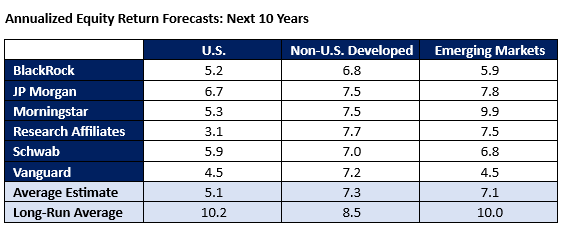
So, it matters how you’re positioned, as don’t expect the next 10 years to give the same returns as the last 10+ years. Currently, valuations in all regions stand above their long-term averages, which strongly implies that benchmark index returns over the next decade will be below average. This eventuality is well-reflected in the table below. In times of below average returns, defensive portfolios that are overweight low volatility, dividend paying stocks have historically outperformed on the equity side. Portfolio construct matters from here on in…
Other Interesting Things To Highlight
October is a very busy month, I will be traveling a lot for work. I love what I do, so I don’t mind – it’s great to see clients and institutional portfolio managers in person – zoom won’t ever replace that.
In November, I am hosting a very small event on ‘tax aware’ strategies – this will be for selected partners and accountants mostly. There are strategies and structures out there that many accountants may not even be aware of, and we’re going to dig into those over a dinner event at a nice restaurant in Toronto.
We will also be hosting our 4th family office event in November, which will bring together many of the top family offices in Canada. These are very limited events for selected family offices and partners, and we have some large institutions joining us to discuss different approaches to Alpha in managing capital.
RBC has brought a few more institutional private alternative funds to the platform – this means that they heavily due diligence the funds, and partner with them to offer the lowest fee version of the funds available anywhere. If you’d like to dig in, we have launched two recently:
·Blue Owl Real Estate Net Lease Trust (ORENT): ORENT is an open-end private market real estate fund that offers a ~6-7% yield via a portfolio of triple-net lease assets. The fund aims to build a diversified portfolio of primarily U.S. commercial real estate properties, secured by 15+ year net leases with contractual rent escalators and predominantly investment-grade tenants. Under a net lease structure, the tenant – rather than the property owner – is responsible for most operating expenses, insurance, and property taxes. In the current environment, the fund is expected to generate a high single-digit net return, primarily through monthly income.
·Blackstone Private Markets Fund (BXPM): This Fund works well for investors seeking institutional-quality private markets exposure in a unified, core solution diversified across private equity, private credit, infrastructure and real estate in a well-structured product from a reputable firm. The Fund targets a ~10-13% annualized net return seeks to deliver medium- to long-term capital appreciation with some ongoing distribution yield.
I am excited to be the presenting sponsor for the Georgian Triangle Humane Society’s marquis annual event on October 14th – this year they’re introducing Dueling Pianos, featuring an incredible performance by the Great Canadian Dueling Pianos. This will be an unforgettable evening of live, interactive entertainment, chef-inspired food stations, and plenty of laughs, all in support of the pets and people who rely on the Georgian Triangle Humane Society. Get your tickets HERE

More Negative Points to Ruin Your Day
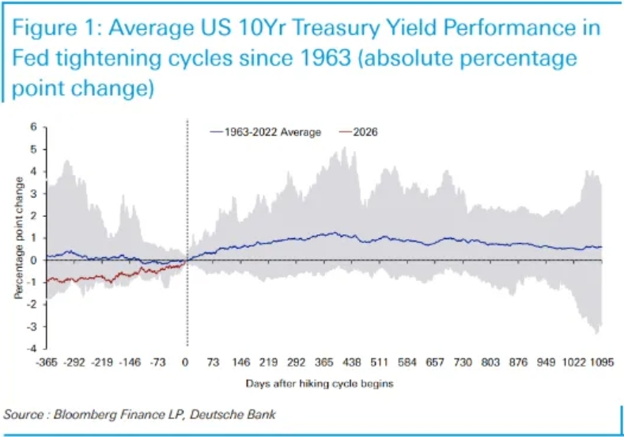
Once the Fed embarks on tightening, it generally continues for a while, and U.S. 10-year Treasury yields continue to rise, generally by more than a percentage point. Judging by history, we may need to brace for the 10-year Treasury yield to reach 6% before the Fed is done:
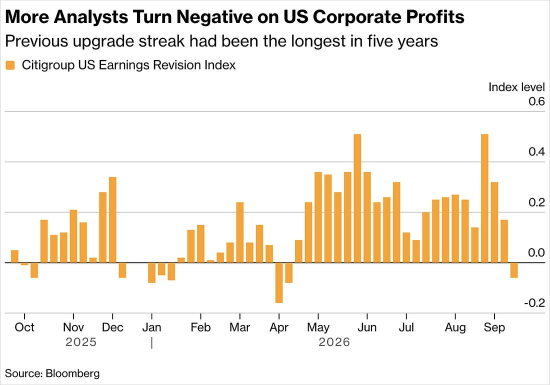
We need the economy to keep chugging – so far so good, but if it weakens, look out. US equity analysts turned net negative on corporate earnings for the first time in 23 weeks just recently, ending the longest upgrade streak since 2021, amid concerns that persistent inflation and higher interest rates are squeezing consumer, materials, and financial sector profits.
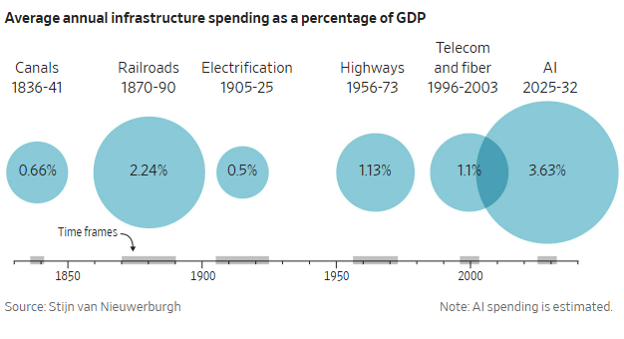
The AI build-out is on track to become the biggest economic bet in U.S. history, dwarfing the investments made to fund other huge U.S. infrastructure projects such as the railroads, the highway system and the plumbing for the internet. This can cause a bubble like those did…
There Are A Number Of Positives To Note Too
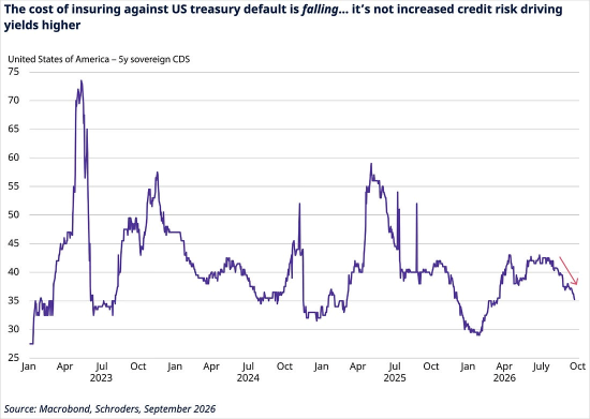
The US debt levels are finally getting a lot of press, but the market isn’t stressing about that issue as much as the media would have you believe. The cost of insuring against US default has been falling, indicating that it’s not increased sovereign credit risk that’s been driving yields higher:
Stocks typically dip for a few months following the start of an interest rate hiking cycle, but rally in the following months:
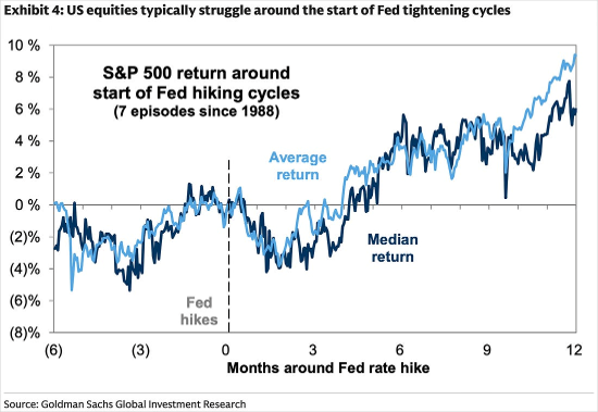
The question is whether the economy continues to perform. Equity performance is subdued or slightly negative on average in the early stages of tightening as we know. However, returns eventually diverge sharply, with recessionary outcomes producing substantially weaker returns than soft landings.
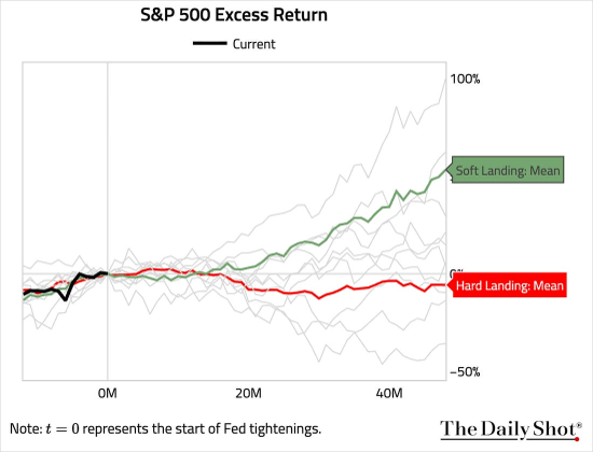
So far, several indicators show why the economy has been able to keep growing:
- Consumers are still spending, giving businesses a reason to invest and hire.
- Unemployment remains low. It held at 4.1% in August, although hiring has been uneven from month to month.
- Corporate profits have risen, giving companies more room to manage higher costs. U.S. AI CapEx is contributing between 0.5% and 0.75% to the country's GDP 2026 growth rate.
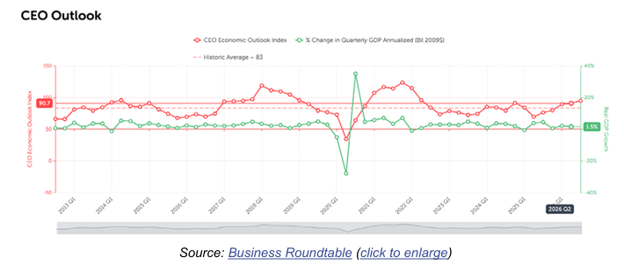
Here’s another K-shaped indicator to ponder—the Business Roundtable CEO Economic Outlook Index ticked higher in Q3 2026. It was the 5th straight quarter of improving sentiment among the nation’s corporate CEOs about business conditions over the next six months. The index was derived from survey responses from 174 CEOs.
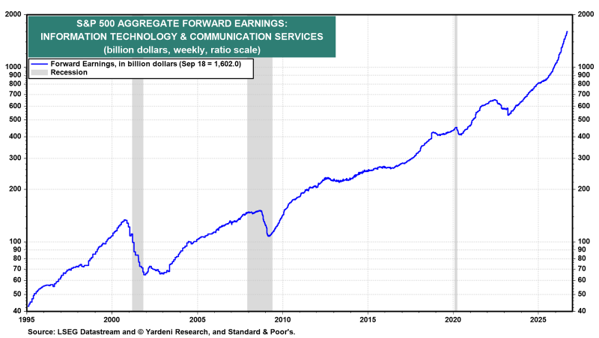
In terms of the potential ‘bubble’ in AI, fears of another 1999 Tech Bubble followed by a Tech Wreck have been blown away by the drop in the two sectors' combined forward P/E from 29.0x late last year to 19.5x currently, as earnings expectations rose faster than the sectors' stock price index. In other words, the sectors are relatively cheap, especially given their rapid earnings growth:
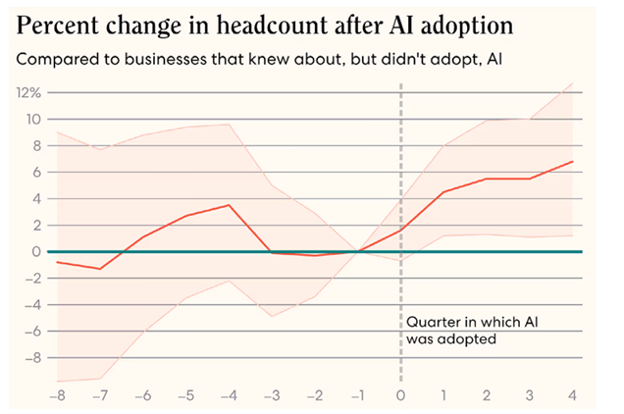
As mentioned in the opening section, one of the biggest fears about a future that includes AI is its potential to replace millions of workers and result in massive layoffs. This anxiety is understandable. However, a survey by Gusto showed that small businesses that use AI were more likely to increase hiring after its adoption. Businesses that use AI hire 7% more than those that don’t in the first year. They also note that businesses with fewer than 10 employees grew their teams by about 10% more than comparable businesses that didn’t use AI. These results were broad across industries, and not just tech or professional services. Gusto concluded that the use of AI helped a business to grow and hire additional staff to meet the added demand.